Verdun Trench-Art Vase — Company A, 368th Infantry — Scholarly Analysis
Extended scholarly study of "Verdun Trench-Art Vase — Company A, 368th Infantry" (accession JCA.2025.006): material analysis, authentication methodology, comparative works, and bibliography.
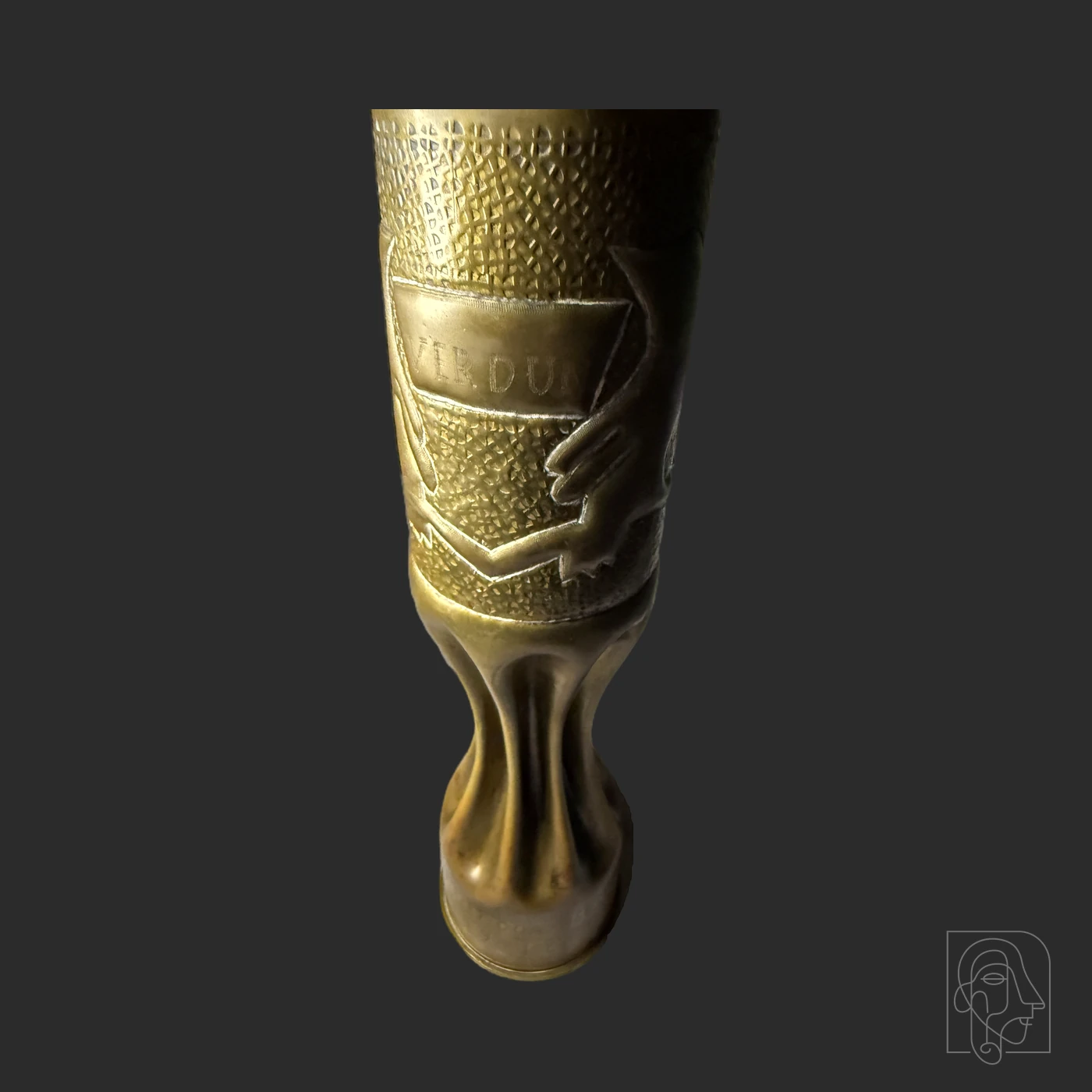
Extended description
JCA.2025.006 is a commemorative vessel formed from a brass artillery cartridge case, approximately 13 inches high and 3.5 inches in diameter according to the recorded measurements. It retains the rimmed case head and central primer assembly. The base marking “75 DE C” strongly supports identification as a French 75 mm field-artillery case, consistent with ammunition for the Canon de 75 modèle 1897.
The upper body carries a reserved panel inscribed “VERDUN.” Two stylized birds face inward toward the panel. The side views show circular eyes, projecting beaks, rounded bodies, and outlined wing or tail details. Leafy branches with acorn-like forms accompany the birds; an oak identification is plausible but not secure. The birds’ species and the precise symbolism of the composition remain undetermined. Repeated angular punches texture the background around the smoother motifs.
The mouth has been cut and shaped into broad scallops. Below the decoration, repeated longitudinal flutes narrow the body into a pronounced waist before it widens toward the retained base. The lower body bears “SEPT-12-COA-368-92-DIV-AEF,” with “1918” separately below. This inscription associates the object with Company A, 368th Infantry, 92nd Division, American Expeditionary Forces. The lettering does not identify the person who made or first owned the vase.
The production markings on the underside are recorded separately as “A . TE . 491 . L . 16 . C” and “75 DE C.” Their direct transcription is firmer evidence than the earlier partial photographic readings. The manufacture date and full production-code interpretation remain unresolved.
Technical analysis
The retained cartridge-case head and primer assembly preserve the ammunition component’s original function. The primer has concentric fittings and opposed tool-engagement features. The caliber designation “75 DE C” is consistent with French 75 mm field-artillery ammunition. Direct measurement of the base diameter and comparison of the complete headstamp and primer with documented cases would further refine identification; the vase’s altered body cannot be treated as the original case profile.
The decorative work involves cutting and shaping the mouth, hammer-forming the lower flutes, punching the background, and outlining the panel and bird-and-foliage motifs with fine tool impressions. Raised or reserved forms stand against a textured field. Repoussé may have contributed to the relief, but the exact sequence of interior and exterior working has not been established from the available views. Through-piercing of the background is not established.
The lower commemorative lettering and the base production markings are recorded as separate evidence groups. The vase’s shaping, decoration, and unit inscription may have been executed at different times or by different hands; the photographs do not establish a single artisan. No racial identity can be inferred from tool marks or decorative style.
The base transcription is “A . TE . 491 . L . 16 . C” and “75 DE C.” No arsenal expansion, lot interpretation, or manufacture date is assigned without a verified reference for this marking system. Further technical study could compare letter formation, tool profiles, and surface relationships across the decorative and commemorative work. No analytical test establishing the age of the decoration is documented.
Authentication methodology
The revised assessment separates direct observation, owner-supplied examination, historical documentation, and interpretation. The full and side photographs establish the vessel’s form and support a reading of paired birds with foliage. Lower-body close-ups and Joshua Mascarenhas’s direct transcription establish the recorded unit lettering. The detailed base photographs and his transcription provide the complete marking groups used in this assessment.
The “75 DE C” designation, retained primer, and case-head morphology strongly support the French 75 mm cartridge-case identification. The inscription names Company A, 368th Infantry, 92nd Division, AEF. Published operational histories independently document that company’s service in the Argonne; they do not document the vase itself.
The American Battle Monuments Commission’s 92d Division: Summary of Operations in the World War, pages 22–25, records Company A’s advance toward Binarville on September 30, 1918, and its subsequent position alongside French troops. Its source list cites company operations reports for September 26–30. These citations identify archival targets; the original company reports have not been examined in this study.
The case-production date, date of decorative conversion, and significance of September 12 remain undetermined. The inscription is not a signature or a chain of ownership. An African American unit association is supported; authorship or ownership by an African American individual has not been proved. Physical appearance and patina alone cannot supply those missing identifications.
Comparative works
Museum collections provide useful comparisons for the conversion of artillery cartridge cases into decorative vases. The Australian War Memorial’s trench-art chrysanthemum vase, accession RELAWM14161, and Imperial War Museums’ decorated shell-case, object 30082737, are previously identified comparative records for this study. They provide context for decorated cartridge-case vessels, shaped mouths, and plant or commemorative ornament.
Such comparisons can support classification and explain the broader practice of reworking ammunition components. They do not establish that JCA.2025.006 shares a maker, workshop, owner, or precise date with another object. Its own distinguishing features are the paired birds flanking “VERDUN,” extensive punched texture, deeply fluted waist, and inscription naming Company A, 368th Infantry, 92nd Division, AEF. No matched workshop series or signed parallel has been established.
Provenance
The earliest identified modern sale is John M. Hess Auction Service, Inc.’s Single Owner Militaria Auction, Manheim, Pennsylvania, closed May 27, 2025. Lot 75, HiBid item 246426751, was titled “WWI U.S. African American Army Trench Art Vase.” Its description stated: “Crafted from French 75mm shell engraved for Co. A 368th Infantry Regiment, 92nd Div. African American unit. Dated Sept. 12,1918 for Saint-Mihiel offensive.” The auction explicitly stated that provenance and descriptions were provided by the seller.
The listing demonstrates that the unit attribution existed before JCA’s acquisition. Its wording “engraved for” does not identify the engraver. The Saint-Mihiel explanation is a seller-supplied interpretation, not independent evidence of Company A’s participation there on September 12. Official chronologies place the division’s infantry in the Saint-Dié sector at that time.
The object’s recorded matching features include the scalloped rim, paired bird-and-foliage composition, panel layout, and strongly fluted waist. JCA’s acquisition record then identifies eBay seller “njcollector500,” item 187533617323, acquisition by Joshua Mascarenhas on September 7, 2025, and delivery on September 10. The link between the Hess sale and that eBay listing has not been documented, and no additional intermediary is assumed.
The publicly available sale description does not name the original veteran, artisan, family, or earlier collection. Original consignment notes, labels, correspondence, or family documentation would be needed to extend the ownership history. Even a documented soldier-owner would not by itself establish who shaped, decorated, or lettered the vase.
Historical context
The 368th Infantry was part of the 92nd Division, an African American division serving in the segregated United States Army during the First World War. The unit inscription gives this vase a specific connection to that history, while leaving the identity of the commemorating individual unknown.
The U.S. Army’s Order of Battle of the United States Land Forces in the World War, volume 2, page 433, places the division’s infantry in the Saint-Dié sector from late August through September 20, 1918. The American Battle Monuments Commission’s official summary, pages 4–5, records a move beginning September 21 toward the region north of Triaucourt, approximately 30 kilometers southwest of Verdun. On September 24 the 368th Infantry moved into the French corps area north of Sainte-Menehould.
The regiment then participated in the opening phase of the Meuse–Argonne offensive. On September 30, Companies A, B, and C advanced toward Binarville. The official summary specifically records Company A accompanying French troops and forming in line with them north of the town. It withdrew from that position around 7 a.m. on October 1 and rejoined its battalion. These events document the service of the company named on the vase, not the object’s presence on that battlefield.
“VERDUN” has a credible regional and commemorative relationship to the regiment’s later September service, but no source examined places Company A there on September 12. The 92nd Division was organized in 1917 and did not participate in the 1916 Battle of Verdun. September 12, 1918, coincides with the opening of the Saint-Mihiel offensive, but that coincidence does not establish the meaning of the vase’s date. It may record a personal or commemorative event whose explanation is now lost.
The combination of a French ammunition case, bird-and-foliage decoration, and an American unit inscription is compatible with the varied production of trench-art souvenirs. Servicemen, civilian artisans, and workshops all participated in this practice. The imagery is not securely identified as a 92nd Division emblem, and no named maker or racial identity can be assigned from the decoration.
Conservation history
No conservation or restoration treatment is documented. The current assessment uses the expanded catalog photography, including lower-body inscription details and several views of the underside, together with the owner’s direct inscription readings. Surface wear, scratches, uneven coloration, and localized dark deposits are visible. The photographs do not determine whether every dark area is stable oxidation, residue, or active corrosion.
Preservation should prioritize the fine lettering, punched decoration, and base markings. Support the vessel beneath its base, avoid pressure on the scalloped mouth, and handle it with clean gloves. Abrasive polishing and aggressive cleaning could reduce the legibility of shallow marks and remove evidence needed for future study. Stable, dry storage and examination of the interior and any suspected repairs are appropriate. Any treatment should be recorded with dated photographs.
Bibliography
American Battle Monuments Commission. 92d Division: Summary of Operations in the World War. Washington, D.C.: Government Printing Office, 1944. Pages 4–5, 22–25, 37–38. Source-list entries 13, 38, and 53 identify regimental, battalion, and company operations reports; those original reports have not been examined here. https://archive.org/details/92d-division-summary-of-operations-in-the-world-war-1
U.S. Army Center of Military History. Order of Battle of the United States Land Forces in the World War. Volume 2, American Expeditionary Forces: Divisions, p. 433. https://history.army.mil/Portals/143/Images/Publications/catalog/23-2.pdf
John M. Hess Auction Service, Inc. Single Owner Militaria Auction, closed May 27, 2025, lot 75: “WWI U.S. African American Army Trench Art Vase.” HiBid item 246426751. Seller-supplied description; the Saint-Mihiel interpretation is not treated as established object history. https://hibid.com/lot/246426751
Australian War Memorial. “Trench Art Chrysanthemum Vase: Sapper S. K. Pearl, 5 Field Company Engineers, AIF.” Accession RELAWM14161. Comparative record. https://www.awm.gov.au/collection/C134014
Imperial War Museums. “Shell-case, decorated.” Object 30082737. Comparative record. https://www.iwm.org.uk/collections/item/object/30082737
National Archives and Records Administration. Guide to Federal Records, Record Group 120, section 120.9.3, Records of combat divisions; Record Group 117, section 117.4.2, records relating to World War I frontline maps and summaries of operations. Archival research routes, not object-specific provenance. https://www.archives.gov/research/guide-fed-records/groups/120.html ; https://www.archives.gov/research/guide-fed-records/groups/117.html
JCA Archives. JCA.2025.006 object and acquisition records; catalog images 0–11; direct inscription transcriptions supplied by Joshua Mascarenhas during the September 2026 reassessment.