Regina Disc Music Box — Scholarly Analysis
Extended scholarly study of "Regina Disc Music Box" (accession JCA.2025.012): material analysis, authentication methodology, comparative works, and bibliography.
Extended description
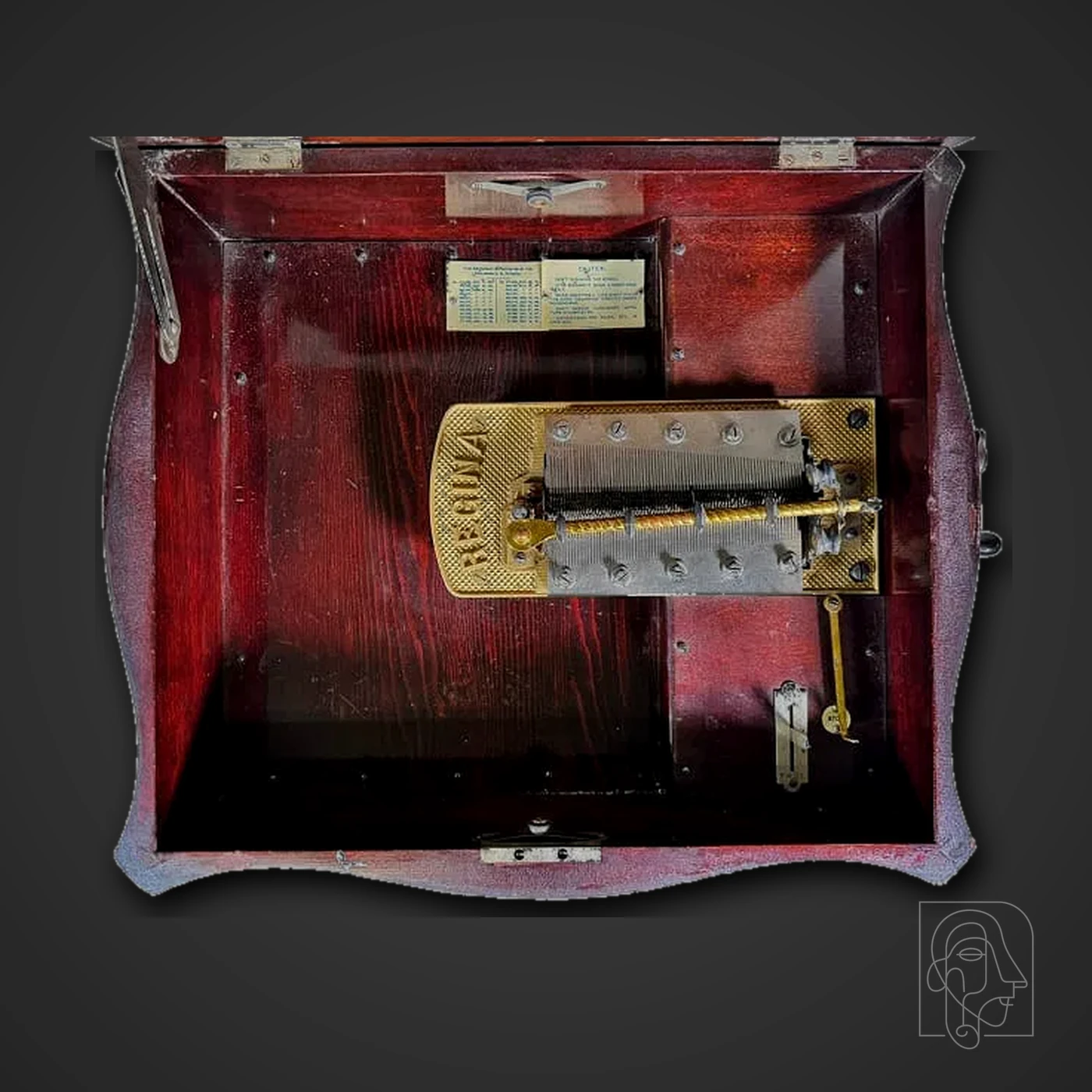
The JCA photographs document a table-form Regina disc music box with a dark wooden serpentine cabinet, curved front and sides, shaped lid, molded base, side handles, and a framed ornamental Regina panel on the interior lid. The panel combines the manufacturer's name with scrolling ornament, putti, and musical imagery. The open-cabinet and movement photographs are complementary evidence for manufacturer identity and physical configuration.
The close movement plate clearly shows two steel combs arranged on opposite sides of the star-wheel assembly, together with a decorated brass-colored bedplate, spindle, gearing, and disc-support or pressure fittings. The retained catalogue reports more than ninety steel discs and mechanical function. No tooth count, precise disc diameter, cabinet dimensions, weight, or wood species is established by these photographs. Those measurements must come from the object rather than from dimensions published for a similar machine.
Technical analysis
This is a duplex, or double-comb, disc-playing configuration. Patterned projections on a rotating music disc engage star wheels, which pluck the tuned comb teeth; the disc supplies the programme while the mechanism produces the sound. The photographs show a compact bedplate carrying the two combs and playing assembly, with a side crank and separate surrounding cabinet space. The arrangement is consistent with the short-bedplate family, but the full drive layout should be documented before fixing a factory designation.
Record the comb tooth counts, actual disc diameter, centre-hole and drive configuration, plate measurements, pressure-wheel layout, and the full serial with its location. A music disc's song number, copyright or patent wording, and publication date describe that disc and must not be converted into the manufacture date of the cabinet or movement. Disc compatibility and the originality of individual discs require a separate inventory.
Authentication methodology
The maker assessment combines direct photographic evidence with retained catalogue observations. The Regina panel, duplex mechanism, case construction, and recorded factory markings support Regina identity. Photograph-based compatibility does not prove that the lid print, finish, screws, discs, and every mechanical component are original to one factory assembly. The catalogue's report of function remains a recorded observation; no new operational or specialist examination was performed for this update.
Confirm the full number presently recorded as 75046 on the factory serial location identified by MBSI, then compare it with the original shipping registers. A shipping certificate can document dispatch date and consignee; it should not automatically be equated with the day of manufacture or with an unbroken later ownership history. For style attribution, combine that record with measured disc format and the actual case/movement layout. Style 50 is a research lead rather than a confirmed replacement model label.
Comparative works
Hathaway & Bowers, Catalogue 17 (Autumn 1971), p. 25, reproduces Regina's description of about 1905 for Style 50 and illustrates a serpentine cabinet with a duplex mechanism. Its described example was sold on 4 November 1905. The case and movement photographs provide a close family comparison to JCA.2025.012, but that example's dimensions, tooth count, and sale date are not measurements or dates for the JCA object.
Elise Low's East Coast Chapter report in Mechanical Music 69, no. 5 (September/October 2023) records a 15 1/2-inch Style 50 Regina with two combs, a short bedplate, and a serpentine mahogany case. This firsthand report corroborates the configuration used as the Style 50 research lead. The University of North Texas Music Library separately documents a 15 1/2-inch Regina made in 1907 with an associated disc collection. It offers a dated institutional comparison and a model for studying repertoire, not a serial-number match or proof of the JCA instrument's exact style.
Provenance
The supplied JCA provenance is Estate Acquisition. No previous owner's name, estate identifier, receipt, acquisition circumstances, or chain of custody before that acquisition is documented in the current record. The catalogue date is an administrative date and is not treated as the date of manufacture or as proof of an earlier ownership event.
The more-than-ninety-disc group is recorded as associated with the instrument, rather than proven to have been supplied with it at the factory. A later owner could have accumulated discs over time. Preserve the group association while inventorying individual titles, numbers, labels, formats, and duplicates. The MBSI factory record may identify an original consignee, but later transfers would still require independent documentation.
Historical context
The University of North Texas Music Library's study places Regina within an American disc-music-box business established in New Jersey in 1892 and examines period advertising and a surviving 1907 instrument. Interchangeable media made these machines useful for repeated domestic performances and for selecting a repertoire without playing a conventional instrument.
For JCA.2025.012, the substantial disc group is as important to interpretation as the cabinet. A future title-level inventory could examine the balance of dance music, theatre selections, marches, sacred music, and popular songs actually present. No particular genre or original owner preference is asserted before that inventory. Manufacturer location in Rahway, New Jersey provides production context; it does not establish where this individual box was originally sold or used.
Conservation history
The existing JCA catalogue grades the object Excellent and reports mechanical function, period-looking patina, and age-consistent wear. No dated specialist treatment report, documented refinishing history, replacement-comb record, or comprehensive before-and-after conservation photographs accompany the current record. Originality of every surface and part is therefore not certified by this review.
A baseline condition record should distinguish cabinet and lid-print condition from comb, star-wheel, drive, and disc condition, and record any loose joints, repairs, replacement teeth, corrosion, or disc distortion actually observed. The present update adds documentation and research only; it records no cleaning, adjustment, restoration, or new playback test.
Bibliography
Object evidence: JCA.2025.012 Supabase catalogue and six associated object photographs, reviewed 6 October 2026; retained serial and assembly-number readings, reported mechanical function, and associated disc count.
Hathaway & Bowers, Inc. Catalogue No. 17, Autumn 1971, p. 25, 'Beautiful Style 50 Regina Box'; includes a reprinted Regina factory description of about 1905 and a described example sold 4 November 1905. https://www.mmdigest.com/Smythe/Hathaway_and_Bowers_Catalog_17_Autumn_1971.pdf
Low, Elise. East Coast Chapter report, Mechanical Music 69, no. 5, September/October 2023, section describing the Wineburgh collection. https://mbsi.org/plaintextjournal/volume-69-no-5-september-october-2023/
Musical Box Society International. 'Regina certificates.' Primary Regina shipping-register custodian and serial-location guidance. https://mbsi.org/regina-certificates/
Zimmerman, Camila. 'How Regina Music Boxes Mediated Listening Culture.' University of North Texas Music Library Blog, 17 September 2021; institution's 1907 Regina and disc collection. https://blogs.library.unt.edu/music/2021/09/17/how-regina-music-boxes-mediated-listening-culture/
Musical Box Society International. 'Glossary,' mechanical-music terminology. https://mbsi.org/glossary/
All web references accessed 6 October 2026. No factory certificate for JCA.2025.012 has been obtained; no unpublished register entry is claimed.