Carved Paneled Oak Blanket Chest (Joined Coffer) — Scholarly Analysis
Extended scholarly study of "Carved Paneled Oak Blanket Chest (Joined Coffer)" (accession JCA.2026.022): material analysis, authentication methodology, comparative works, and bibliography.
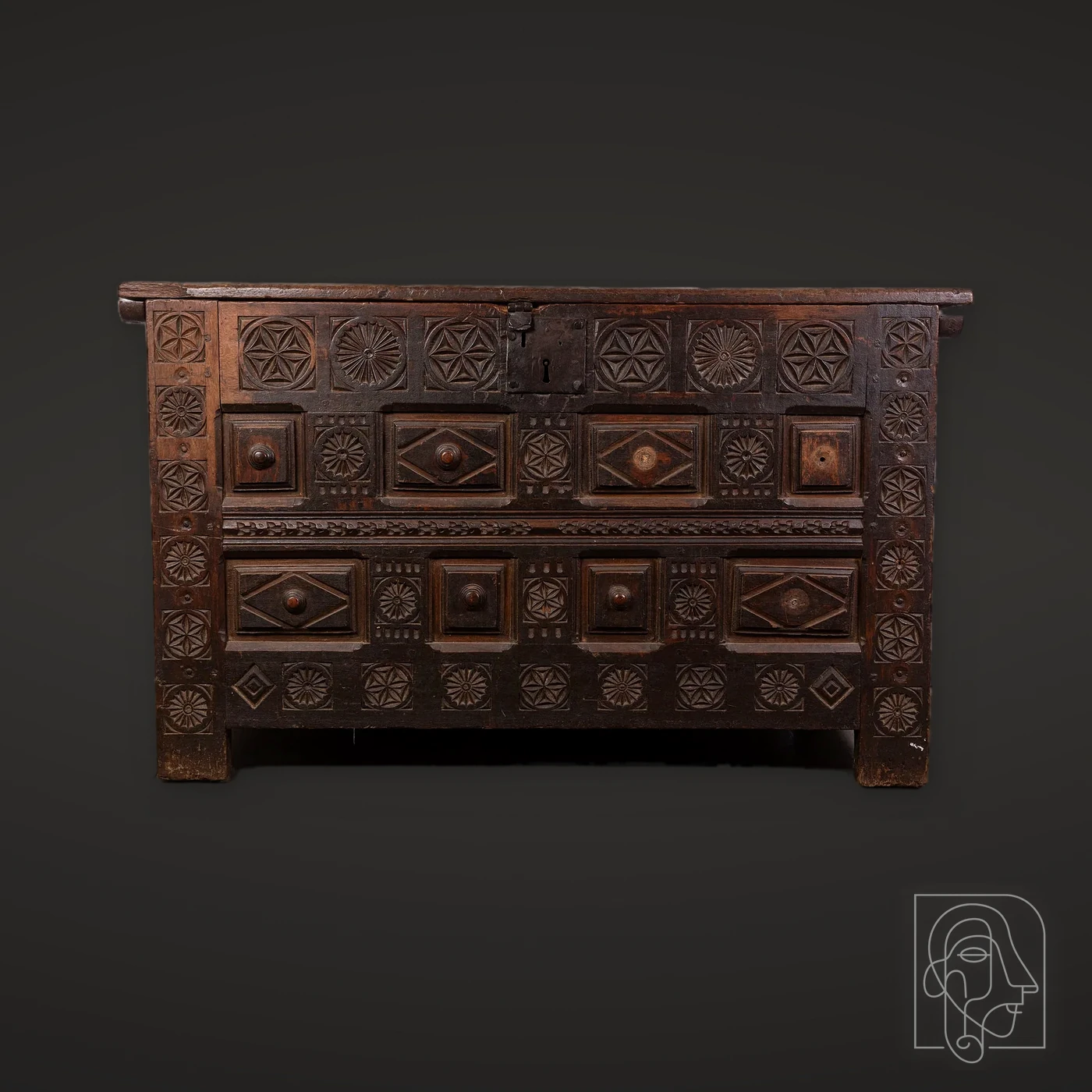
Extended description
JCA.2026.022 is a large joined oak coffer built around a frame-and-panel carcass with heavy corner posts, carved front panels, a boarded base, hinged lid, and iron lock hardware. The front decoration uses compass-derived geometric and rosette motifs cut in relief, while the interior preserves saw and plane marks associated with hand woodworking. Wooden pegs secure major joints. The base boards are fitted into the lower structure rather than simply nailed beneath the case. Together, these features place the chest within the long northern European tradition of joined storage furniture. The current working attribution favors an English vernacular or related northern European workshop of the seventeenth to early eighteenth century, but the absence of a maker's mark, dendrochronological date, or documentary provenance prevents a narrower assignment.
Technical analysis
The principal structural evidence lies in the joined carcass: substantial hardwood members, mortise-and-tenon or related framed joints secured with wooden pegs, inset panels, and a multi-board base integrated into the frame. Interior surfaces preserve irregular saw and plane marks. The iron strap hinges, rosehead-type nails, and warded lock are compatible with pre-industrial furniture construction, though each component should be checked for replacement or reuse before being used as a dating marker. The wood appears macroscopically consistent with oak, but species has not been confirmed scientifically. Future technical study should record every joint, fastener, hinge attachment, lock component, saw pattern, panel edge, and evidence of repair. Dendrochronology may be informative if suitable boards retain enough measurable growth rings and sapwood context.
Authentication methodology
The present attribution is based on constructional analysis rather than decorative style alone. Relevant observations include pegged joined framing, inset panels, hand-worked interior surfaces, a framed multi-board base, wrought-iron hardware, a warded lock, and compass-laid carving. These traits are compatible with Early Modern furniture, but none is individually exclusive to that period. Authentication therefore requires checking whether the carcass, panels, base, lid, hinges, lock, and nails belong to the same construction phase. Future work should include measured drawings, macro photography of tool marks and fasteners, wood identification, hardware comparison, and dendrochronology if feasible. The object is best classified as probably Early Modern rather than securely dated solely from visual construction evidence.
Comparative works
Useful comparanda are joined oak coffers in the Victoria and Albert Museum, Museum of the Home, regional English furniture collections, and northern European decorative-arts collections that preserve documented seventeenth- and early eighteenth-century frame-and-panel construction. Comparison should focus on joinery, base construction, stile and rail proportions, lock placement, hinge type, carving layout, and evidence of later alteration. Rosettes and compass motifs were widespread, so ornament alone cannot establish English manufacture.
Provenance
The chest was acquired privately and its earlier ownership history is not presently documented. No maker's inscription, dated ownership mark, estate record, old photograph, shipping label, or named collection has been linked to it. Construction evidence can support dating and regional comparison, but it cannot substitute for a chain of custody. Any future labels, chalk marks, inscriptions, repair notes, or underside evidence should be photographed and retained as provenance data.
Historical context
Large joined coffers were practical pieces of household furniture throughout Early Modern northern Europe. Their framed construction allowed broad carved panels while providing a strong container for textiles and other possessions. Decoration often drew on repeated geometric, floral, and compass-based motifs that could be adapted by local joiners. Because similar forms remained in use and were later revived, scholarly interpretation must distinguish original construction from subsequent repairs, replacements, and antiquarian reproduction. JCA.2026.022 is especially useful for teaching how joinery and hardware can refine a furniture attribution without automatically producing a precise date or workshop.
Conservation history
The chest is presently structurally stable but shows the accumulated wear expected of a large utilitarian wooden object. No comprehensive treatment history is documented, so apparent age, surface color, and hardware oxidation should not be assumed to be wholly original without closer examination. Conservation priorities are to document existing repairs and replacements, monitor wood movement and insect activity, avoid aggressive waxing or stripping, and protect iron fittings from moisture. Any dismantling, hardware removal, or finish intervention should be carried out only after full photographic and construction documentation.
Bibliography
Future research should prioritize museum catalogues and standard scholarship on English and northern European joined furniture, together with technical references on historic woodworking, wrought-iron furniture hardware, and dendrochronological dating of oak furniture. Institutional comparanda from the Victoria and Albert Museum and other decorative-arts collections are preferable to undated dealer examples. The JCA measured and photographic record remains the primary source for object-specific observations.