Seated Anthropomorphic Figure — Scholarly Analysis
Extended scholarly study of "Seated Anthropomorphic Figure" (accession JCA.2026.040): material analysis, authentication methodology, comparative works, and bibliography.
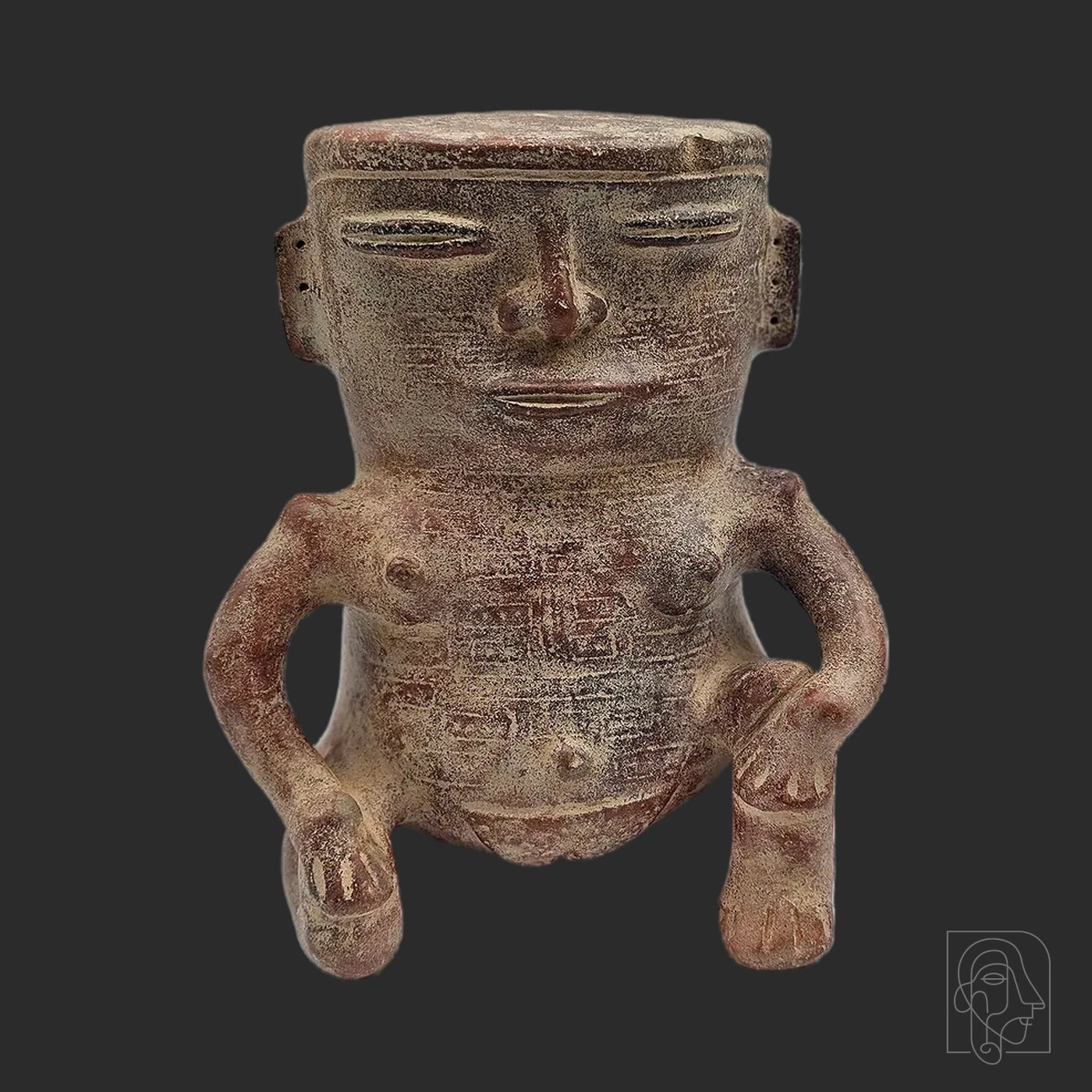
Extended description
JCA.2026.040 is a hollow terracotta figure representing a seated anthropomorphic individual. The figure is frontal and compact, with bent legs, arms resting toward the knees, a cylindrical-to-rounded torso, simplified facial modeling, and perforations at the ears that may once have accommodated ornaments or attachments. The clay surface ranges from buff to reddish brown and carries abrasion and mineralized deposits. The form can be compared with pre-Columbian ceramic figures from western Mexico, but the current record does not preserve an archaeological findspot or a documented excavation association. The object should therefore be studied as an unprovenanced seated figure with a provisional West Mexican comparison rather than assigned automatically to a shaft-tomb burial, named regional culture, or specific ritual role.
Technical analysis
The figure is hollow and appears to have been built and modeled in low-fired earthenware rather than carved from a solid mass. Visible surface irregularities and modeled transitions are compatible with hand-forming, while the hollow interior would have reduced firing stress. The current photographic record does not establish the exact forming sequence, clay recipe, firing atmosphere, or whether any components were mold-assisted. Surface accretions and abrasion should be documented under magnification before cleaning. Clay inclusions, firing core, tool marks, joins, venting, pigment or slip, and the interior wall should be recorded during future in-hand examination.
Authentication methodology
Assessment presently relies on morphology, construction visible in photographs, recorded dimensions, surface condition, and comparison with published West Mexican ceramic traditions. None of these observations alone establishes firing age. Mineral deposits, irregular modeling, and low-fired fabric can be compatible with antiquity but can also occur on later objects. A stronger assessment would require high-resolution photography of the base and interior, microscopic examination of joins and surface deposits, ceramic-fabric documentation, provenance research, and, if consequential, thermoluminescence dating from a carefully selected sample.
Comparative works
Comparative study should focus on seated anthropomorphic ceramics from western Mexico in institutional collections, especially securely provenanced or archaeologically excavated examples from Nayarit, Jalisco, and Colima. Relevant formal points include seated posture, body proportions, hollow construction, ear perforations, surface treatment, and clay fabric. These comparanda establish a regional visual vocabulary but should not be used to infer a shaft-tomb origin or a specific cultural identity for JCA.2026.040 without supporting provenance.
Provenance
The object was acquired at public auction. Documentation for earlier ownership remains unavailable, resulting in a partially documented chain of custody. A blue adhesive label affixed to the underside reads “VALTA MERCADO 924,” which likely represents a dealer inventory number or private collection cataloging mark from a prior custodial phase.While the label is modern and unrelated to original manufacture, it forms part of the object’s modern ownership history and provides a tangible link to its recent circulation. No evidence currently indicates illicit recovery or modern forgery; however, absence of excavation documentation limits reconstruction of earlier ownership history.
Historical context
West Mexican ceramic sculpture encompasses multiple regional traditions and spans several centuries. Figures occur in funerary, domestic, ceremonial, and other archaeological contexts, and superficially similar seated forms can carry different meanings. The widespread modern circulation of unprovenanced West Mexican-style ceramics also makes careful separation of observation, typology, provenance, and scientific dating especially important. JCA.2026.040 is most useful as a study object for that method: its form supports comparison, while its undocumented archaeological context limits historical specificity.
Conservation history
No treatment history is documented. The figure is presently described as structurally stable, with surface abrasion and mineralized deposits. These deposits, along with any pigment or slip traces, should be preserved and photographed before intervention. Avoid soaking, abrasive cleaning, restoration fills, coatings, or consolidants unless a ceramic conservator determines they are necessary. Future condition documentation should include the interior, base, ear perforations, joins, and any cracks or old repairs.
Bibliography
Comparative research should prioritize archaeological publications and institutional catalogues of West Mexican ceramics, especially excavated Nayarit, Jalisco, and Colima material, together with technical literature on ceramic manufacture and thermoluminescence dating. No object-specific excavation publication is currently known for JCA.2026.040; the JCA photographic and condition record remains the primary source for direct observations.