Lee–Enfield SMLE Mk III Rifle — Scholarly Analysis
Extended scholarly study of "Lee–Enfield SMLE Mk III Rifle" (accession JCA.2026.041): material analysis, authentication methodology, comparative works, and bibliography.
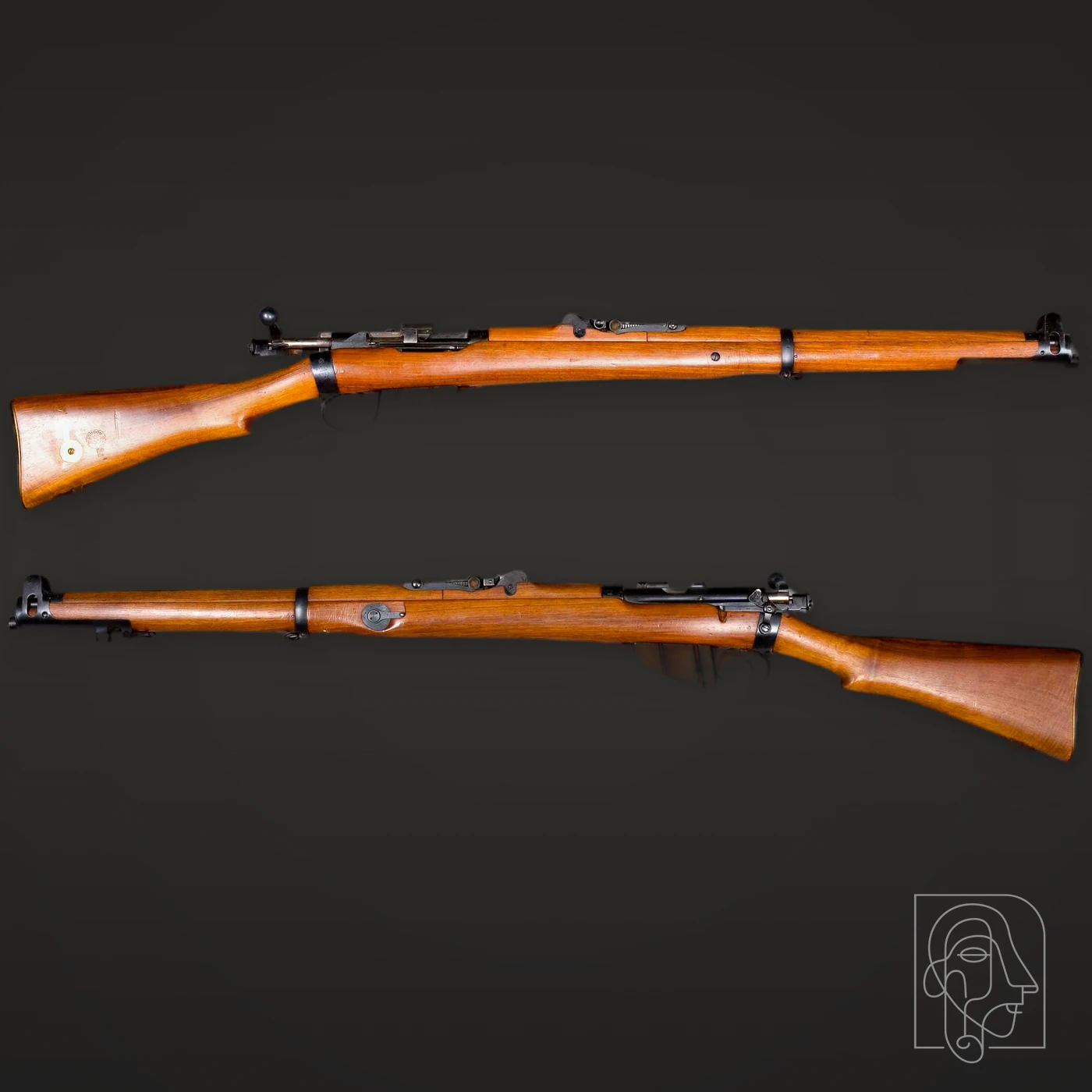
Extended description
JCA.2026.041 is a British Short Magazine Lee–Enfield Mk III bolt-action service rifle carrying a receiver date of 1916. It retains the full-length military stock, steel receiver and barrel assembly, magazine-fed action, and service-profile sighting arrangement associated with the SMLE family. No civilian stock shortening or sporting conversion is recorded. The 1916 date securely anchors manufacture to the First World War period. Additional proof and inspection marks around the action and barrel junction indicate later official examination or maintenance, but the present evidence does not permit those later marks to be assigned confidently to a particular year, unit, depot, or conflict. The rifle is therefore best documented as a 1916 British military arm with evidence of continued institutional handling after manufacture.
Technical analysis
The rifle is a manually operated, bolt-action, magazine-fed British military shoulder arm of the SMLE Mk III pattern. Direct study should distinguish original manufacture marks from later proof, inspection, repair, and export marks and map each mark by location. The receiver date “1916” is the strongest chronological evidence for primary manufacture. The full military stock and service profile are important because many surviving Lee–Enfields were later shortened or converted for sporting use. A recorded “ENGLAND” mark, if confirmed in direct macro photography, should be treated as a later export or commercial mark rather than evidence of wartime issue. Final registrar-grade measurements, serial-number comparison across components, bore condition, and a complete mark map remain desirable.
Authentication methodology
Authentication rests on model morphology, the dated receiver, military construction, component configuration, and the observed proof and inspection marks. These features support identification as a genuine British military SMLE Mk III of First World War manufacture. Later service history must be treated separately: clustered inspection marks can document official examination without proving a specific Second World War reissue event. Future work should include serial and component-number reconciliation, high-resolution raking-light photography of every stamp, comparison with British proof and inspection references, and archival research only where a traceable serial or depot record exists.
Comparative works
Institutional comparanda include dated SMLE Mk III and Mk III* rifles in the Imperial War Museums and Royal Armouries collections. Useful comparisons are full-length military examples retaining service stocks, original sighting arrangements, and documented British proof or inspection marks. These examples establish the standard morphology and range of wartime and post-manufacture markings; they should be used to compare configuration rather than to infer the specific service history of JCA.2026.041.
Provenance
The rifle's history before entry into the present collection is incomplete. The 1916 receiver date establishes manufacture, while later proof, inspection, and possible export marks document subsequent institutional and commercial stages without identifying a specific unit or individual user. No factory dispatch ledger, regimental issue record, deaccession document, or named veteran ownership chain is currently attached to the accession file. Any “ENGLAND” export mark should be recorded as evidence of later commercial movement rather than converted into a complete provenance narrative.
Historical context
The Lee–Enfield SMLE Mk III occupies a central place in the military history of Britain and the wider British Empire. Introduced in the early twentieth century as a short universal rifle, it became the principal infantry arm of British and Empire forces during the First World War and remained deeply embedded in military service culture well into the Second World War era. Its importance lies not merely in numbers produced, but in its close identification with British field infantry, imperial logistics, and the doctrine of rapid, disciplined rifle fire for which British troops became known.A rifle dated 1916 belongs to the heart of wartime manufacture, a moment when British industry was sustaining vast military demand under combat conditions on multiple fronts. Such rifles were not abstract industrial products; they were tools of imperial warfare, carried through trench systems, training depots, reserve formations, colonial garrisons, and later emergency mobilization structures. The model’s continued visibility in the Second World War reflects both the durability of the design and the practical British reliance on earlier stocks of proven arms during rearmament.For a collection such as JCA, the historical significance of this object lies in continuity. JCA.2026.041 is not only a World War I rifle in the narrow chronological sense. It is evidence of how British military material persisted, was reinspected, and remained institutionally useful across a second global conflict. It therefore illustrates a broader historical theme: the long operational lives of military objects, and the way imperial arsenals managed continuity between wars rather than beginning each conflict with wholly new equipment.As a cultural object, the rifle also represents British state production and military standardization rather than local colonial manufacture. Its correct cultural-origin designation is therefore British. Its imperial context is historical and operational, but its manufacture, typology, and ordnance identity remain rooted in Britain itself.
Conservation history
The rifle is cataloged in Very Good condition and presents as a structurally intact military object with finish wear and surface thinning appropriate to extended service life, handling, and storage. Its present state is notable for the absence of the major degradations that commonly compromise surviving Lee–Enfield rifles in the collector market, particularly civilian sporterization, heavy sanding, stock shortening, aggressive polishing, or indiscriminate refinishing.Observed condition suggests long-term survival without invasive modern intervention. The stock remains full-length and military in character, the barrel profile is unaltered, and the visible components remain consistent with official British military patterns. Surface evidence of age and handling should be understood as part of the object’s authentic service biography rather than as defects requiring cosmetic correction. No evidence has been documented for active structural instability or for restoration measures that would materially obscure original surfaces.From a conservation standpoint, the rifle is best treated as a preserved historical arm rather than as a candidate for cleaning or aesthetic enhancement. The inspection and proof marks are themselves historically significant evidence and should be protected from abrasion, over-oiling, wire-brushing, or any treatment that could soften stamp clarity. Future documentation priorities should include final measured dimensions, a complete mark map of receiver and barrel-junction areas, and controlled photography of all stamp clusters under raking light. Those steps would strengthen the record without altering the object.
Bibliography
Imperial War Museums. “Rifle, Short, Magazine, Lee Enfield, .303 inch, Mk 3*.” Collection record.Imperial War Museums. “Life At The World War 1 Front Line In 14 Objects.” Section on the Lee–Enfield Mk III.Imperial War Museums. Collection records for SMLE / No. 1 Mk III series rifles documenting service in both world wars.Royal Armouries. “Arms of the First World War.” Section on the British SMLE Mk III Rifle and Pattern 1907 Bayonet.Royal Armouries. Collection records for Lee–Enfield / SMLE Mk III examples, including dated 1916 specimens.Internal JCA object file for JCA.2026.041, including the locked catalogue entry, identifying-mark notes and saved photographic mark-study observations.