Circular Terracotta Tableau with Ten Figures — Scholarly Analysis
Extended scholarly study of "Circular Terracotta Tableau with Ten Figures" (accession JCA.2026.047): material analysis, authentication methodology, comparative works, and bibliography.
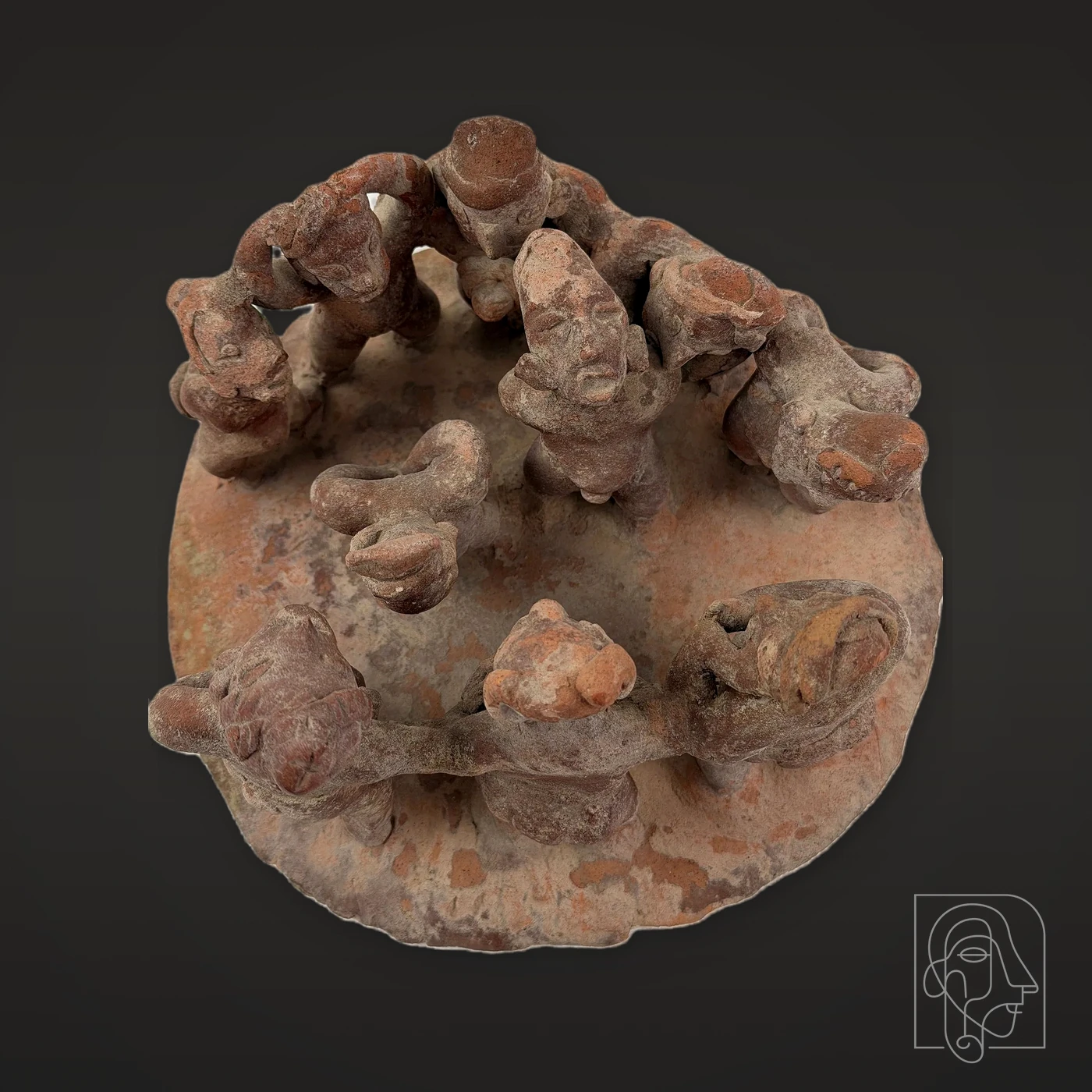
Extended description
JCA.2026.047 is a complex hand-modeled terracotta tableau composed of ten anthropomorphic figures arranged in a continuous circular formation on a shared disc platform. The figures are deliberately differentiated in posture, scale, bodily form, and cranial treatment. Three prominent upright figures are modeled with pronounced gravid abdomens and free arms. Several of the remaining figures, including one of reduced scale, hold the arms behind the body in postures compatible with restraint.
The contrast between the unbound gravid figures and the figures with arms held behind the body establishes a pronounced visual differentiation within the group, but the precise narrative remains unresolved. Captive display, fertility or lineage ritual, sacrificial ceremony, mythological narrative, and other forms of ceremonial representation remain possible interpretations rather than established identifications.
The object belongs to the broader West Mexican tradition of ceramic scene groups associated with shaft-tomb contexts, in which social, ritual, domestic, funerary, and ceremonial activities were represented through modeled figures. Current stylistic assessment favors Nayarit, particularly the Ixtlán del Río tradition, although the object was historically catalogued as Colima. Its documentary identification as Barakat PF536 and the surviving PF.0536 / 9000 inventory marking provide an unusually useful historical anchor for an object of this class.
Technical examination documents manufacture- and burial-related features compatible with an ancient West Mexican ceramic, but scientific dating remains outstanding.
Technical analysis
Microscopic examination documents a low-fired oxidized earthenware body with a pale buff-to-cream matrix and abundant poorly sorted angular mineral temper. Visible inclusions include dark volcanic, reddish, pale altered, and quartz/feldspar-like grains, some approaching approximately 2 mm. Their angularity and poor sorting are consistent with intentionally crushed mineral temper rather than uniformly rounded sand.
Manufacturing traces include broad fields of fine, irregular, sub-parallel striations interpreted as hand-wiping or smoothing marks. Later mineral deposits lie within these grooves, establishing that the striations predate the burial-related surface sequence. No concentric rotary marks, regular lathe tooling, or machine chatter were observed in the examined fields.
The surface carries an ordered poly-mineralic deposit system. An orange-red iron-rich ground occupies lows and interstices. A hard green mineral phase forms rounded, mammillated and locally annular nodules with central pits, consistent morphologically with botryoidal or pisolitic concretion. A black phase forms branching dendritic to sub-dendritic clusters with dense nucleated cores and increasingly dispersed margins, occurring over and among the earlier deposits. The green and black phases remain morphologically identified only; XRF or SEM-EDS is required to determine composition.
Irregular fissures contain dark staining and mineral material and are locally overlain by later deposits, indicating that at least some cracking preceded subsequent burial accretion. Heterogeneous sand-grade sediment, including angular mineral grains in a pale cementing matrix, occurs deeply within protected V-junctions and undercuts. Deposits extend continuously into several modeled seams without obvious adhesive interruption.
The underside additionally carries a branching, forking network of shallow subtractive channels that meander across the ceramic surface and thin along their courses. Their morphology is consistent with root-related etching during burial. Comparable weathering and mineral deposition occur across both the disc base and modeled figures, indicating a broadly shared surface history.
An elongated body observed within one channel remains unresolved and should not presently be identified as an insect puparium; root fragment and mineral concretion remain viable alternatives. A separate fibrous mass is likewise unresolved. These features are retained in the technical research file but are not used as established antiquity markers.
Taken together, the fabric, manufacture traces, deposit stratigraphy, old fissures, cemented sediment, root-related channels, and cross-element consistency provide substantial corroboration of burial and traditional manufacture. None independently dates the firing.
In-hand hardness testing of the green phase found it hard and inert under a pick. This supports interpretation as an in-place mineral encrustation rather than a soft modern biological film, while leaving the specific mineralogy unresolved until compositional analysis. A dedicated raking-light imaging pass into the underside channels and deepest undercuts remains useful because coaxial/ring illumination can flatten relief and obscure channel depth.
Authentication methodology
Authentication proceeds through independent but complementary lines of evidence: stylistic comparison, documentary provenance, ceramic technology, surface stratigraphy, conservation examination, and scientific dating. Microscopy is used to document fabric, temper, hand-finishing, deposits, fissures, sediment in protected zones, join continuity, and possible burial-related biological or mineral features. Surface morphology is treated as corroborative evidence rather than chronological proof.
Thermoluminescence remains the principal outstanding test because it addresses the last firing of the ceramic. Multi-location sampling is recommended, including the base and at least one modeled figure, both to assess date and to test whether different elements share a common firing history.
XRF or SEM-EDS should be used to characterize the black manganese-type and green mineral phases. Ultraviolet fluorescence examination should map adhesive, fill, retouching, and consolidant. Radiography or micro-CT may subsequently assist in evaluating internal joins, repairs, and structural fill. Petrographic thin-section analysis could further characterize the ceramic fabric and temper.
No burial deposit should be removed before examination and documentation.
The consolidated imaging master records one remaining microscope task: raking-light documentation of the root-etched channels and deepest undercuts. This is intended to characterize morphology and depth, not to date the firing; thermoluminescence remains the chronological test capable of resolving the principal ancient-versus-recently-buried alternative.
Comparative works
Primary documentary comparator: The Barakat Gallery, A Catalogue of the Collection, Volume II — Pre-Columbian Art (1986), entry PF536, illustrating the present object. The Barakat publication attributed the group to Colima; current JCA stylistic reassessment favors Nayarit, Ixtlán del Río tradition.
Broader comparanda include West Mexican multi-figure ceramic tableaux representing village, ritual, funerary, domestic, and ceremonial scenes, particularly Nayarit groups composed around shared architectural or disc-like grounds. Relevant institutional comparanda include Nayarit figural scene groups in the Metropolitan Museum of Art and other museum collections cited in the bibliography. These provide typological and iconographic context but do not constitute exact parallels for the present combination of gravid figures and figures posed with arms behind the body.
No close published parallel for the complete iconographic configuration has yet been established in the present research record.
Provenance
Published as Barakat Gallery inventory PF536 in The Barakat Gallery: A Catalogue of the Collection, Volume II — Pre-Columbian Art (1986). The object's underside retains the associated inventory marking PF.0536 / 9000. Formerly held in the Barakat Gallery inventory under Fayez Barakat and subsequently stored in Los Angeles units later liquidated at public auction following default. Acquired through American Auctioneers, Los Angeles, on October 28, 2025, and subsequently accessioned as JCA.2026.047.
The 1986 Barakat catalogue constitutes the earliest presently secure documentary point in the ownership history. No excavation record or earlier chain of custody has yet been established.
Historical context
The sculpture belongs to the ceramic traditions of the West Mexican shaft-tomb cultural sphere, with current stylistic assessment favoring Nayarit, Ixtlán del Río. These traditions produced modeled human and animal figures as well as complex multi-figure scenes representing feasting, music, ritual, ballgames, domestic activities, funerary practices, and other forms of social life.
JCA.2026.047 is unusual in combining three prominently gravid figures with a larger group whose arms are modeled behind the body. Restraint or captive imagery is a plausible reading of the latter posture, while the gravid figures introduce themes potentially related to fertility, lineage, childbirth, renewal, or social identity. The relationship between these two iconographic elements is not securely established.
Accordingly, the composition should not presently be presented as a literal depiction of female authority, warfare, sacrifice, or a specific ritual. Its scholarly value lies partly in precisely this unresolved combination of bodily differentiation, restraint-like posture, pregnancy, scale, and circular arrangement.
Conservation history
No complete professional conservation history is presently documented. Photographic assessment has identified probable modern intervention at a neck and leg-to-base junction, including glossy material consistent with adhesive or consolidant. Microscopy of additional joins, however, records mineral deposits and cemented sediment extending continuously into seams without obvious modern adhesive interruption. The complete repair map therefore remains unresolved.
Ultraviolet fluorescence examination and professional conservation assessment are recommended to identify adhesive, fill, retouching, coatings, and previous consolidation.
The burial-related surface is itself evidentiary. Mineral crusts, manganese-type deposits, sediment in protected undercuts, root-related channels, and unresolved organic or fibrous inclusions should not be cleaned, brushed, scraped, or chemically removed during the present research phase. Loose modern fibres may be lifted only after documentation in situ. Stabilization required for active deterioration is distinct from cleaning and should be undertaken by a qualified conservator.
Bibliography
JCA Archives. Surface, Fabric, Deposits & Burial Evidence: Forensic Imaging — Consolidated Master Record, JCA.2026.047 / Barakat PF536. Imaging sessions 20, 24, 25 and 27 August 2026. Internal technical research record.
JCA Archives. Microscopy Evidence: Surface, Fabric & Deposits. 24 August 2026. Superseded technically by the Consolidated Master Record but retained as an imaging-session record.
JCA Archives. Microscopy Findings: Base & Figure Deposit Survey — Session Supplement II. 27 August 2026. Retained as a session supplement; its manganese and encrustation plates are incorporated into the Consolidated Master Record.
The Barakat Gallery. A Catalogue of the Collection, Volume II — Pre-Columbian Art. 1986. Entry PF536.
The Metropolitan Museum of Art. “Village Scene (Nayarit Artist[s]).” Collection Database. Accessed 2026.
Milwaukee Public Museum. “West Mexican Ceramic Figurative Sculptures.” Anthropology Collections Archive. Accessed 2026.
Penn Museum. “The Enduring Villages of Western Mexico.” Expedition Magazine. University of Pennsylvania Museum of Archaeology and Anthropology.
Florida Museum of Natural History. Mesoamerican / Latin American archaeology collections resources. Accessed 2026.
North Carolina Museum of Art. “Standing Male Figure.” NCMALearn Educational Resources. Accessed 2026.