Alfred Dunhill Rollagas Butane Pocket Lighter (Textured Gold-Tone with Black Lacquer Panels) — Scholarly Analysis
Extended scholarly study of "Alfred Dunhill Rollagas Butane Pocket Lighter (Textured Gold-Tone with Black Lacquer Panels)" (accession JCA.2026.055): material analysis, authentication methodology, comparative works, and bibliography.
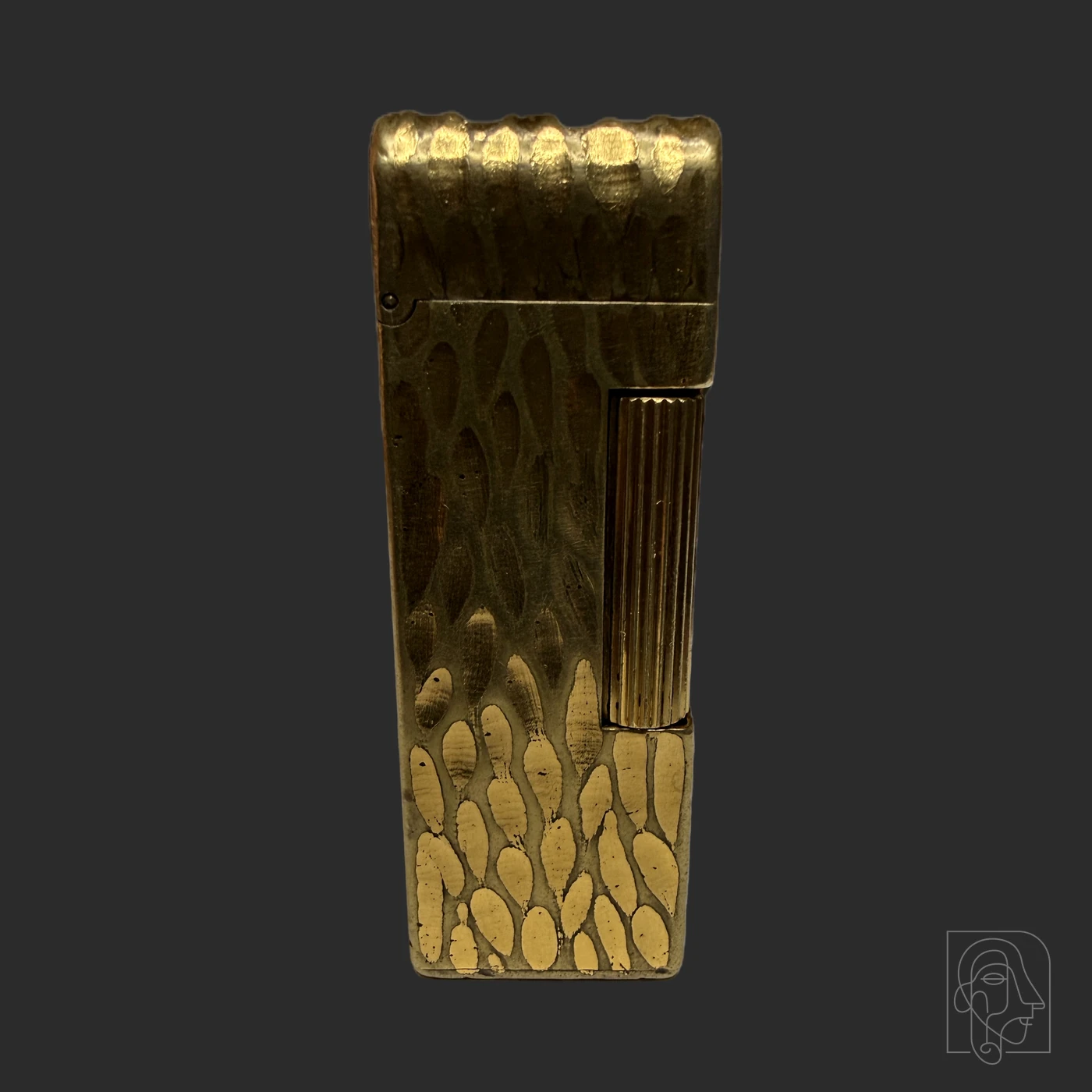
Extended description
JCA.2026.055 is a Swiss-made Alfred Dunhill Rollagas butane pocket lighter with a rectangular plated-brass body, side-mounted roller ignition, hinged lid, and contrasting decorative surfaces. The primary faces carry an irregular textured or bark-like gold-tone finish, while the side panels are finished in black lacquer, producing a deliberate contrast between reflective relief and dark smooth fields. The base is stamped “dunhill,” “MADE IN SWITZERLAND,” and “US RE 24163 PATENTED,” markings consistent with the Rollagas family rather than Dunhill's earlier petrol lift-arm “Unique” type. The mechanism uses pressurized butane fuel and a roller-operated flint ignition system. Surface wear is concentrated on edges and high-contact points, while the lacquer panels remain substantially intact. The object is useful for documenting Dunhill's post-1956 transition to butane technology and the brand's use of decorative metal finishing within a standardized mechanical platform. Exact production year remains unresolved without a more specific dating mark or factory record.
Technical analysis
The lighter is built around a plated brass body with black lacquer side panels and a Swiss-made Rollagas butane mechanism. Fuel is stored as pressurized butane rather than in petrol-soaked wadding. Ignition is produced by the side-mounted roller acting on a flint while the valve system releases gas to the burner. The contrasting exterior required multiple finishing operations: mechanical texturing of the gold-tone surfaces, plating, and application of the black lacquer panels. Edge wear exposes the brass substrate at high-contact areas, while the lacquer remains substantially adherent. Internal seals are service components and may require replacement during routine maintenance; such work should be recorded separately from original manufacture.
Authentication methodology
Identification as an Alfred Dunhill Rollagas is based on the combined evidence of Dunhill branding, “MADE IN SWITZERLAND,” the “US RE 24163 PATENTED” marking, side-roller ignition, butane-valve architecture, dimensions, materials, and factory-quality finishing. These features are mutually consistent with the Rollagas family. They do not establish an exact production year or specific plating specification. Authentication should therefore distinguish secure model-family identification from narrower dating. Wear, plating loss, and lacquer aging support a history of use but are not authentication criteria by themselves.
Comparative works
Relevant comparanda are Swiss-made Alfred Dunhill Rollagas pocket lighters produced after the model's 1956 introduction, particularly examples with textured plated bodies, lacquer panels, and the same Swiss/patent base legend. Comparison should focus on body proportions, roller and valve layout, base stamping, finish execution, and internal mechanism. Plain Rollagas examples establish the mechanical platform; decorated variants document the range of factory surface treatments.
Provenance
The lighter was acquired through auction, with no additional documentation of prior ownership presently available. While the absence of extended provenance limits reconstruction of ownership history, the object’s authenticity is supported by its material characteristics, markings, and construction. Dunhill lighters of this type were distributed through luxury retail channels during the mid-20th century, including Dunhill flagship stores and authorized international retailers. Swiss-manufactured examples reflect the brand’s expansion into precision production environments beyond the United Kingdom, supporting increased global demand. Objects of this type were typically retained in private ownership for extended periods due to their durability and continued functionality. Their eventual appearance in secondary markets—such as estate sales and auctions—is consistent with established patterns of circulation for mid-century luxury accessories.
Historical context
The Rollagas, introduced in the mid-1950s, represents Dunhill's move from petrol-fueled pocket lighters to a cleaner pressurized-butane system. Swiss precision manufacture allowed Dunhill to combine a standardized mechanical platform with numerous decorative finishes aimed at the luxury-accessory market. JCA.2026.055 is significant within that history because its textured gold-tone surfaces and black lacquer panels show how the company differentiated visually distinctive variants without altering the underlying Rollagas operating principle.
Conservation history
The lighter is preserved in good to good-plus condition, retaining its original structural and mechanical components. The gold-tone plating exhibits expected wear at edges and high-contact areas, with underlying brass visible in localized regions. Surface scratching is consistent with normal use. The black lacquer side panels remain intact with minor wear and no evidence of significant loss or delamination. Internal components show light oxidation consistent with age but remain functionally intact. A non-invasive gasket repair has been performed to restore fuel retention and maintain operational functionality. This intervention was limited to internal maintenance and did not involve replacement of original visible or defining components. It is therefore classified as conservation-grade upkeep rather than restoration. No evidence of structural repair, refinishing, or component substitution is observed. The object remains both materially authentic and fully functional.
Bibliography
Useful primary references include period Alfred Dunhill Rollagas catalogues and instruction literature, Dunhill company histories describing the post-1956 Rollagas line, and the U.S. patent/reissue documentation cited on the lighter itself (US RE 24163). Comparative object records should be drawn from documented Swiss-made Rollagas examples in museum, auction, and specialist collections. The JCA object photographs and base markings remain the primary evidence for this specific lighter.