Alfred Dunhill Rollagas Pocket Lighter (Engine-Turned Diamond Guilloché) — Scholarly Analysis
Extended scholarly study of "Alfred Dunhill Rollagas Pocket Lighter (Engine-Turned Diamond Guilloché)" (accession JCA.2026.060): material analysis, authentication methodology, comparative works, and bibliography.
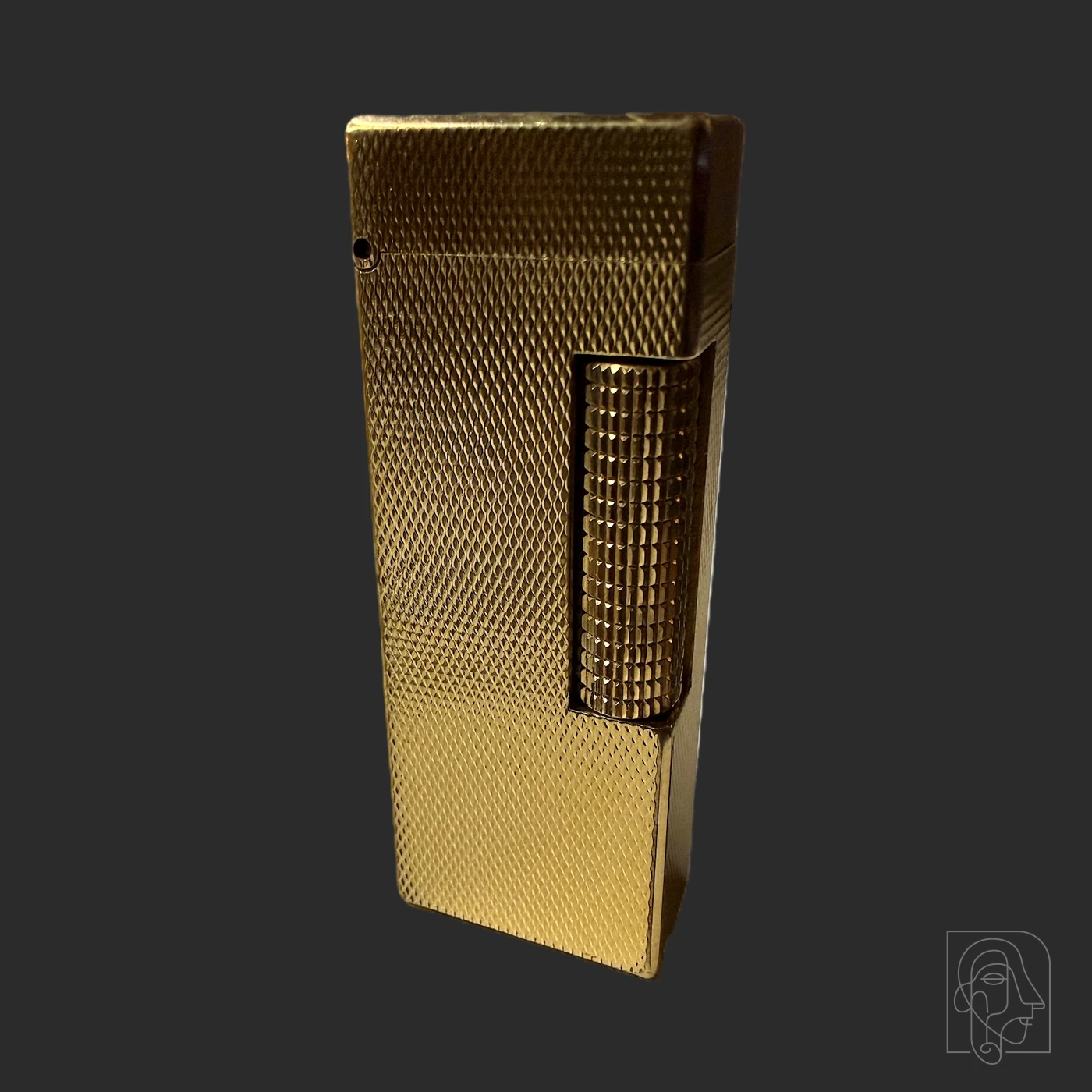
Extended description
JCA.2026.060 is a Swiss-made Alfred Dunhill Rollagas butane pocket lighter with a rectangular plated-brass body, hinged lid, and side-mounted roller ignition. The exterior is covered by a precision engine-turned diamond or guilloché pattern that continues across the principal surfaces and provides both visual texture and tactile grip. The base carries Dunhill branding, Swiss manufacture wording, and the US RE 24163 patent legend. The exact production year has not been established; the secure chronological anchor is that it belongs to the post-1956 Rollagas era.
Technical analysis
The lighter is constructed from a brass substrate with a gold-plated exterior finish. Internally, it employs a pressurized butane fuel system paired with a flint ignition mechanism. The side-mounted roller engages a geared striker assembly, producing spark in coordination with controlled gas release through a precision valve system. This configuration reflects Dunhill’s early adoption of reliable butane technology, replacing earlier petrol-based systems. The machining quality, tolerances, and mechanical layout are consistent with Swiss production standards of the period.
Authentication methodology
Authentication is based on a combination of physical construction, mechanical configuration, and stamped markings. The base marking “MADE IN SWITZERLAND” confirms production origin, while the presence of U.S. patent marking RE24163 corresponds to known Dunhill Rollagas patent protection during the mid-20th century. The integration of the side roller ignition within a recessed channel, along with the specific engine-turned pattern style, aligns with documented authentic examples. No indicators of modern reproduction or later fabrication are observed.
Comparative works
Comparable examples include Alfred Dunhill Rollagas lighters produced between the late 1950s and mid-1960s, particularly those featuring engine-turned or guilloché-style finishes. Similar specimens appear in auction archives and collector references, often exhibiting identical base markings and mechanical layouts. The present example conforms closely to these known production variants in both form and execution.
Provenance
The lighter was acquired as part of a multi-piece Dunhill lighter grouping obtained through secondary market channels. Specific prior ownership history is not documented; however, the object’s condition, wear patterns, and mechanical integrity are consistent with long-term private ownership and use.
Historical context
The Dunhill Rollagas series marks the company's transition from petrol-fueled lighters to pressurized butane technology in the mid-twentieth century. The mechanism paired Swiss precision engineering with luxury decorative finishes, allowing engine turning, plating, lacquer, and other surface treatments to distinguish variants built around the same core operating system. The diamond guilloché of JCA.2026.060 belongs to that design strategy and is best understood as a decorative finish on a standardized butane platform rather than evidence for a unique mechanism.
Conservation history
The object remains in stable condition with no evidence of invasive restoration. Surface wear is consistent with age and handling, including minor abrasions and softening at high-contact points. Routine non-invasive maintenance has been performed, including replacement of internal O-ring seals to ensure functional integrity. No disassembly or structural modification has been undertaken.
Bibliography
Primary reference points include period Alfred Dunhill Rollagas catalogues and instruction literature, the US RE 24163 patent/reissue marking cited on the object, and documented Swiss-made Rollagas examples in specialist and institutional collections. JCA macro photography of the base stamps, finish, and mechanism provides the object-specific evidence.