Copper-Alloy Bird-Form Finial or Terminal — Scholarly Analysis
Extended scholarly study of "Copper-Alloy Bird-Form Finial or Terminal" (accession JCA.2026.061): material analysis, authentication methodology, comparative works, and bibliography.
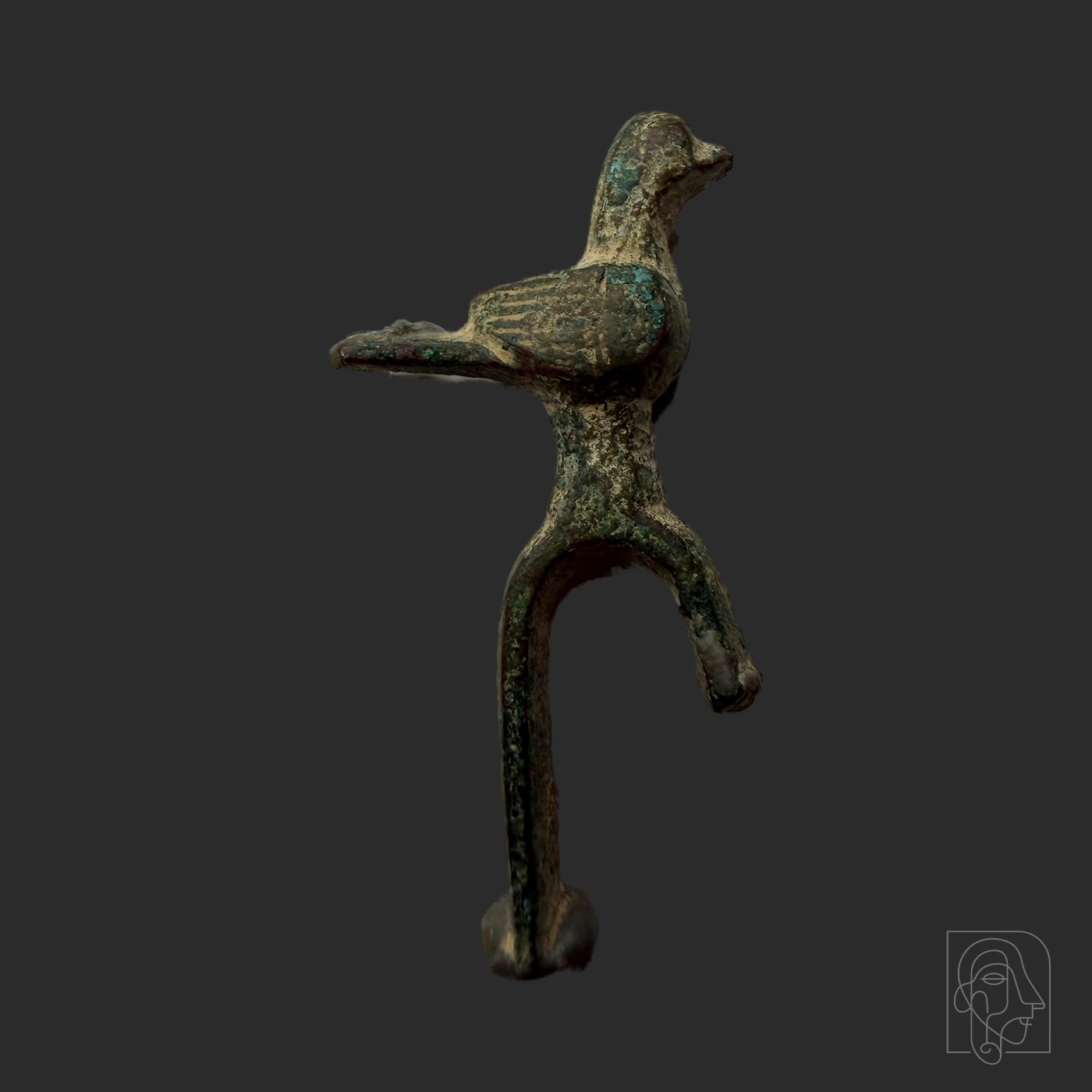
Extended description
JCA.2026.061 is a small copper-alloy bird-form terminal or finial measuring approximately 63 mm high, 32 mm wide, and 11.5 mm thick. The bird is reduced to an elongated neck, rounded body, simplified beak, and paired groups of incised lines suggesting wings. Beneath the body is an integral mounting element ending in a broken tang, demonstrating that the figure originally formed part of a larger object. The missing parent object cannot presently be reconstructed. Green-blue corrosion, reddish copper-oxide areas, and mineral deposits cover much of the surface. These features are important condition evidence but should not be used by themselves to assign age.
Technical analysis
The object appears cast, with secondary incision used to define the wings, but the available visual record does not establish whether it was produced by lost-wax, open-mold, or another casting process. The broken lower tang is especially important because its fracture may expose metal structure and casting porosity more clearly than patinated exterior surfaces. Future examination should document seam lines, tool marks, fracture morphology, metal inclusions, and corrosion stratigraphy under magnification. Portable XRF could characterize major alloying elements but would not by itself date the object or prove a Luristan origin.
Authentication methodology
Current assessment is comparative and non-destructive. Morphology, mounting structure, surface condition, and broad parallels in ancient Iranian animal-form metalwork support further study, but the object lacks excavation context and scientific dating. Stable green and red corrosion products are compatible with aged copper alloy yet can occur on objects of many periods. A stronger authentication program would combine microscopy, XRF alloy characterization, radiography where useful for casting structure, and provenance research. Any cultural attribution should remain provisional unless the full feature set matches securely provenanced comparanda.
Comparative works
Comparative research should include securely provenanced bird- and animal-form finials, standards, pins, and mounted bronze elements from western Iran and neighboring regions, especially examples published in institutional catalogues of Iranian Iron Age metalwork. Similarity in subject alone is insufficient: mounting architecture, scale, casting technique, incision, and alloy should all be compared. No exact institutional match for JCA.2026.061 has yet been established.
Provenance
Ownership history before acquisition is undocumented. No findspot, excavation record, export documentation, earlier named collection, or historical inventory accompanies the object. “Iranian” and “Luristan-style” therefore describe working comparative categories, not documented provenance.
Historical context
The term “Luristan bronze” covers a heterogeneous body of metalwork associated with western Iran, much of which entered collections without controlled excavation context. Animal imagery is common in Iranian metalwork, but bird forms occur in multiple object classes and regions. For unprovenanced objects such as JCA.2026.061, responsible study requires keeping iconographic resemblance separate from geographic provenance and firing or casting age.
Conservation history
The lower mounting tang is broken and the object is detached from its original support. Corrosion appears stable in the current record, but no treatment history is documented. Do not polish or remove the green-blue and red corrosion layers before microscopy and photography. Store in a dry, stable environment and monitor for powdery bright-green active corrosion. Any stabilization should be undertaken by a metals conservator and recorded.
Bibliography
Comparative study should consult P. R. S. Moorey's catalogue of ancient Persian bronzes in the Ashmolean Museum, published catalogues of Iranian metalwork in major museum collections, and current archaeometallurgical literature on western Iranian copper alloys. No object-specific publication or excavated parallel has yet been identified for JCA.2026.061.