Japanese WWII Shin-Guntō Katana — Scholarly Analysis
Extended scholarly study of "Japanese WWII Shin-Guntō Katana" (accession JCA.2026.071): material analysis, authentication methodology, comparative works, and bibliography.
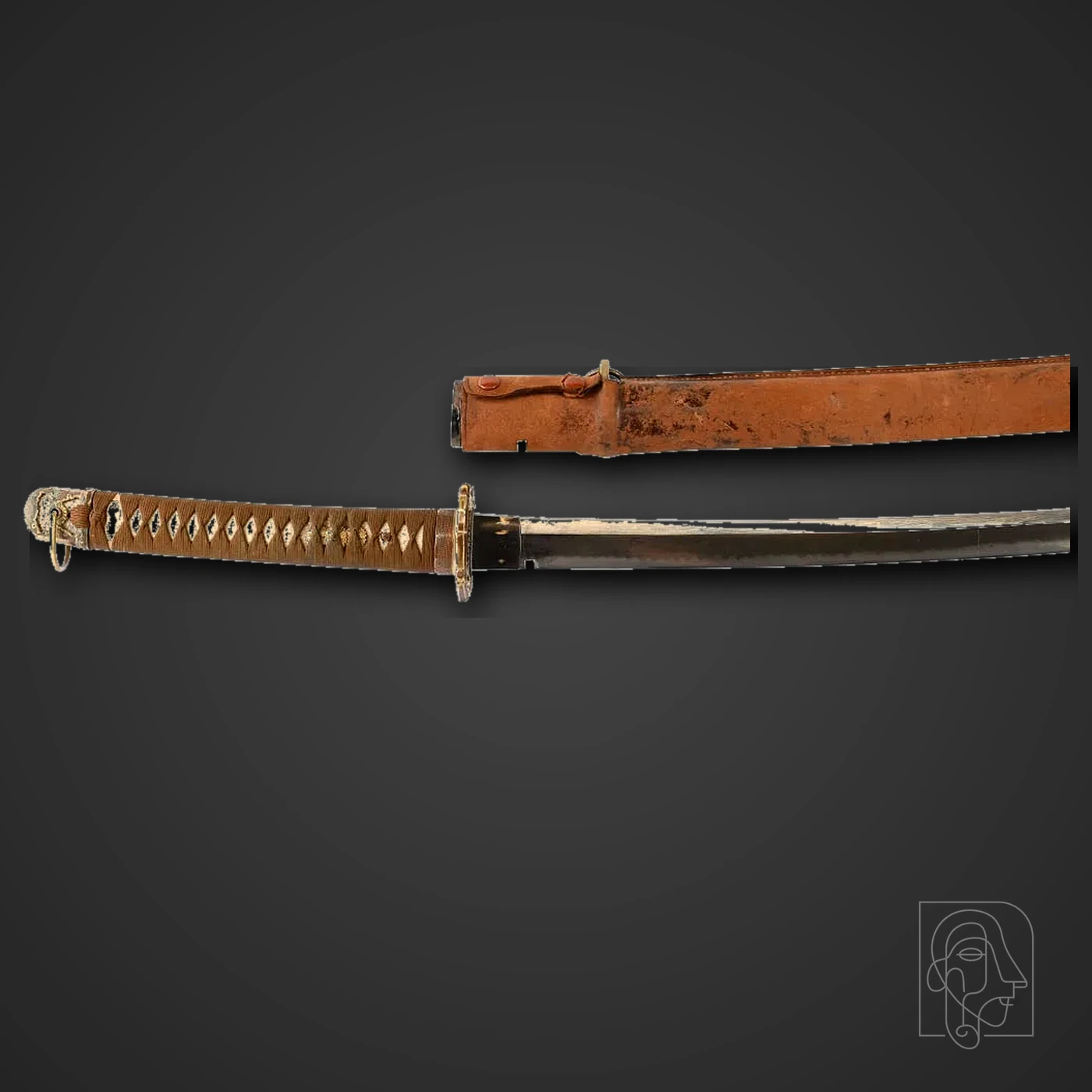
Extended description
Japanese katana mounted in Imperial Japanese Army Shin-Guntō officer fittings of the Shōwa wartime period, signed 関住森俊治作 (Seki-jū Mori Toshiharu saku), “Made by Mori Toshiharu, resident of Seki.” The sword retains a leather-covered military saya and regulation-style wartime mounts associated with Japanese officer service during the Second World War. The blade measures 65.2 cm nagasa with 1.5 cm sori and two mekugi-ana, dimensions confirmed by Japanese registration documentation and corresponding Japanese-market sale records. The blade displays a visible hamon with shallow undulating gunome/notare characteristics and a brighter habuchi or nioiguchi line visible along the upper boundary of the hardened area. Magnified photographic examination reveals fine visible hada showing flowing longitudinal steel texture provisionally interpreted as masame-leaning with mixed itame activity. The tang retains dark stable patination and visible yasurime file marks consistent with Shōwa-period manufacture. The kissaki remains intact and generally healthy in visible condition, though clearer boshi/kaeri documentation remains desirable. The object represents a well-preserved and unusually well-documented example of a wartime Japanese military-mounted katana associated with the Seki swordmaking tradition.
Technical analysis
The blade appears shinogi-zukuri in form with moderate curvature and military wartime proportions. Hamon appears suguha-based with shallow gunome-midare or notare activity. The visible bright boundary at the crest of the hamon waves suggests active habuchi or nioiguchi formation rather than a simple etched decorative line. Fine hada visible under angled magnified lighting suggests forged lamination structure and supports probable traditional or semi-traditional forging methods. Hada appears fine and tight with longitudinal flowing texture, provisionally interpreted as mixed itame-masame with masame tendency. No arsenal, Shōwa, Seki, or Rikugun Jumei Tōshō star stamp was observed in supplied nakago photography. Nakago exhibits hand-finished yasurime and stable aged patination. The blade retains military koshirae including copper habaki, six seppa noted in Japanese auction description, leather combat cover, and regulation suspension hardware. The sword weight was listed in Japanese-market sale documentation as approximately 1 kilogram without saya.
Authentication methodology
Authentication methodology combined mei analysis, tang morphology study, military mounting typology, registration-document comparison, provenance-chain reconstruction, and comparative blade-surface examination. Mei was independently translated and matched to the Shiga Prefecture 銃砲刀剣類登録証 and to Japanese-market auction documentation. Measurements recorded in the registration certificate, including nagasa 65.2 cm, sori 1.5 cm, and two mekugi-ana, correspond precisely with the physical sword and auction descriptions. Tang examination confirmed hand-cut chisel signature, wartime-consistent yasurime, stable patination, and absence of visible arsenal or inspection stamps in available imagery. Blade examination identified visible active hamon and fine hada inconsistent with decorative reproductions or low-grade stainless military replicas. Comparative assessment against known wartime Seki production suggests the blade exceeds ordinary mass-produced stamped Shōwatō examples in workmanship and finish. Current conclusion supports attribution as an authentic Shōwa-period Japanese katana by Mori Toshiharu, probably traditionally or semi-traditionally forged, though formal NBTHK/NTHK authentication has not been obtained.
Comparative works
Comparable objects include wartime Shin-Guntō-mounted katana signed by Seki-region smiths active during the Shōwa era, particularly examples lacking arsenal stamps and displaying visible hada and active hamon. Comparable market examples include signed WWII officer swords offered through Rock Island Auction, Griffin Militaria, and Morphy Auctions featuring leather-covered saya, military fittings, and traditionally forged or semi-traditionally forged blades. Comparative mei references for Mori Toshiharu appear in Nihonto Message Board discussions and Japanese dealer archives documenting the signature forms 関住森俊治作 and 濃州住森俊治作. The sword may be compared typologically with wartime Seki-made officer swords exhibiting mixed military and traditional craft characteristics rather than purely factory-produced oil-quenched blades. The visible hada and absence of visible arsenal marks place the object closer to the upper tier of wartime military-mounted blades rather than low-grade stamped examples.
Provenance
Documented provenance chain begins with wartime manufacture in Seki, Gifu Prefecture, Japan, by the smith Mori Toshiharu. Exact early ownership history remains unknown. The sword was legally registered in Shiga Prefecture, Japan, on 24 August 2022 under registration number appearing as 滋刀第2178号 following likely estate discovery, paperwork regularization, or private-family surfacing. The registration paper records the object as a katana with nagasa 65.2 cm, sori 1.5 cm, two mekugi-ana, and mei 関住森俊治作. The sword subsequently appeared on Yahoo! Japan Auctions under auction ID g1169111544 ending 19 January 2025 from Nara Prefecture, closing after four bids. The listing described the object as a wartime military sword with gunome-midare hamon, copper habaki, six seppa, and leather-covered combat mounting. The sword was later exported through the Japanese export/dealer pipeline and appeared in the United States through Milestone Auctions / Invaluable as Lot 607 on 18 April 2026 under the title “Japanese Katana Seki Ju Mori Toshiharu.” It was subsequently acquired by Joshua Cabinet of Antiquities and cataloged as JCA.2026.071.
Historical context
Documented provenance chain begins with wartime manufacture in Seki, Gifu Prefecture, Japan, by the smith Mori Toshiharu (森俊治), active during the Shōwa wartime period. The blade is signed 関住森俊治作 (Seki-jū Mori Toshiharu saku), translated “Made by Mori Toshiharu, resident of Seki,” directly associating the object with the wartime Seki swordmaking tradition. Exact early ownership history during and immediately following WWII remains unknown, though the sword remained in Japan into the twenty-first century. The sword was legally registered in Shiga Prefecture, Japan, on 24 August 2022 under a Japanese 銃砲刀剣類登録証 (Firearms and Swords Registration Certificate) issued by the Governor of Shiga Prefecture. The registration number appears to read 滋刀第2178号. The registration document records the object as a katana with nagasa 65.2 cm, sori 1.5 cm, two mekugi-ana, and the mei 関住森俊治作. The registration event likely reflects estate discovery, legal regularization following loss of older paperwork, or re-entry into the formal Japanese registration system prior to commercial sale. The existence of this document is significant because it firmly anchors the object within Japan’s modern legal and cultural-property framework before export. The sword subsequently appeared on Yahoo! Japan Auctions under auction ID g1169111544, ending 19 January 2025. The listing originated from Nara Prefecture, Japan, and closed after four bids. The auction description identified the object as a wartime Shōwa military sword with blade length 65.2 cm, curvature 1.5 cm, two mekugi-ana, moto-haba 3.00 cm, copper habaki, six seppa, leather-covered combat mounting, and hamon described as 互の目乱れ (gunome-midare). The Japanese-market listing is especially important because its measurements, mei, and physical characteristics correspond exactly with the Shiga registration certificate and with the physical sword now cataloged as JCA.2026.071. Following the Japanese-market sale, the sword appears to have entered the Japanese export/dealer pipeline and was transferred to the United States through standard commercial export channels for registered Japanese swords. The object later appeared in the United States through Milestone Auctions / Invaluable as Lot 607 on 18 April 2026 under the title “Japanese Katana Seki Ju Mori Toshiharu.” The American auction description identified a 33 3/4 inch blade with 25 3/4 inch cutting edge, active hamon, two-hole signed tang, WWII Shin-Guntō mounts, leather-covered saya, and accompanying import/registration paperwork. The sword was subsequently acquired by Joshua Cabinet of Antiquities and formally cataloged as JCA.2026.071. The object therefore possesses an unusually strong modern provenance chain for a WWII Japanese military-mounted sword, including Japanese legal registration documentation, traceable Japanese-market sale history, export-market transition, and documented American auction appearance prior to institutional cataloging.
Conservation history
No modern restoration or professional polish history is presently documented within the JCA record. The blade appears to retain a later polish of functional rather than elite art-polish grade. Surface examination reveals fine abrasion marks, haze, and scattered oxidation spots but no obvious evidence of aggressive machine buffing or destructive modern refinishing. Tang patina appears stable and should not be cleaned or altered. Leather combat cover and wartime fittings retain age-consistent wear. Future conservation recommendations include controlled-humidity storage, avoidance of abrasive cleaning, periodic choji-oil maintenance under proper handling protocol, and professional evaluation before any restoration or polish intervention. Any future polish should be undertaken only by a qualified Japanese sword polisher familiar with wartime blades and traditional geometry preservation.
Bibliography
Shiga Prefecture Government, 銃砲刀剣類登録審査 guidance and registration procedures. Yahoo! Japan Auctions, auction ID g1169111544. Milestone Auctions / Invaluable, Lot 607 “Japanese Katana Seki Ju Mori Toshiharu.” Nihonto Message Board discussions concerning Mori Toshiharu mei readings and wartime Seki smiths. Japanese Sword Index, wartime swordsmith and Shōwatō/gendaitō reference materials. Markus Sesko swordsmith reference citations as discussed in collector literature. Seki City and Seki blade-industry historical materials concerning Mino and Seki swordmaking traditions.