Pair of Copper-Alloy Dagger-Shaped Objects, Luristan Attribution Provisional — Scholarly Analysis
Extended scholarly study of "Pair of Copper-Alloy Dagger-Shaped Objects, Luristan Attribution Provisional" (accession JCA.2026.077): material analysis, authentication methodology, comparative works, and bibliography.
Extended description
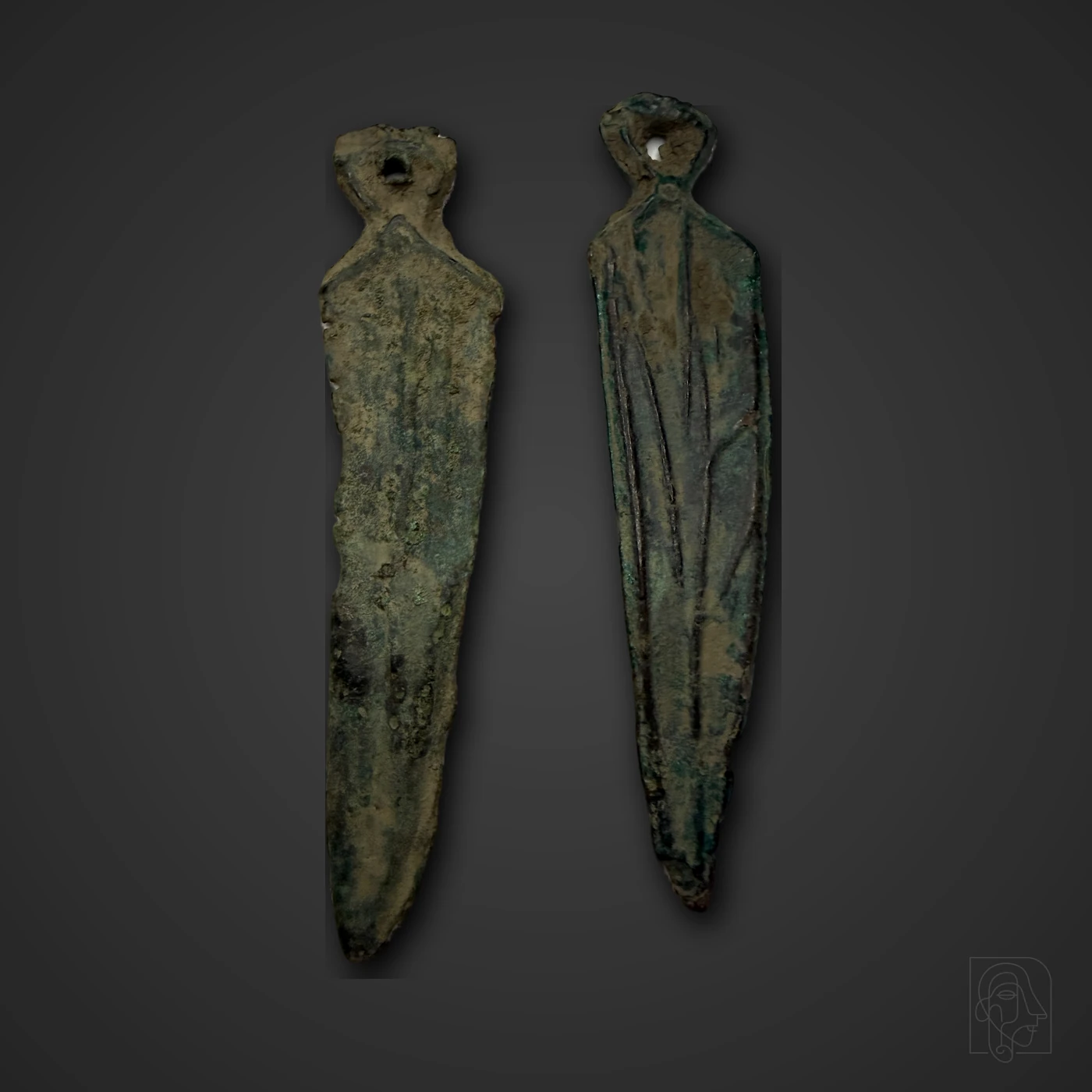
JCA.2026.077 comprises two small copper-alloy dagger-shaped objects acquired as a pair. Each is approximately 5 in. long and has a perforated tang above a narrow leaf-shaped blade. Piece 1 weighs 43 g and has a broader trapezoidal tang, pronounced shoulders, and several longitudinal raised ribs or ridges. Piece 2 weighs 38 g and has a more rounded or lobed tang and three prominent longitudinal grooves. Both are thin in profile and show slight longitudinal deformation. Their green, red-brown, and darker surface products vary across each piece and between the pair. The similarities justify cataloguing them together, but the differences do not establish that they were made in the same workshop or even deposited together in antiquity. Their current identification is best expressed as dagger-shaped amuletic or votive candidates with a provisional comparison to Iranian/Luristan Iron Age metalwork.
Technical analysis
Both objects appear to have been cast, followed by some degree of finishing, but the exact mold system and sequence of perforating, grooving, or trimming cannot be determined confidently from photographs. The very thin blades and suspension holes distinguish them from full-scale functional daggers, yet miniature or symbolic function remains an interpretation rather than a demonstrated use. Piece 1 carries raised longitudinal features; Piece 2 carries deeper grooves. Both show green copper-corrosion products with red-brown areas and exposed or less-corroded metal at selected edges. Microscopy should document casting seams, tool marks, perforation walls, fracture or edge structure, and whether corrosion penetrates the metal. Portable XRF can characterize alloying elements, but an alloy consistent with ancient bronze would not by itself date the objects. Radiography could assist with casting structure and hidden defects.
Authentication methodology
The present authentication status is Unverified / Possible. Visual typology and corrosion morphology justify comparison with Iranian Iron Age bronzes but do not establish age or origin. The recommended non-destructive sequence is: high-resolution macro and stereomicroscope examination; XRF at multiple cleaned or naturally exposed points where ethically appropriate; radiography if available; precise dimensional and weight recording; and provenance research aimed at identifying the pre-auction collection. Specific gravity may characterize bulk density but should not be used as a pass/fail ancient-versus-modern test. XRF can identify alloy composition but cannot alone authenticate. Lead-isotope analysis can sometimes address ore-source questions when robust reference populations exist, but it cannot independently prove manufacture in Luristan or ancient date. Any destructive sampling should require a clear research question and conservator approval.
Comparative works
Published Iranian metalwork catalogues contain small blades, votive weapons, pins, and related cast objects that provide a useful typological framework. The Metropolitan Museum of Art's Luristan holdings, the Ashmolean Museum corpus published by P. R. S. Moorey, and catalogues by Peter Calmeyer and Bruno Overlaet are appropriate starting points. Comparisons should be based on tang shape, perforation, blade section, dimensions, casting and finishing, not on green patina alone. Met accession 61.261.6 and other institutional daggers may provide broad morphological context, but no exact match proving the attribution of JCA.2026.077 has been established.
Provenance
The pair was acquired in 2025 from a regional United States auction house. The consignor, earlier collection, findspot, export history, and chain of ownership before that sale are not documented in the current file. No speculative reconstruction of a twentieth-century Iranian export route should be treated as provenance. Until documentary evidence is found, the pre-2025 history must remain unknown.
Historical context
“Luristan bronzes” is a modern collecting and archaeological category covering diverse metal objects associated with western Iran, particularly the central Zagros region. Much material entered international collections during the twentieth century without controlled archaeological context, which has complicated chronology and attribution and encouraged a substantial reproduction market. For an unprovenanced pair such as JCA.2026.077, the central scholarly task is therefore not to force a precise cultural label but to test morphology, alloy, manufacture, corrosion, and ownership history against securely excavated or well-documented comparanda. Miniature weapon forms may have had votive, funerary, amuletic, symbolic, or other uses; the current pair does not preserve enough contextual evidence to choose among those possibilities.
Conservation history
Both pieces are presently retained without cleaning so that corrosion, deposits, tool marks, and surface stratigraphy remain available for study. Piece 1 has heavier pitting and green corrosion; Piece 2 is somewhat cleaner and retains a reddish zone at the blade tip. Slight warping is present in both. No active powdery bright-green corrosion is recorded, but the surfaces should be monitored periodically in dry storage. Avoid polishing, acid treatment, ultrasonic cleaning, oils, waxes, or removal of corrosion before technical examination. Any active bronze disease should be assessed by a qualified metals conservator rather than treated according to a fixed recipe in the catalogue.
Bibliography
Selected comparative references: P. R. S. Moorey, Catalogue of the Ancient Persian Bronzes in the Ashmolean Museum; Peter Calmeyer, Datierbare Bronzen aus Luristan und Kirmanshah; Bruno Overlaet, publications on Luristan bronzes and western Iranian Iron Age material; and current archaeometallurgical studies of Iranian copper alloys, including work by Omid Oudbashi and collaborators. Institutional collection records from the Metropolitan Museum of Art, British Museum, Ashmolean Museum, and Penn Museum provide additional typological context. These sources support comparison and testing strategy; none authenticates JCA.2026.077.