Iron Socketed Lanceolate Spear/Pike Head — Scholarly Analysis
Extended scholarly study of "Iron Socketed Lanceolate Spear/Pike Head" (accession JCA.2026.078): material analysis, authentication methodology, comparative works, and bibliography.
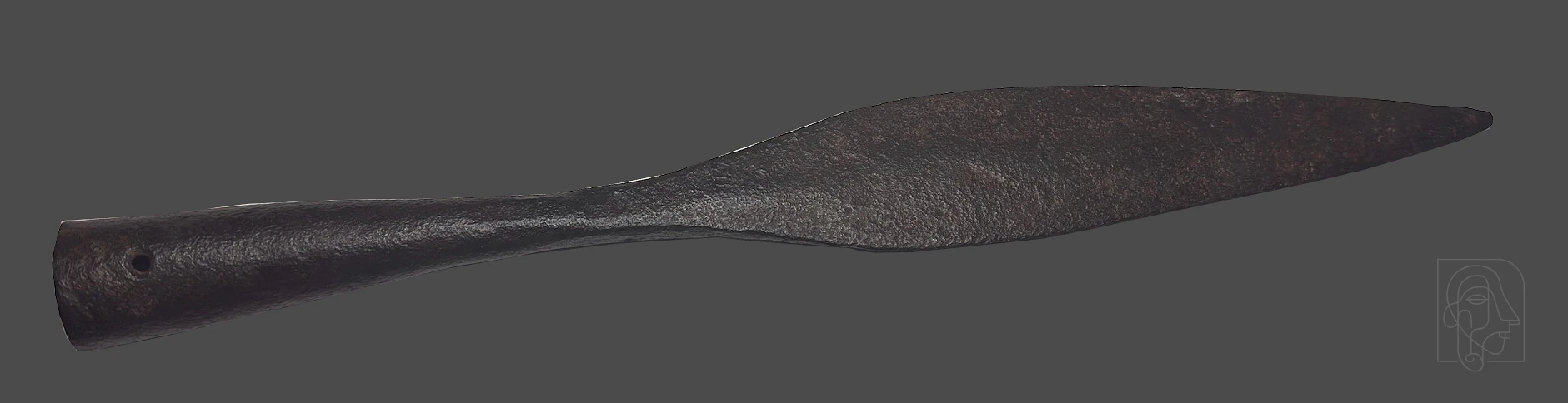
Extended description
JCA.2026.078 is a plain iron socketed polearm head approximately 14.5 in. overall, with a broad lanceolate blade and a tapered hollow socket about 4.5 in. long. The socket preserves a longitudinal wrapped seam and a single circular hole for securing the head to a wooden shaft. There is no inscription, maker mark, decorative feature, crossguard, or surviving haft. The blade is simple and thrust-oriented. Its construction is consistent with hand-forged spear or pike heads made over a long period, including eighteenth- and nineteenth-century examples, but morphology alone does not distinguish a colonial, Revolutionary, early Federal, European, naval, militia, or later utilitarian context.
Technical analysis
The socket appears to have been formed by wrapping an iron blank around a mandrel and hammering the edges together, leaving a longitudinal seam that is now partly open. The pin hole near the socket mouth was used to secure a wooden haft. The blade lacks a pronounced central rib and appears relatively plain in section. Dark brown-black oxide and localized reddish corrosion cover the surface. These observations support hand forging and age but do not provide a narrow chronology. Metallographic or compositional testing might characterize the iron and fabrication, but dating should rely primarily on secure typological and provenance evidence.
Authentication methodology
Current assessment is based on manufacture, morphology, corrosion, and broad comparison with historical polearms. The object does not show obvious seamless modern tubing or decorative casting, but a handmade appearance is not itself a date test. Authentication should remain at Possible until provenance or stronger technical evidence narrows the chronology. High-resolution examination of forge-weld structure, socket seam, pin-hole walls, blade edges, and any file or grinding marks would improve the record. Revolutionary War association should not be claimed without documentary evidence.
Comparative works
Useful comparanda include documented eighteenth- and nineteenth-century socketed spear, pike, and boarding-pike heads in the Royal Armouries, USS Constitution Museum, Fort Ticonderoga, and other military-history collections. These comparisons are valuable for construction and dimensional range, but the simplicity and longevity of the form mean that even a close visual match cannot establish national origin or conflict association for JCA.2026.078.
Provenance
No secure findspot, maker, owner, military unit, ship, battlefield association, or continuous chain of custody is presently documented. Any regional acquisition history should be recorded separately from manufacture. Map coordinates or dealer location must not be presented as an archaeological or historical origin.
Historical context
Socketed polearms remained useful long after firearms became dominant. They could serve military, naval, militia, guard, hunting, agricultural, or improvised purposes, and many forms changed only gradually. That longevity makes plain unmarked heads difficult to date. JCA.2026.078 is therefore best used to illustrate traditional forged construction and the methodological limits of conflict-specific attribution when provenance is absent.
Conservation history
No conservation treatment is currently recorded. The object appears stable in its present condition, with heavy dark iron oxide patina and localized areas of reddish corrosion in seams and recesses. No modern cleaning, polishing, grinding, repair, coating, or restoration is visible from the available photographs. Mechanical cleaning is not recommended because the corrosion surface, socket seam, pin-hole margins, and forge texture are important evidentiary features. The object should be stored and displayed in a stable low-humidity environment, ideally below approximately 45% relative humidity, with minimal handling and no abrasive contact. If active powdery rust develops, the object should be examined by a qualified metals conservator before any treatment is attempted.
Bibliography
Gilkerson, William. Boarders Away, With Steel: A History of Naval Close Combat Weapons and Boarding Tactics. Lincoln, RI: Andrew Mowbray Publishers, 1991. Lee, Charles. Letter to John Hancock, April 19, 1776. In Edward Langworthy, ed., Memoirs of the Life of the Late Charles Lee. New York, 1792. Neumann, George C. Battle Weapons of the American Revolution. Texarkana, TX: Scurlock Publishing, 1998. Neumann, George C. Swords & Blades of the American Revolution. Harrisburg, PA: Stackpole Books, 1973. Peterson, Harold L. Arms and Armor in Colonial America, 1526–1783. New York: Bramhall House, 1956. Peterson, Harold L. Arms and Armor of the Pilgrims, 1620–1692. Plymouth, MA: Pilgrim Society / Plimoth Plantation, 1957. Schecter, Barnet. "Bows and Arrows — Pikes and Spears." Journal of the American Revolution, 2013. USS Constitution Museum. "1797 Pattern Boarding Pike." Object record. Washington, George. General Orders and correspondence relating to spear and pike use during the Revolutionary War period. Founders Online, National Archives. Ward-Perkins, J. B. London Museum Medieval Catalogue. London: His Majesty's Stationery Office, 1940.