WWI French 37 mm Verdun Trench-Art Artillery Shell — Scholarly Analysis
Extended scholarly study of "WWI French 37 mm Verdun Trench-Art Artillery Shell" (accession JCA.2026.081): material analysis, authentication methodology, comparative works, and bibliography.
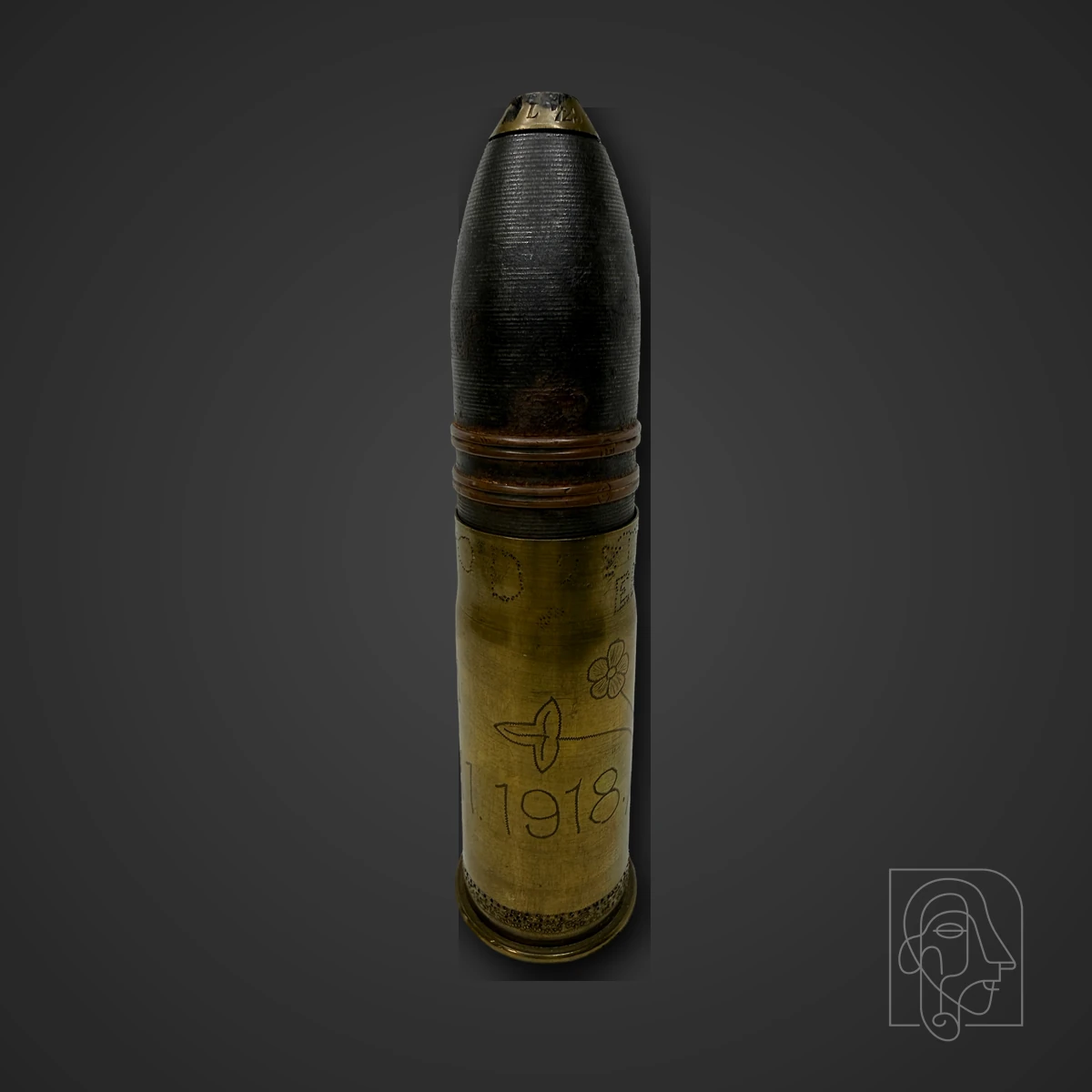
Extended description
WWI-era French 37 mm artillery cartridge/shell assembly converted into trench art, consisting of a brass cartridge case with seated dark oxidized steel/iron projectile and copper/brass driving bands. The object measures approximately 7 in. tall by 1.75 in. diameter and weighs 582 g. The brass case is decorated by hand with engraved and punched-dot ornament, including the large inscription “VERDUN,” “Nov.,” “1918,” floral elements, and a bird or butterfly-like motif. Additional hand-punched markings on the body appear to include “COD,” “2877,” “ENC,” and possibly terminal “HB,” with a separate lower punched inscription apparently reading “R.J.R.” The base headstamp includes apparent “37-85,” consistent with French 37 mm ordnance cases. The projectile nose and primer area appear open or empty from photographs, suggesting inert display conversion, though inert status has not been certified. The object is best described as a commemorative Verdun trench-art shell, probably produced during or shortly after World War I from French battlefield or surplus ordnance components.
Technical analysis
The artifact appears to use a French 37 mm brass cartridge case of the 37-85 / Hotchkiss or Model 1885 family, with a dark steel/iron projectile seated above the case and copper/brass driving bands visible around the projectile body. The “37-85” headstamp is interpreted as an ordnance/case-type marking rather than a personal identifier. The brass case shows hand-applied decorative work using engraving, scratching, and dotted punchwork. The upper body inscription is not mechanically stamped and appears to have been added as part of the trench-art personalization. The visible projectile corrosion, aged brass patina, irregular handwork, and survival of original base markings are consistent with WWI-period or near-period trench art. The apparent open nose and empty primer area support display/inert status visually, but no destructive or internal examination has been performed; live ordnance safety cannot be certified from photographs alone.
Authentication methodology
Authentication was conducted by visual typological comparison, inscription analysis, construction review, and contextual assessment from submitted photographs and measurements. The object was evaluated for consistency with known WWI French 37 mm ordnance forms, including brass case construction, projectile form, copper/brass driving bands, and base headstamp format. Decorative work was assessed for hand-executed punchwork, engraving irregularity, patina continuity, and consistency with WWI trench-art practices. The Verdun / Nov. / 1918 inscription was treated as a commemorative association rather than proof of battlefield recovery. The personal or coded inscriptions, including possible “COD 2877 ENC HB” and “R.J.R.,” were transcribed cautiously due to wear, curvature, and partial visibility. External search of plausible inscription strings produced no confirmed soldier or unit attribution. Overall authentication is visual and comparative, not forensic; no metallurgical testing, archival proof of individual ownership, or certified ordnance deactivation inspection has been completed.
Comparative works
Technical comparanda include documented French 37 mm Model 1885 / Hotchkiss-family cartridge cases in military museums such as the Australian War Memorial, together with institutional collections of First World War trench art in the Imperial War Museums and other military-history collections. Relevant comparisons are brass 37 mm cases retaining ordnance headstamps and later hand-worked examples bearing Western Front place names, dates, floral ornament, or personal initials. Such parallels support identification of the underlying ordnance and the broader trench-art category; they do not prove that JCA.2026.081 was recovered or decorated at Verdun.
Provenance
Ownership history before entry into JCA is presently undocumented. The case itself bears “VERDUN,” “Nov.,” and “1918,” along with smaller punched markings provisionally read as “COD,” “2877,” “ENC,” possibly “HB,” and “R.J.R.” These inscriptions are part of the object's historical evidence but do not identify a confirmed maker, owner, unit, or findspot. The Verdun inscription should therefore be described as commemorative or associative rather than archaeological provenance.
Historical context
“Trench art” is a broad modern term for objects made, altered, or decorated from military materials by soldiers, prisoners of war, civilians, craftspeople, and commercial workshops during and after conflict. Brass shell cases were especially common raw material during and after the First World War because they were durable, workable, and visually associated with military service. Place names such as Verdun could commemorate combat, travel, memory, or the postwar souvenir economy. The “Nov. 1918” inscription places the decoration conceptually in the Armistice period, but the exact date and location of conversion remain unknown. JCA.2026.081 is therefore best understood as an ordnance-derived commemorative object rather than direct proof of battlefield recovery.
Conservation history
No documented conservation history is known at intake. The object shows aged brass patina, scratches, oxidation, hand engraving, punched-dot decoration, and dark oxidation/corrosion on the projectile body. No active cleaning, polishing, coating, disassembly, or stabilization has been recorded. Recommended conservation approach is minimal intervention: avoid polishing the brass, removing patina, erasing penciled/scratched layout marks, or disturbing corrosion products unless active deterioration is identified by a conservator. Do not heat, drill, soak, mechanically clean, or attempt to disassemble the object. Because the artifact is ordnance-related, inert status should be confirmed by a qualified inert-ordnance specialist before any invasive conservation or display handling beyond normal static collection storage.
Bibliography
Imperial War Museums. “10 Pieces Of Trench Art From World War One.” Used for general definition and context of trench art as objects made from the debris and by-products of modern warfare. Imperial War Museums. “Trench Art.” Used for broader context on WWI trench art, later reworking of shell cases, and the continuing souvenir/artifact trade. Australian War Memorial. “37 mm Hotchkiss Cartridge Case.” Used as a technical comparative reference for French WWI 37 mm Hotchkiss cartridge cases. Pritzker Military Archives / OCLC ContentDM. “37 mm artillery shell with projectile, decorated.” Used as a close comparative example of a Verdun-decorated 37 mm shell with projectile. Antiqurio Military Antiques. “A Pair of WW1 French 37mm Brass Cartridge Case 37-85 PD.Ps.” Used as a market and headstamp comparison for French 37 mm 37-85 / PD.Ps cases. TJ’s Militaria. “French WW1 37x95 Shell Case for the French 37mm Model 1885 Cannon.” Used as a comparative reference for 37-85 / PD.Ps French 37 mm case identification. Internal JCA visual examination notes and submitted photographs for accession JCA.2026.081, June 2026.