U.S. 37 mm Verdun Trench-Art Shell — 81st Division — Scholarly Analysis
Extended scholarly study of "U.S. 37 mm Verdun Trench-Art Shell — 81st Division" (accession JCA.2026.084): material analysis, authentication methodology, comparative works, and bibliography.
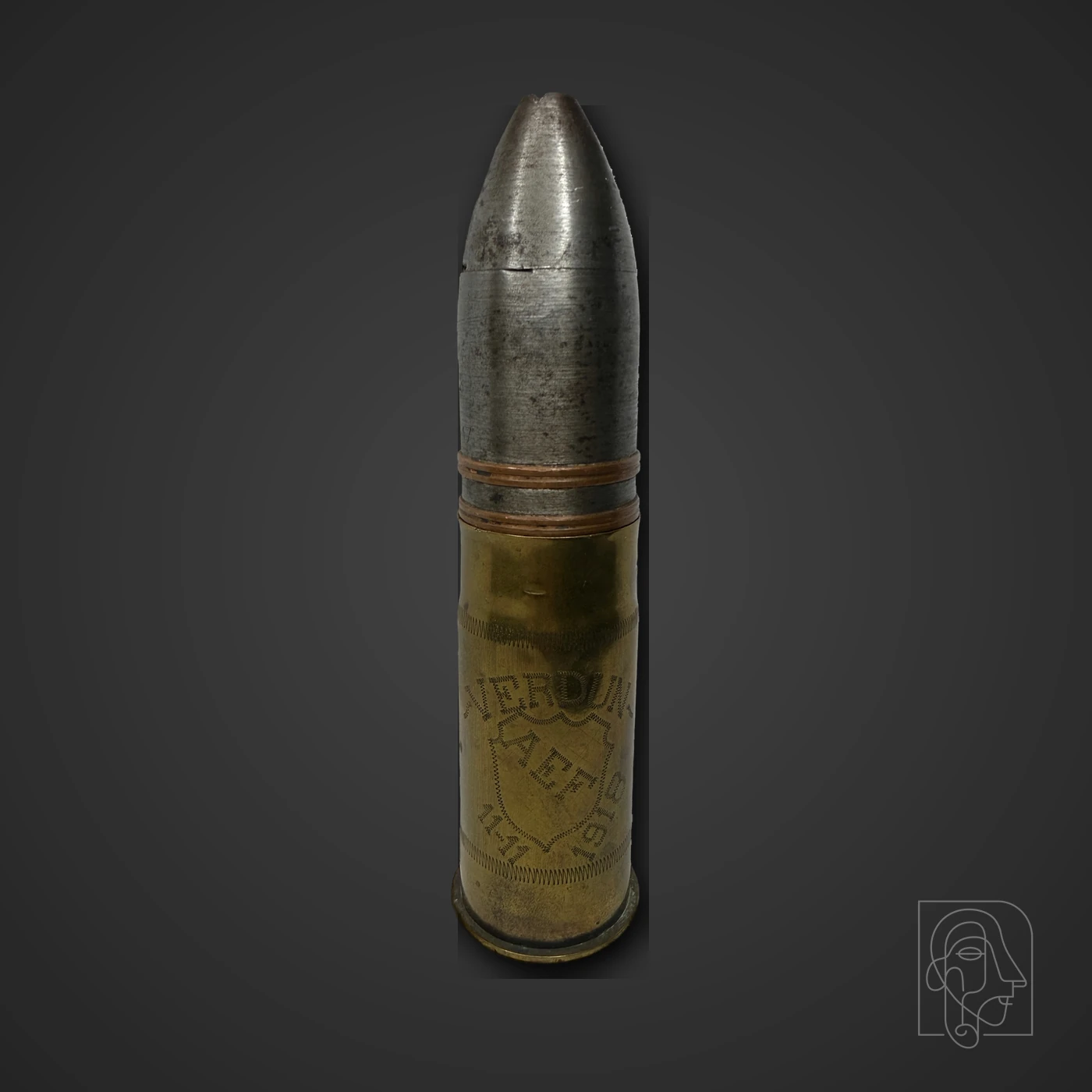
Extended description
U.S. First World War 37 mm Gun Model of 1916 cartridge case and projectile, later hand-engraved as American Expeditionary Forces trench art. The brass cartridge case is decorated with the inscription VERDUN, an AEF shield, the Armistice date 11-11 / 1918, and a wildcat emblem marked 81 with surrounding O-C-L lettering. These elements strongly associate the piece with the U.S. 81st Division, known as the “Wildcat Division.” The base markings identify the ordnance as a U.S. 37 mm Gun Model of 1916 case, probably manufactured by P.E.&M.Co. / Poole Engineering & Machine Company. The primer shows a visible firing-pin strike, indicating the case was likely fired/spent before decoration. The projectile remains seated, with dark oxidation and aged surface toning. The object measures approximately 7 in tall x 1.65 in diameter and weighs 612 g.
Technical analysis
The object consists of a brass 37 mm cartridge case with seated ferrous projectile and copper-alloy driving bands. The base is marked 37MM GUN, MODEL OF 1916, LOT 1075-27 or similar, and P.E.&M.CO. or similar, consistent with U.S. 37x92 mm ammunition for the 37 mm Gun Model of 1916. The primer appears struck, with a visible firing-pin impression, supporting identification as a fired or spent cartridge case. The hand engraving was executed after manufacture and likely after firing, using punched, incised, and stippled techniques typical of trench-art shell decoration. The decoration includes military-symbolic rather than factory-applied markings: VERDUN, AEF in shield, 11-11 / 1918, and a wildcat emblem with 81 and O-C-L letters. The O-C-L letters are most plausibly interpreted as initials for Obedience, Courage, Loyalty, associated with the 81st Division’s Wildcat symbolism. The object should remain classified as ordnance-related until projectile and inert status are verified by a qualified specialist.
Authentication methodology
Authentication was based on visual examination of supplied photographs, dimensional comparison, weight consistency, base/headstamp analysis, projectile and primer inspection from images, and contextual comparison with known U.S. WWI 37 mm Gun Model of 1916 examples. The official ordnance markings were separated from later hand-engraved trench-art elements. The case markings, caliber, dimensions, and construction support identification as an original U.S. WWI 37 mm cartridge case. The visible firing-pin strike supports the conclusion that the case was fired/spent before conversion or decoration. The engraved VERDUN, AEF, 81, wildcat emblem, O-C-L lettering, and 11-11 / 1918 form a coherent historical group consistent with an 81st “Wildcat” Division AEF commemorative object. Authentication is strongest at the level of original case and divisional association; no individual soldier, exact maker, or specific regiment is confirmed.
Comparative works
Comparative examples include published inert U.S. 37 mm Gun Model of 1916 rounds marked for P.E.M. Co. / Poole Engineering & Machine Company, including 37x92 mm examples with brass cases and seated projectiles of approximately similar size and weight. Additional comparative context comes from U.S. WWI trench-art shell cases decorated with battlefield names, dates, unit emblems, and AEF references. The engraved wildcat emblem and 81 marking compare closely with the recognized 81st Division “Wildcat” insignia tradition. The VERDUN and 11-11 / 1918 inscriptions align with American commemorative trench art associated with the final Meuse-Argonne / Verdun-sector operations and the Armistice.
Provenance
No documented chain of ownership, veteran attribution, battlefield recovery record, or family provenance was supplied with the object. Internal evidence provides the primary provenance indicators. The base markings identify the object as a U.S. WWI 37 mm Gun Model of 1916 cartridge case, probably associated with P.E.&M.Co. / Poole Engineering & Machine Company production. The hand-engraved VERDUN, AEF, 81, wildcat emblem, O-C-L lettering, and 11-11 / 1918 indicate a commemorative association with the U.S. 81st Division, American Expeditionary Forces, during or shortly after the closing phase of WWI. The object should be cataloged as having inscription-based association with the 81st “Wildcat” Division rather than documented veteran provenance.
Historical context
The 81st Division, American Expeditionary Forces, was known as the “Wildcat Division.” Its wildcat emblem became one of the earliest distinctive U.S. Army divisional shoulder insignia traditions. During the final phase of World War I, American forces operated in the Meuse-Argonne and Verdun sector, with the campaign ending at the Armistice on November 11, 1918. The inscriptions VERDUN and 11-11 / 1918 therefore point to a commemorative Armistice and Verdun-sector meaning rather than the earlier 1916 French Battle of Verdun. The object most likely commemorates the 81st Division’s service near Verdun during the closing days of the war. The engraving should be understood as trench-art or souvenir art: it strongly reflects unit memory and post-combat commemoration, but it does not prove that this exact shell was fired by the 81st Division or recovered from a specific battlefield position.
Conservation history
No prior conservation history is documented. The object shows aged brass patina, surface scratches, handling wear, dark oxidation to the projectile, minor dents, and accretions consistent with age and handling. The primer shows a visible firing-pin strike. No cleaning, stabilization, deactivation, or professional ordnance inspection documentation was supplied. Recommended conservation approach is preventive only: keep dry, avoid polishing or abrasive cleaning, avoid oiling or chemical treatment, and store in a stable low-humidity environment. Because the object is ordnance-related and the projectile remains seated, do not disassemble, heat, fuel, ignite, drill, or otherwise alter the object unless cleared by a qualified ordnance specialist.
Bibliography
National Archives. “The Meuse-Argonne Offensive.” National Archives and Records Administration. U.S. Army Center of Military History. Meuse-Argonne: 26 September–11 November 1918. U.S. Army Campaigns of World War I series. NCpedia. “Wildcat Division.” North Carolina Government & Heritage Library / NCpedia. U.S. Army Institute of Heraldry. “Shoulder Sleeve Insignia: 81st Division / 81st Readiness Division.” Ordnance.com. “37mm P.E.M. Co. Explosive Round With Mark 2 Projectile.” JC Militaria. “Artillery Ammunition 37 mm” listing describing 37MM GUN MODEL OF 1916 P.E.&M.CO marked case.