Dakakari Terracotta Sculpture of a Woman — Scholarly Analysis
Extended scholarly study of "Dakakari Terracotta Sculpture of a Woman" (accession JCA.2026.085): material analysis, authentication methodology, comparative works, and bibliography.
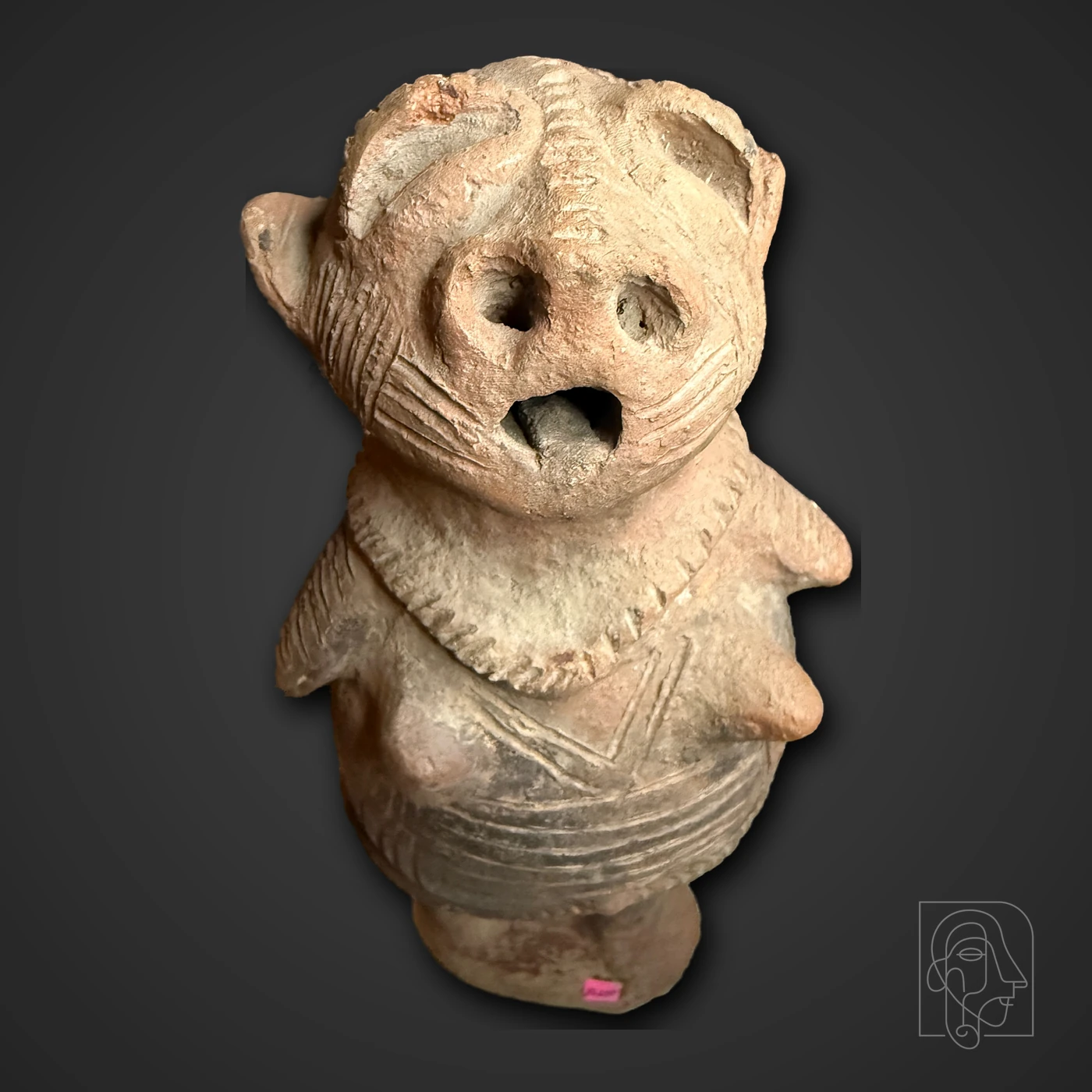
Extended description
Large hand-built Dakakari / Dakarkari terracotta female figure, attributed to northwest Nigeria, probably Zuru-region cultural context. The figure stands on an integral base with two elongated legs supporting a rounded, bulbous torso. The body is modeled with pronounced breasts, a clearly marked female genital cleft, short projecting arms, a heavy notched collar or necklace, and dense incised linear decoration across the torso. The head is comparatively small and animalized, with rounded ears, hollow eye apertures, a broad modeled facial plane, deep nostril-like openings, and an open circular mouth directed upward, giving the figure a chanting, mourning, or spirit-invocation quality. The surface is reddish-buff terracotta with grey-black staining, pale mineral-like accretions, granular clay exposure, abrasion, and minor losses. The incised decoration appears integral to the clay surface rather than recently engraved. A modern pink inventory sticker on the base reads “AB.239.” The object is a close visual and dimensional match to Barakat Gallery’s published Dakakari Terracotta Sculpture of a Woman, inventory PF.5139, listed as terracotta, 6.5 x 19 in, dated by the gallery to 1500–1800 CE.
Technical analysis
The object appears to be fired clay / terracotta with hand-built construction. Visual inspection indicates non-mechanical modeling, asymmetrical form, pressure-varied incised lines, irregularly formed facial apertures, granular ceramic texture, and deposits embedded into grooves, cavities, and surface depressions. The torso incisions show softened shoulders and inconsistent depth, suggesting they were made while the clay was workable or leather-hard rather than cut into a finished modern surface. The eye and mouth openings are rough and irregular internally, with darkened deposits visible inside the cavities. No obvious modern resin, plaster body, mold seam regularity, rotary-tool carving, glossy adhesive, or recent mechanical grinding is visible in the supplied photographs. The leg-to-base joins appear continuous from available views. Some exposed reddish clay on high points and chips may represent old abrasion, storage damage, or minor recent handling loss. The pale chalky accretions and grey-black staining are visually favorable but cannot independently prove age. Thermoluminescence testing is required to confirm the last firing date of the ceramic body.
Authentication methodology
Authentication assessment is based on visual examination of submitted photographs, dimensional comparison, stylistic analysis, surface-condition review, provenance review, and comparison with published Dakakari terracotta examples. The strongest comparative reference is Barakat Gallery PF.5139, which matches the object in type, dimensions, material, facial modeling, open mouth, incised torso patterning, breasts, collar, and genital marking. The object was also assessed against known Dakakari funerary sculpture conventions, including terracotta grave-associated figures from northwest Nigeria. Museum sources document Dakakari terracotta funerary sculptures as works traditionally placed on burial mounds of important deceased individuals, with human, animal, and equestrian subjects made by female artists. Visual evidence supports the object as a hand-built terracotta figure in the Dakakari / Dakarkari tradition. Authentication as a genuine 1500–1800 CE object remains provisional pending thermoluminescence testing, written Barakat Gallery confirmation, auction documentation, or earlier collection records.
Comparative works
Primary comparative work: Barakat Gallery, “Dakakari Terracotta Sculpture of a Woman,” inventory PF.5139, terracotta, 6.5 x 19 in, dated 1500–1800 CE by the gallery. The published Barakat object closely matches the present figure in measurements, material, open mouth, modeled nostril apertures, cheek scarification, heavy collar, protruding breasts, incised torso decoration, and delineated female genitalia. Institutional comparison: Saint Louis Art Museum, “Pair of Figures,” Dakakari peoples, northwest Nigeria. The museum identifies Dakakari funerary sculpture as a tradition produced for several centuries and placed on burial mounds of important deceased members of society. It further notes that human, animal, and equestrian figures were popular subjects and that the works were made by female artists. Additional comparative context: University of Miami Lowe Art Museum / eMuseum Dakakari figure entry notes that Dakakari tomb mounds could be marked with terracotta images for important individuals and that human figures associated with grave mounds were not necessarily portraits of the deceased, but could function as grave-related attendants or “sons of the grave.”
Provenance
Purchased at auction in Los Angeles, California. The auction was reported by the purchaser as offering artifacts from a storage unit associated with Fayez Barakat / Barakat Gallery. The object bears a modern pink sticker on the base reading “AB.239.” This sticker should be preserved as a possible auction, storage, gallery, or prior-inventory reference. The object closely corresponds to Barakat Gallery’s published Dakakari Terracotta Sculpture of a Woman, inventory PF.5139. The reported Los Angeles Barakat connection is plausible in general context because Barakat Gallery documents a long Los Angeles presence, including a West Hollywood / La Cienega showroom and over three decades in Los Angeles and the United States. However, the specific storage-unit provenance, AB.239 code, and connection between this physical object and PF.5139 require confirmation through auction paperwork, Barakat Gallery records, invoices, old labels, storage records, or written gallery correspondence.
Historical context
Dakakari / Dakarkari terracotta sculpture belongs to a northwest Nigerian funerary and commemorative ceramic tradition. Published museum context indicates that Dakakari terracotta works were traditionally placed on burial mounds of important deceased persons, including chiefs, leading warriors, and prominent farmers. Subjects included human figures, animals, and equestrian forms, and the sculptures were made by female artists. The present figure’s open mouth, hollow eyes, animalized facial features, prominent breasts, genital marking, collar, and incised body decoration are consistent with a ritual or grave-associated visual language rather than portrait naturalism. Saint Louis Art Museum describes certain female Dakakari figures as “pots of the grave” and notes that such figures may represent bush spirits accompanying the deceased in the afterlife. The University of Miami comparison further indicates that Dakakari human grave figures could serve as attendants or grave-related figures rather than literal portraits of the deceased.
Conservation history
No documented conservation history is currently known. Visual inspection from photographs shows surface abrasion, chips, pale accretions, grey-black staining, granular clay exposure, and minor losses around high points, apertures, collar, and base. No obvious modern adhesive, overpaint, resin fill, or structural restoration is visible in the supplied images, though this cannot be ruled out without in-person examination under magnification and ultraviolet light. Recommended handling: do not clean, wet, oil, seal, polish, consolidate, or repair without professional conservation review. Do not remove the AB.239 sticker. Lift only from the base and lower body; do not lift by the head, collar, arms, breasts, or legs. Store upright with padded support and low vibration. Keep away from excessive humidity, direct sunlight, and abrasive handling. Before any scientific sampling, photograph all sides, underside, interior apertures, and sticker area in high resolution.
Bibliography
Barakat Gallery. “African Art / Dakakari Terracotta Sculpture of a Woman, 1500 CE–1800 CE.” Inventory PF.5139. Terracotta, 6.5 x 19 in. Used as the primary published visual and dimensional comparison for the present object. Saint Louis Art Museum. “Pair of Figures.” Dakakari peoples, northwest Nigeria. Used for cultural and funerary context, including burial mound use, female makers, and “pots of the grave” interpretation. Lowe Art Museum / University of Miami eMuseum. “Figure.” Dakakari. Used for comparative context regarding Dakakari grave mounds, terracotta memorial figures, and the interpretation of human figures as grave-related attendants rather than portraits. Barakat Gallery. “Los Angeles.” Used for general context regarding Barakat Gallery’s Los Angeles presence and long-term operation in the United States.