Japanese Rising Sun Hachimaki with Hand-Applied 神風 Kamikaze Inscription — Scholarly Analysis
Extended scholarly study of "Japanese Rising Sun Hachimaki with Hand-Applied 神風 Kamikaze Inscription" (accession JCA.2026.086): material analysis, authentication methodology, comparative works, and bibliography.
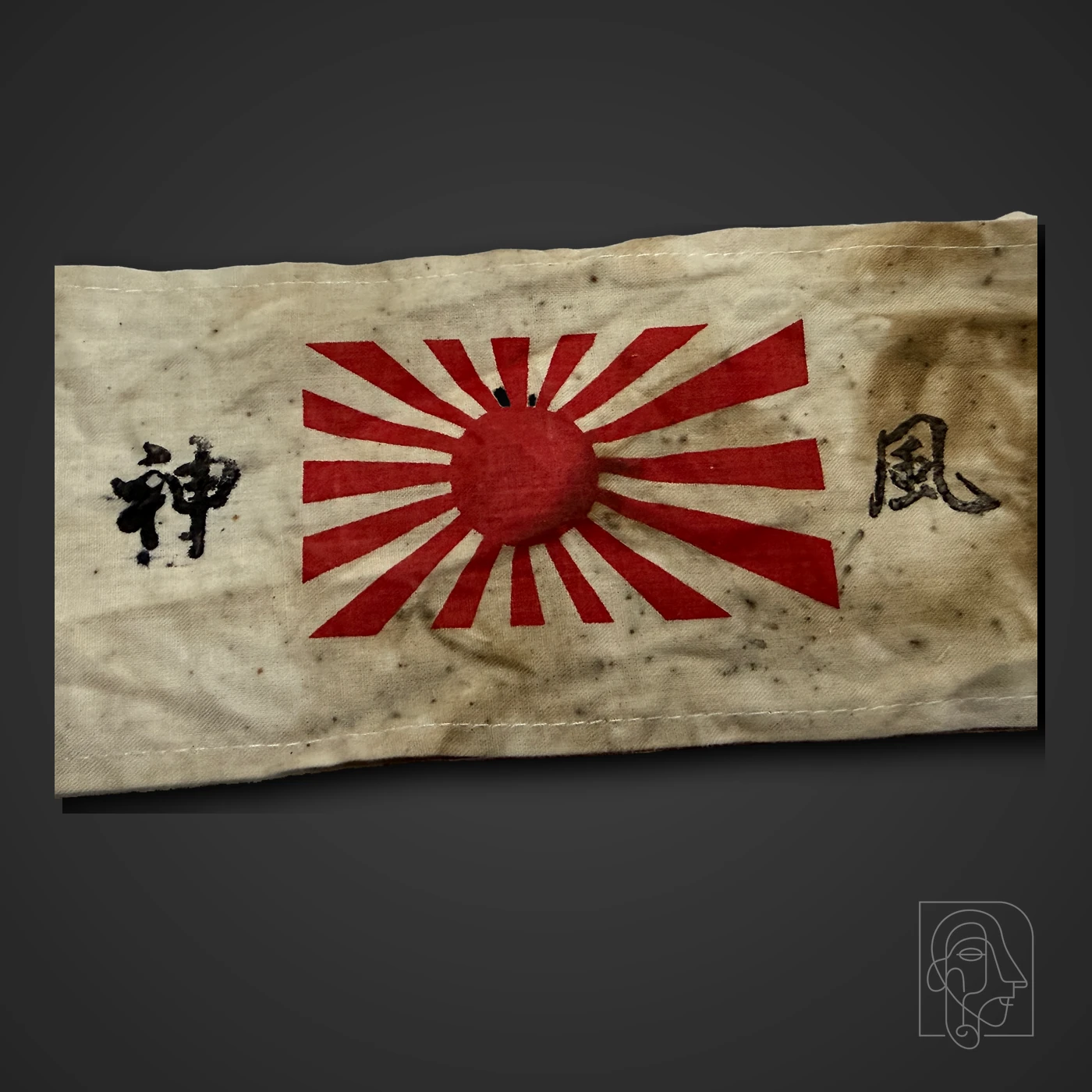
Extended description
Japanese hachimaki-style headband, recorded as 36 inches long by 4 inches wide and 13 g, of plain-woven natural-fiber textile, probably cotton. A red Rising Sun motif accompanies black 神風 characters, read kamikaze or shinpū, “divine wind.” The red medium appears mechanically applied and the black strokes separately brush-applied, with reverse penetration. Folded machine-stitched hems, staining, spotting, creasing and edge wear are recorded.
Imagery and construction support a wartime-style patriotic-headband comparison. Manufacture date and wearer are unconfirmed; postwar or later manufacture remains possible. No specific pilot or special-attack use is documented.
Technical analysis
The recorded textile is light and plain-woven, with natural-fiber appearance and folded machine-stitched hems. Cotton is a proposed material requiring confirmation. The red motif appears printed, stamped or stencil-applied; black 神風 strokes show variable density, yarn-following feathering and reverse penetration compatible with liquid application. These features describe technique and absorbency without independently distinguishing wartime from later application. Document staining, folds, grime, spotting and wear without assigning age from appearance alone. The owner's negative UV result does not date the cloth.
Authentication methodology
Evaluate fiber, weave, seams, red medium, black inscription, wear and associated documents separately. Preserve the owner-reported UV result as a screening observation, with method if available. Typological comparison can test compatibility with wartime-associated hachimaki but does not establish this specimen's manufacture date or use. Later manufacture remains possible. No current provenance links it to a named serviceman, special-attack unit, aircraft, ship or dated wartime photograph.
Comparative works
Comparable objects include Japanese “Kami Kaze” or kamikaze-associated headbands held or described in public museum and auction records. Imperial War Museums records Japanese headbands associated with the Second World War, including examples cataloged as souvenirs and ephemera with Japanese characters and textile construction. Bonhams has described a 1944–45 Japanese kamikaze hachimaki measuring 33 in long, bearing a red disc and characters translated as “divine wind.” The present object differs from some comparables by having a full Rising Sun motif with radiating rays rather than only a red disc. Its 36 in length is within the broader range expected for wearable hachimaki-style textiles. The combination of a printed or stencil-applied red emblem with separately hand-applied black kanji is plausible for wartime or wartime-style production. The closest comparison is to WWII-associated hachimaki bearing 神風 or translated “divine wind” inscriptions. However, without provenance, comparison can support typological plausibility but cannot establish individual wartime use.
Provenance
No documented provenance is currently available. Prior ownership history, acquisition source, veteran bring-back association, military unit connection, and original owner are not presently recorded. The object should therefore be treated as an unprovenanced but materially plausible WWII-era Japanese patriotic or military textile. Future provenance research should prioritize auction records, estate documentation, family history, veteran bring-back groupings, period photographs, storage materials, accompanying labels, and any prior collector notes. Until such documentation is found, the object should not be represented as having confirmed battlefield, pilot, or Special Attack Corps provenance.
Historical context
Hachimaki occur in military and civilian contexts. The 神風 inscription and Rising Sun imagery have wartime patriotic associations and provide a framework for comparison. The symbolic association does not establish that this specimen was manufactured during the Second World War or used by a special-attack participant. Study the textile's physical and ownership history independently of its imagery; later wartime-style manufacture remains possible.
Conservation history
No prior conservation treatment is documented. The object appears untreated in the available images. No cleaning, washing, pressing, stain removal, repair, or stabilization has been reported. Recommended conservation measures: store flat or gently rolled with acid-free tissue support; avoid folding along existing stressed creases; maintain stable temperature and relative humidity; keep away from direct sunlight and prolonged UV exposure; handle only with clean dry hands or nitrile gloves; avoid washing, steaming, ironing, stain removal, adhesive repair, or chemical testing without a textile conservator. Condition should be monitored for active mold, fiber embrittlement, insect activity, seam failure, pigment powdering, or additional staining. The existing grime, staining, foxing, and discoloration are part of the object’s evidentiary surface and should be preserved unless a conservator determines that active biological deterioration is present.
Bibliography
Imperial War Museums. “Headband, Japanese, Kami Kaze, ‘Rising Sun.’” IWM Collections, catalogue no. EPH 9896. Imperial War Museums. “Headband, Japanese, Kami Kaze.” IWM Collections, catalogue no. EPH 7044. Imperial War Museums. “How Effective Was the Japanese Kamikaze Campaign?” IWM historical essay. Bonhams. “A Japanese Kamikaze Headband or Hachimaki, 1944–45.” Auction lot record, 33 in / 84 cm long. Ministry of Foreign Affairs of Japan. “Rising Sun Flag.” Government of Japan explanatory page. Joshua Cabinet of Antiquities. Object examination photographs and owner-supplied measurements for JCA.2026.086.