U.S.E.D. Creagh-Osborne Marching Compass, Mark VII Mod. D — Scholarly Analysis
Extended scholarly study of "U.S.E.D. Creagh-Osborne Marching Compass, Mark VII Mod. D" (accession JCA.2026.087): material analysis, authentication methodology, comparative works, and bibliography.
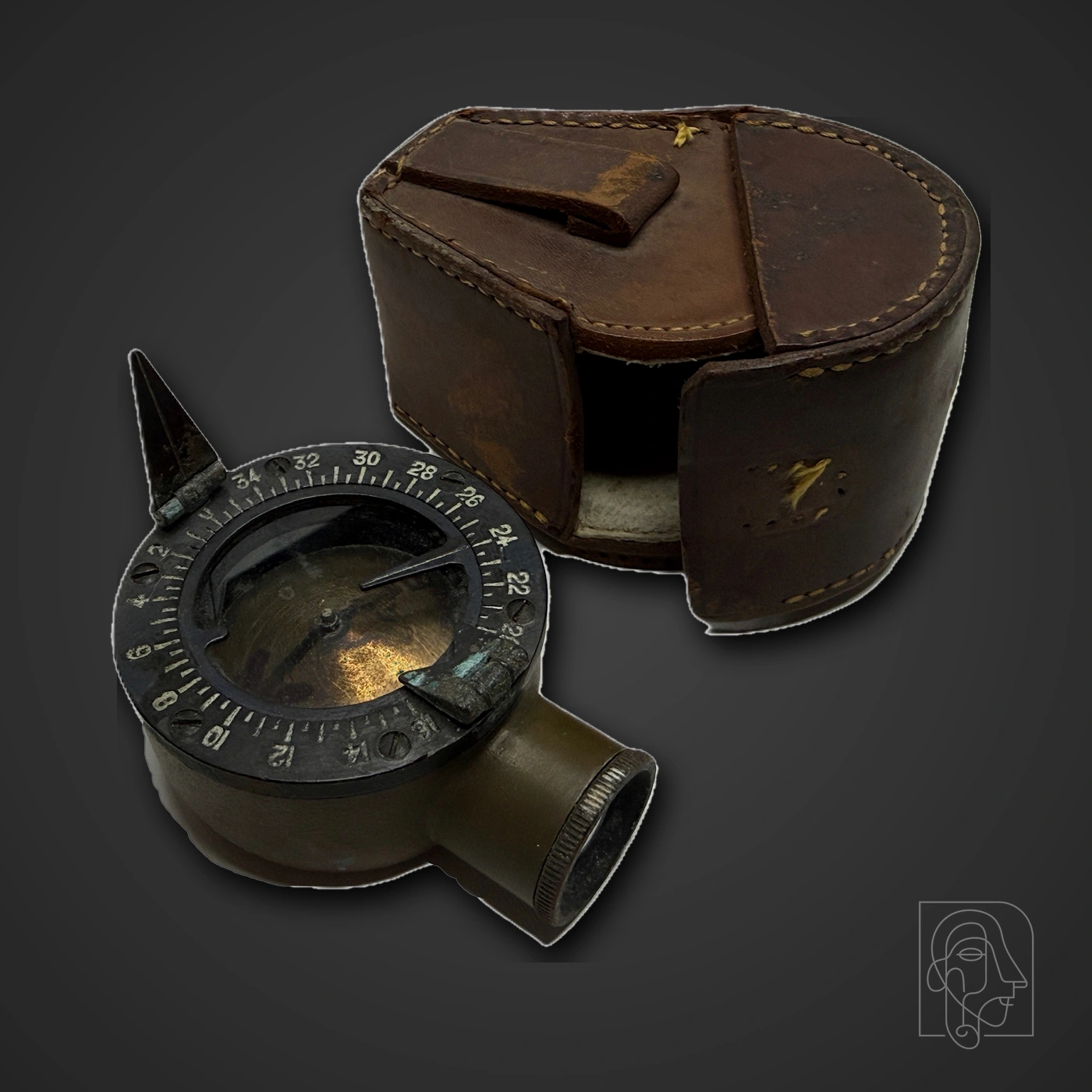
Extended description
Compact U.S. military marching compass of the Creagh-Osborne type, Mark VII Mod. D, manufactured by Sperry Gyroscope Co. of Brooklyn, New York. The instrument consists of a cylindrical brass or copper-alloy body with a blackened rotating degree ring, glass or crystal-covered compass chamber, folding triangular sight, opposite folding sight marked U.S.E.D., and a lens or viewing tube projecting from the body. The base is stamped CREAGH-OSBORNE MARCHING COMPASS MARK VII MOD. D SPERRY GYROSCOPE CO BROOKLYN N.Y. and bears serial number 17517. The compass retains its original or period leather carrying case. The case is formed in brown leather with stitched edges, shaped compartments, and a flap-like construction intended to protect the instrument during transport. Both compass and case show field-use and storage wear, including darkened patina, oxidation, verdigris, finish loss, scratches, scuffing, leather deformation, and surface losses. The compass measures approximately 2.5 in in diameter and 1.25 in high, rising to approximately 2.5 in when the folding sighting point is lifted. Weight is approximately 195 g. The form, markings, and construction are consistent with a World War I-era Creagh-Osborne military marching compass used for field bearings, marching direction, and sight alignment.
Technical analysis
The body appears to be brass or copper alloy with a darkened military finish. Areas of finish loss expose warmer brass-colored metal beneath, particularly on edges and high-contact areas. Green-blue corrosion around hinge assemblies and sight components is consistent with copper-alloy oxidation and long-term storage in contact with moisture or leather acids. The upper ring is marked with white-filled numerical graduations and tick marks. The compass includes folding rifle-type sights: one triangular sight and one opposite sight stamped U.S.E.D. These sights are designed to be raised for alignment with a landmark or marching direction. The projecting tube or lens housing at the side is consistent with Creagh-Osborne-type sighting and reading arrangements. The crystal or glass appears intact but scratched or clouded. The internal compass element and fluid condition have not been confirmed. Function should be tested only gently: the card or needle should be observed for free movement, sticking, leakage, bubble formation, or corrosion without disassembly. The painted numerals and graduations should be considered potentially radium-luminous until tested. Related Creagh-Osborne compass patents and early military compass examples used luminous radium paint for night-readable markings. No scraping, polishing, brushing, or abrasive cleaning should be performed.
Authentication methodology
Authentication was conducted through visual examination of supplied photographs, dimensional review, inscription and maker-mark analysis, construction assessment, patina evaluation, and comparison with documented Creagh-Osborne marching compasses in museum and militaria records. The principal authentication indicators are the stamped base inscription, model designation, maker name, Brooklyn manufacture location, serial number, U.S.E.D. marking, correct folding sight configuration, brass or copper-alloy body, blackened graduated ring, leather carrying case, and age-consistent corrosion and wear. The U.S.E.D. mark corresponds to the United States Engineer Department, also associated with the U.S. Army Corps of Engineers. The Mark VII Mod. D designation is consistent with documented World War I-era examples manufactured by Sperry Gyroscope Co. No immediate visual evidence suggests modern reproduction. The engraving, stamped lettering, patina, and case wear are consistent with an authentic early 20th-century military compass. Authentication remains provisional only because functional condition, internal originality, fluid status, and possible luminous paint composition have not yet been tested.
Comparative works
Comparable examples include Creagh-Osborne Mark VII marching compasses in institutional and militaria records. The Smithsonian National Museum of American History records a Creagh-Osborne marching compass marked U.S.E.D. and manufactured by Sperry Gyroscope Co. of Brooklyn, New York, identifying U.S.E.D. as the United States Engineer Department. The Pritzker Military Museum records similar U.S.E.D. examples as World War I handheld compasses used by U.S. Engineer Department personnel. A documented Mark VII Mod. D example with original packing label identifies the type as a Creagh-Osborne Marching Compass manufactured by Sperry Gyroscope Co. and tested/packed in April 1918. This supports the dating of the present object to the 1917-1918 wartime production period. The present compass compares closely with these examples in maker, model, construction, sighting arrangement, leather case form, and military department marking. The present object differs primarily in condition, with notable oxidation, verdigris, leather wear, and unknown functional status.
Provenance
No documented provenance is currently available. Prior ownership, acquisition chain, military issue history, field-use history, and original user are not presently recorded. The object should therefore be cataloged as an authentic or likely authentic U.S. military marching compass of World War I date, but not assigned to a specific soldier, engineer unit, campaign, or battlefield context without further documentation. Future provenance research should prioritize any estate records, collector notes, auction descriptions, case labels, inscriptions, unit markings, service-number associations, or associated groupings that may have accompanied the compass. The serial number 17517 should be retained as a research point for comparison against surviving Sperry production or packing records, if such records can be located.
Historical context
The Creagh-Osborne marching compass was developed from the work of Frank Osborne Creagh-Osborne, a British compass specialist associated with the Royal Navy. The type was introduced during the First World War and adapted for field navigation. In American service, examples marked U.S.E.D. were associated with the United States Engineer Department, whose personnel required reliable instruments for route finding, surveying support, battlefield engineering, map work, and bearing determination. The compass represents a transitional period in military navigation equipment: it combines durable brass construction, folding sighting elements, a graduated ring, and compact portability. Such instruments allowed field personnel to take bearings, align on landmarks, and maintain a marching course under campaign conditions. The present example also reflects the broader technological environment of World War I, when precision instrument makers such as Sperry Gyroscope Co. produced navigational and military devices for expanding American wartime needs. Its leather case indicates intended field portability and protection rather than desk or civilian survey use.
Conservation history
No conservation treatment is documented. The compass and leather case appear untreated in the supplied images. Recommended conservation measures: do not polish or mechanically clean the brass; do not remove verdigris without conservator review; do not oil the compass mechanism; do not disassemble the instrument; do not scrape or abrade painted markings; and do not apply leather dressings to the case without textile/leather conservation guidance. Because the numerals and graduations may contain radium-luminous paint, the object should be surveyed with a Geiger counter before routine storage or display. If elevated radiation is detected, store in a labeled container away from prolonged human occupancy areas, avoid opening the compass unnecessarily, and prevent dust release. If the glass or paint is unstable, consult a conservator familiar with radioluminescent military instruments. The leather case should be stored separately or with an inert barrier if it is contributing to copper-alloy corrosion. Maintain stable humidity and avoid damp environments, which may accelerate verdigris and leather deterioration.
Bibliography
Smithsonian National Museum of American History. “Marching Compass.” Collection record for Creagh-Osborne U.S.E.D. marching compass by Sperry Gyroscope Co. Pritzker Military Museum & Library. “Creagh-Osborne Marching Compass.” Digital collection record. Horse Soldier. “World War One Marching Compass with Original Label.” Dealer/archive record describing Mark VII Mod. D Sperry Gyroscope Co. example tested and packed April 29, 1918. Smithsonian National Air and Space Museum. “Compass, Creagh-Osborne.” Collection records for related Creagh-Osborne compass types with documented material listings including radium paint. Google Patents. “Improvements in and connected with Magnetic Compasses,” GB191501148A, relating to Creagh-Osborne compass construction and luminous radium-painted markings. Joshua Cabinet of Antiquities. Object examination photographs and owner-supplied measurements for JCA.2026.087.