Japanese Wakizashi with Provisional Kanemoto Signature Reading — Scholarly Analysis
Extended scholarly study of "Japanese Wakizashi with Provisional Kanemoto Signature Reading" (accession JCA.2026.101): material analysis, authentication methodology, comparative works, and bibliography.
Extended description
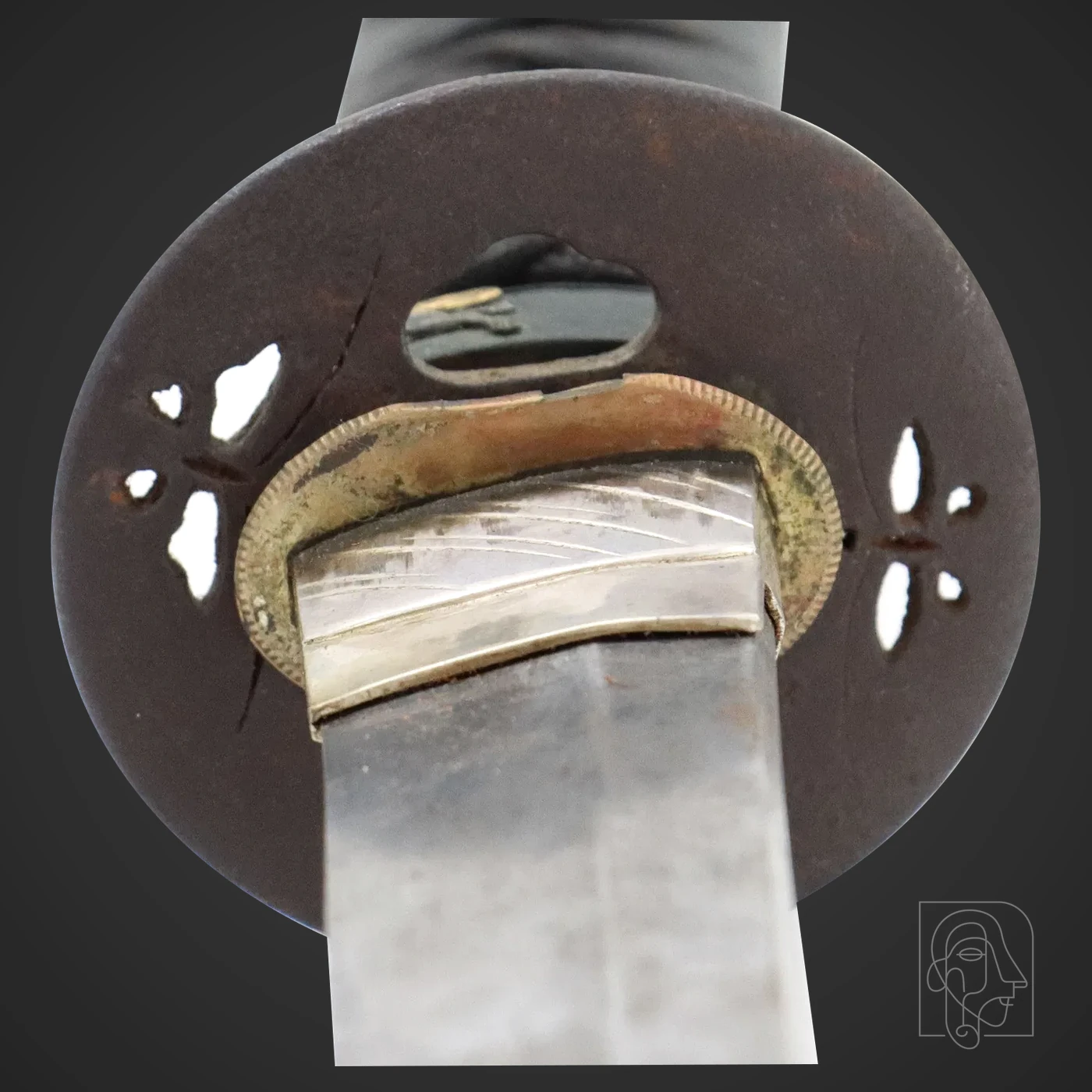
Japanese wakizashi in civilian koshirae, with a shinogi-zukuri blade measuring approximately 39 cm / 15.5 in. in nagasa. The blade has moderate torii-zori curvature, substantial but balanced kasane, and pronounced taper from base to tip. Recorded measurements include motohaba 27.77 mm, sakihaba 16.33 mm, motokasane 7.0 mm, and sakikasane 5.6 mm. The blade is preserved in an older polish with visible surface haze, scratches, staining, and light oxidation. Despite the tired polish, the hardened edge remains visible and appears consistent with a pointed sanbonsugi hamon with a bright nioiguchi. The hada and boshi are not sufficiently clear for final kantei-level assessment. The tang is deeply patinated and bears one mekugi-ana. A corroded two-character niji-mei is provisionally interpreted as 兼元 (Kanemoto) following in-hand examination under raking light. Because the inscription is partially obscured by corrosion, the reading remains provisional pending comparison with authenticated oshigata and formal shinsa. The sword is mounted in civilian koshirae with black leather or lacquered-leather wrap over samegawa panels, horse-themed soft-metal fuchi-kashira, likely equestrian menuki, and an iron sukashi tsuba. The mounting appears to be a traditional civilian assembly rather than a twentieth-century military mounting.
Technical analysis
The blade presents a balanced shinogi-zukuri wakizashi form with moderate torii-zori and measurable distal taper. The width decreases from 27.77 mm at the base to 16.33 mm toward the tip, representing approximately 41% width taper. Thickness decreases from 7.0 mm at the machi to 5.6 mm near the yokote, representing approximately 20% thickness taper. This geometry suggests a robust but properly shaped blade rather than an excessively thick or poorly proportioned example. The visible hamon appears to consist of grouped pointed gunome formations, with recurring taller peaks suggestive of sanbonsugi. The nioiguchi remains bright where visible, supporting the interpretation of genuine differential hardening. The current polish limits visibility of finer activities such as ashi, yo, sunagashi, kinsuji, utsuri, and detailed jihada structure. The nakago shows mature dark brown to black patination with corrosion and one mekugi-ana. The patina extends into the aperture and appears consistent with age, though patina alone cannot provide a precise date. Yasurime are heavily obscured and are not presently reliable for school attribution. The most diagnostic technical feature currently visible is the apparent sanbonsugi hamon. In combination with the provisional 兼元 mei, this supports a working attribution to the Kanemoto tradition of Mino Province / Sue-Seki workmanship. This remains a provisional technical assessment rather than a final authentication.
Authentication methodology
The authentication approach follows standard nihonto kantei logic: workmanship is assessed before accepting the inscription. The mei is treated as evidence, but not as proof. The current assessment considers the following evidence categories: 1. Sugata and geometry: shinogi-zukuri wakizashi form, moderate torii-zori, and healthy taper. 2. Hamon: visible hardened edge appearing consistent with pointed sanbonsugi. 3. Nioiguchi: bright boundary line where visible, supporting genuine differential hardening. 4. Nakago: mature patinated tang with one mekugi-ana. 5. Mei: corroded niji-mei provisionally read as 兼元 under raking light. 6. Mounting: civilian koshirae with older fittings, not military gunto mounts. The proposed reading of 兼元 is internally consistent with the apparent sanbonsugi hamon, since sanbonsugi is strongly associated with the Kanemoto school of Mino. However, the Kanemoto name is historically one of the most frequently forged signatures in Japanese swords. Therefore, the present record does not accept the mei as shoshin. Current authentication status: traditionally made Japanese wakizashi, likely pre-Meiji, with workmanship consistent with the Kanemoto / Sue-Seki Mino tradition. Mei authenticity, specific generation, and shoshin-versus-gimei status remain unresolved pending authenticated oshigata comparison and NBTHK or NTHK shinsa.
Comparative works
The principal comparison group is the Kanemoto lineage of Mino Province, especially later Sue-Seki and subsequent Kanemoto-school work characterized by sanbonsugi hamon. The second-generation Magoroku Kanemoto is historically associated with the development and prestige of sanbonsugi, but this blade is not presently attributed to Magoroku himself. Later Kanemoto generations and related Sue-Seki smiths provide a more appropriate comparison group. The visible hamon appears more consistent with the Kanemoto-school idiom than with the earlier photographic hypothesis of Bungo/Takada workmanship. Other Mino lineages, including Kanesada and related Kane-lineage smiths, remain possible comparative references, but the apparent grouped pointed sanbonsugi favors Kanemoto as the leading working hypothesis. Future comparison should include authenticated oshigata of multiple Kanemoto generations, NBTHK-papered Sue-Seki blades, and published examples showing sanbonsugi variation between earlier irregular forms and later more regularized patterns. The mei should be compared stroke-by-stroke against authenticated examples before any stronger attribution is made. The horse-themed fuchi-kashira and likely associated menuki should be compared separately against Edo-period machibori soft-metal fittings, especially examples using equestrian subjects, nanako ground, takabori relief, and iroe surface treatment.
Provenance
Current provenance is owner-held / JCA Archives study collection. Provenance prior to current ownership is not documented. No export papers, collection labels, dealer invoice, surrender document, family history, or earlier publication record has yet been recorded. The sword should therefore be cataloged as an object with undocumented prior provenance. The absence of early provenance does not determine authenticity, but it limits historical reconstruction and market confidence. Future provenance research should seek prior sale records, family ownership history, old photographs, Japanese registration papers if any exist, dealer records, and any documentation associated with acquisition. The current JCA record preserves the known state of research as of cataloging and should be updated if new provenance evidence becomes available.
Historical context
The proposed 兼元 reading places the sword within the broad historical context of Mino Province sword production, especially the Sue-Seki tradition. Mino was one of the major sword-producing regions of late medieval Japan, known for practical, durable blades and for smith lineages whose work circulated widely. The Kanemoto name is particularly significant because of its association with sanbonsugi, a grouped “three cedar” style hamon composed of pointed peaks. This hamon became one of the most recognizable features associated with the Kanemoto school. Because of the prestige of the name, however, 兼元 is also a frequently forged signature. The blade’s apparent sanbonsugi hamon and provisional 兼元 mei make it a valuable study object even before formal authentication. It illustrates the relationship between mei, workmanship, school tradition, gimei risk, and shinsa methodology. The object also preserves a meaningful civilian mounting with equestrian-themed fittings, reflecting the continued cultural and martial symbolism of the horse in Japanese sword furniture. For catalog purposes, the object should be presented as a research-stage Japanese wakizashi with a provisional Kanemoto-school attribution, not as an authenticated Kanemoto blade.
Conservation history
No formal conservation treatment history is currently documented. The blade remains in an older polish with visible scratches, haze, staining, and light oxidation. The hamon remains visible, but fine metallurgical features are partly obscured. The nakago retains mature patina and corrosion. This patina is historically significant and must not be cleaned, scraped, wire-brushed, chemically treated, polished, or oiled. The koshirae shows age-related wear, including compression and wear to the leather or lacquered-leather wrap. The tsuka core has not been structurally examined and should not be stressed. The sword should not be swung, used for cutting, or handled as a functional weapon. Recommended conservation approach: minimum intervention. Oil only the polished blade surface lightly with appropriate sword oil or refined mineral oil. Do not oil the tang. Store in a stable indoor environment, avoid damp conditions, avoid rapid humidity swings, and limit handling. Professional polish should be considered only after in-hand review by a qualified nihonto specialist or togishi. Any decision to polish should weigh potential improvement in authentication visibility against irreversible steel removal.
Bibliography
NBTHK-AB2. “Shinsa Standards.” NBTHK American Branch. Consulted for general context on Hozon criteria, horyu / reserved judgment, and tosogu / koshirae review standards. NIHONTO.com. “Magoroku Kanemoto 孫六兼元.” Consulted for contextual information on Magoroku Kanemoto, sanbonsugi, and later Kanemoto-school characteristics. Nihonto Kikou. “Magoroku Kanemoto.” Consulted for contextual information on the Kanemoto lineage, Mino / Seki production, and generational continuation. Unique Japan. “Kanemoto / Magoroku Katana.” Consulted for comparative discussion of sanbonsugi, boshi differences, and Kanemoto-school characteristics. Nihontocraft. “Sue-Mino Kanemoto Katana, NBTHK.” Consulted as a comparative example of later Kanemoto-school workmanship, nioi-deki sanbonsugi, and bright nioiguchi. JCA Archives. “Preliminary Nihonto Object Study: Japanese Wakizashi with Niji-Mei Reading 兼元 (Kanemoto), Sanbonsugi Hamon, and Horse-Themed Koshirae.” Internal draft report, 2026. Recommended future references for expansion: Nihontō Kōza; Fujishiro; Token Bijutsu; NBTHK published oshigata; specialist references on Sue-Seki Mino workmanship; and published studies of Edo-period tosogu with equestrian motifs.