Imperial Japanese Army M1938 / Type 98 Field Cap (Ryakubō) — Scholarly Analysis
Extended scholarly study of "Imperial Japanese Army M1938 / Type 98 Field Cap (Ryakubō)" (accession JCA.2026.105): material analysis, authentication methodology, comparative works, and bibliography.
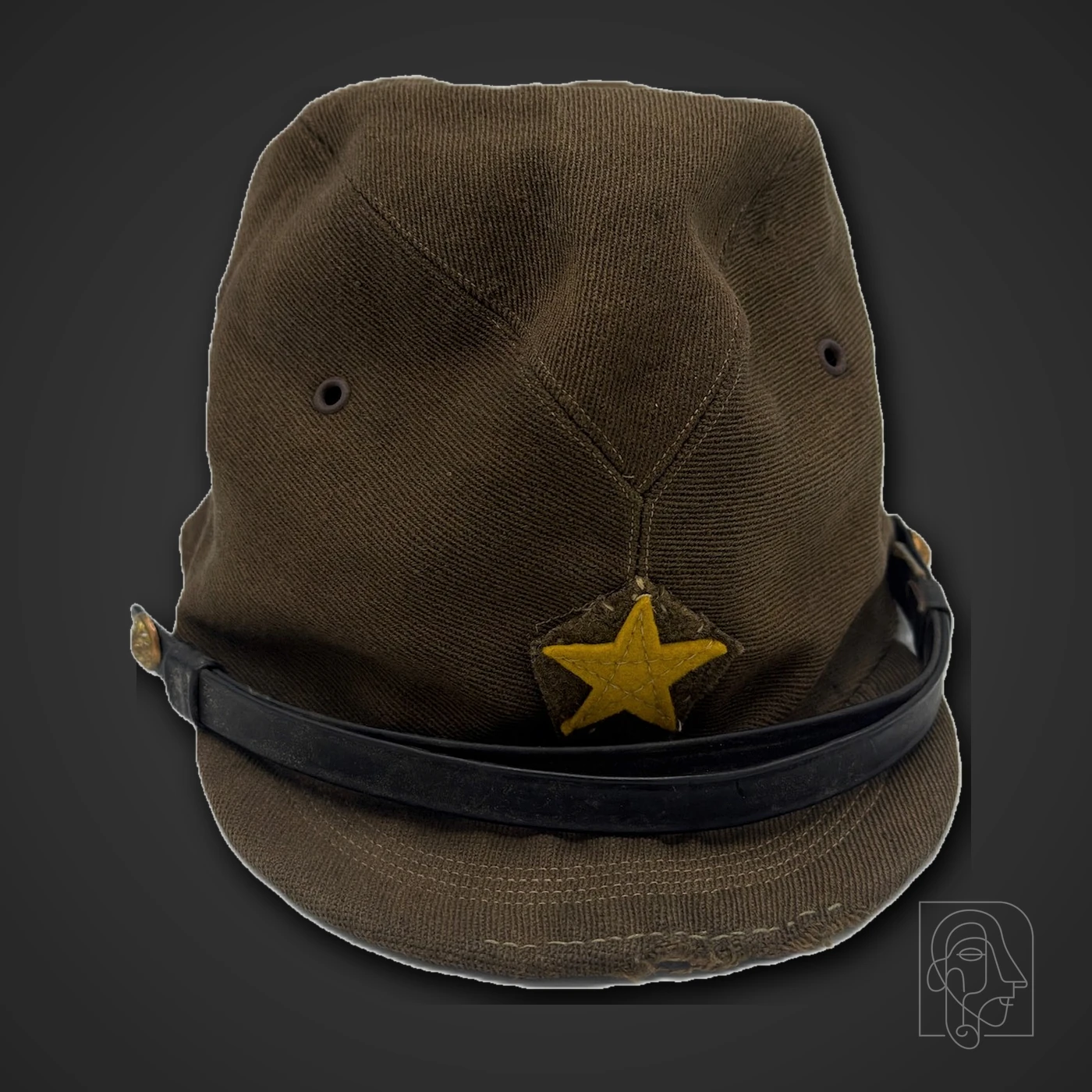
Extended description
JCA.2026.105 is an olive-brown wool field cap associated with the Imperial Japanese Army’s M1938 or Type 98 uniform system. The cap is constructed with a soft, close-fitting panelled crown, a short textile-covered visor reinforced by multiple concentric rows of machine stitching, three ventilation eyelets on each side, and a rear adjustment opening fitted with six metal eyelets. A dark leather chinstrap passes across the front and is secured at either side by gilt-brass buttons embossed with a five-petalled cherry-blossom design. The front bears a yellow five-pointed wool or felt Army star mounted on an olive pentagonal textile backing. Examination reveals remnants of a relatively regular original attachment together with a second generation of coarse, irregular hand stitching crossing the star. This later stitching is interpreted as reinforcement added after deterioration of the earlier attachment. The original rear adjustment lace is no longer present. It was replaced with a reddish-orange braided textile cord that displays advanced fibre breakdown, localized compression, abrasion at the eyelets, differential fading, and extensively frayed ends. The replacement appears to have remained installed for a prolonged period and is considered a significant service-life or early post-service alteration. The cap remains complete and structurally coherent despite extensive wear. Its utilitarian internal finishing, exposed seam allowances, absence of a luxury lining, and overall construction favor classification as a service-grade field cap. The wearer’s rank, unit, and identity remain unknown.
Technical analysis
The crown is assembled from multiple shaped wool panels joined by machine-sewn seams. Interior seam allowances remain visible and are finished in a practical, economical manner consistent with mass-produced field equipment. No modern fusible interfacing, synthetic foam, plastic reinforcement, or adhesive construction was observed in the photographed areas. The visor consists of layered textile construction reinforced by several parallel rows of machine stitching. Wear is concentrated along its outer edge, where the covering has progressively abraded through and exposed underlying layers and broken sewing threads. The softened, discolored fibre ends and gradual failure of successive layers are consistent with repeated handling, flexural fatigue, and prolonged use rather than a recent cut or superficial artificial distressing. The ventilation eyelets are darkened and oxidized, with compression and abrasion of the immediately surrounding wool. Their integration with the textile indicates longstanding installation. The gilt-brass chinstrap buttons are thin, pressed fittings secured by paired flat tangs. The tangs exhibit established bends, oxidation, and surrounding textile compression, without evidence of recent screw fittings, replacement rivets, adhesives, or newly opened attachment holes. The leather chinstrap shows surface cracking, abrasion, ingrained deposits, finish loss, and a permanent curved set. The front insignia displays two stitching phases: a finer, more regular primary attachment and a coarse secondary reinforcement. The rear replacement cord has a braided outer structure and pale fibrous core, with deformation precisely corresponding to its passage through the eyelets. Reported dimensions conform to comparable M1938-pattern field caps, although exact numerical measurements have not yet been entered into the catalog record.
Authentication methodology
Authentication was undertaken through non-destructive visual and comparative examination. The assessment considered overall typology, crown geometry, visor construction, seam organization, ventilation arrangement, insignia form, chinstrap configuration, metal fittings, internal finishing, dimensions, material deterioration, and the mechanical distribution of wear. The object was evaluated against three principal alternatives: an authentic wartime cap retaining service-life alterations; an authentic period cap assembled from unrelated period components; and a modern reproduction subjected to artificial ageing. Particular attention was given to whether deterioration was integrated through the object’s construction or merely applied to exposed surfaces. The wear was found to be mechanically coherent. Visor-edge failure progresses through successive textile layers; leather deterioration follows flexed and handled areas; cord compression corresponds with eyelet contact; metal oxidation is integrated with adjacent textile; and the button tangs appear to have remained bent in position for an extended period. The star retains evidence of an earlier regular attachment beneath later reinforcement, reducing the probability that the insignia was recently added to create a military appearance. Ultraviolet examination produced no visible optical-brightener fluorescence in the tested cord and textile areas. This result is consistent with older natural-fibre materials and weakens, but does not independently eliminate, the possibility of later replacement. No persuasive modern reproduction indicators were identified. The object is therefore authenticated with high confidence as an Imperial Japanese Army M1938/Type 98 field cap dating approximately 1938–1945. The rear lace and star reinforcement are considered longstanding utilitarian alterations. The conclusion remains non-destructive and observational; no fibre microscopy, dye analysis, radiography, elemental analysis, or laboratory dating was performed.
Comparative works
The primary institutional comparison is the Imperial War Museums object “Cap, M1938 Field Cap (with neck curtain): Japanese,” catalogue number UNI 8110. The museum classifies that object as an Imperial Japanese Army field cap associated with the Second World War and records textile and leather among its materials. This comparison supports the general identification, period attribution, and material category of JCA.2026.105, although it does not independently authenticate the present object. A contemporary documentary comparison is provided by the United States War Department’s TM-E 30-480, Handbook on Japanese Military Forces, dated 1 October 1944. Chapter XI describes two regular Japanese uniform systems used in temperate regions: the Model 90 of 1930 and Model 98 of 1938. It describes the field cap as olive-drab wool, generally shaped to the head, with a narrow visor of matching material, a brown leather chinstrap, and a star positioned on the vertical front seam. These characteristics correspond closely with JCA.2026.105. Additional comparative references include Mike Hewitt’s Uniforms and Equipment of the Imperial Japanese Army in World War II, a 288-page illustrated monograph covering Japanese Army uniforms and equipment, and Ritta Nakanishi’s Nihon no Gunsō: 1930–1945, a Japanese-language reference devoted to Japanese military dress of the period. The present cap differs from an untouched regulation example through its reddish replacement lace, heavily worn visor edge, and reinforced star. These differences are interpreted as alterations accumulated through use rather than evidence of an incorrect basic type.
Provenance
The ownership and movement of JCA.2026.105 before its entry into The Joshua Cabinet of Antiquities are presently undocumented. No associated veteran history, bring-back documentation, export record, dealer archive, family testimony, unit attribution, or previous collection label has been identified. The cap bears no currently legible manufacturer’s mark, arsenal mark, date stamp, unit designation, owner’s name, service number, or size marking. The absence of visible markings prevents attribution to a particular contractor, depot, military formation, geographic theatre, or individual wearer. The rear replacement cord and reinforced front insignia constitute evidence of the object’s physical history but do not establish provenance in the documentary sense. Their materials and wear support prolonged association with the cap, although the place, date, and person responsible for the repairs cannot be determined. Possible interpretations include wartime field or barracks maintenance, supply-related substitution, or an early post-service utilitarian repair. These remain hypotheses rather than documented events. The object is currently held by The Joshua Cabinet of Antiquities under accession number JCA.2026.105. Tokyo, Japan, is used in the digital map record solely as a representative geographic point for Japanese cultural origin. It must not be interpreted as evidence that the cap was manufactured, issued, worn, repaired, recovered, or acquired in Tokyo. Until further documentary evidence emerges, the provenance should be stated as unrecorded before entry into The Joshua Cabinet of Antiquities.
Historical context
The cap belongs to the uniform culture of the Imperial Japanese Army during the late Shōwa period and the Second World War. The Army uniform regulations were comprehensively revised under Imperial Decree No. 392, promulgated on 1 June 1938. The resulting uniform system is conventionally described in English-language collecting and museum literature as the Type 98 or M1938 system. A contemporary Allied intelligence manual distinguished the Model 98 uniform from the earlier Model 90 system. It recorded wool winter and cotton summer forms and described the field cap as a close-fitting olive-drab wool cap with a narrow visor, leather chinstrap, and frontal star. It further stated that the field cap could be worn beneath the steel helmet. This practical relationship with combat equipment helps explain the cap’s low crown and flexible construction. JCA.2026.105 should be interpreted as functional military clothing rather than ceremonial dress. The unlined interior, exposed seam finishing, worn visor, abraded chinstrap, and localized repairs reflect an object intended for sustained practical use. The yellow star identified Army affiliation but does not, by itself, indicate the wearer’s rank or branch. The repaired star and replacement rear lace contribute substantially to the object’s historical character. They demonstrate that the cap was maintained rather than immediately discarded when components weakened or failed. The repairs may reflect necessity, scarcity, convenience, or personal attachment, but no surviving evidence identifies the exact motivation or circumstances. The cap therefore provides evidence not only of standardized military dress but also of the informal maintenance and adaptation through which issued equipment remained usable.
Conservation history
No professional conservation treatment undertaken before or after accession has been documented. The coarse reinforcement of the Army star and replacement of the rear adjustment lace are interpreted as historic utilitarian repairs rather than modern museum conservation or restoration. No cleaning, washing, chemical stabilization, leather dressing, metal polishing, reshaping, recoloring, adhesive consolidation, or replacement of original components has been performed by The Joshua Cabinet of Antiquities. The object remains in an unrestored state. The existing repairs should be preserved unchanged because they form part of the cap’s material history. The reddish rear cord should not be removed, untied, trimmed, tightened, or repositioned. The pale reinforcement thread crossing the star should not be cut or concealed. The brass buttons and metal eyelets should not be polished, as their oxidation and surface wear contribute to the evidence of age and use. The cap should be stored on an inert, padded support shaped to distribute the weight of the crown without forcing it into a corrected profile. The visor should remain unsupported by its weakened outer edge, and the leather chinstrap should be positioned without tension. Direct handling should be minimized. Storage should be dark or maintained at low light levels, with a stable moderate environment appropriate for a composite object incorporating wool, leather, and metal. Damp conditions must be avoided because they increase risks of mould, textile weakening, leather deterioration, and metal corrosion. The wool should be inspected periodically for clothes moth or carpet beetle activity. Any future interventive treatment should be performed by a qualified textile or objects conservator and fully documented.
Bibliography
Hewitt, Mike. Uniforms and Equipment of the Imperial Japanese Army in World War II. Atglen, Pennsylvania: Schiffer Publishing, 2002. Imperial War Museums. “Cap, M1938 Field Cap (with neck curtain): Japanese.” Catalogue no. UNI 8110. Imperial War Museums Collections. Japan. Rikugun Fukusei [Army Uniform Regulations]. Imperial Decree No. 392, promulgated 1 June 1938. National Diet Library, Japan Law Index. Nakanishi, Ritta. Nihon no Gunsō: 1930–1945 [Japanese Military Uniforms 1930–1945]. New edition. Tokyo: Dai Nihon Kaiga, 2023. Originally published 1991. United States War Department. TM-E 30-480: Handbook on Japanese Military Forces. Washington, D.C.: United States Government Printing Office, 1 October 1944. Chapter XI, “Uniforms, Personal Equipment, and Insignia.” Canadian Conservation Institute. “Caring for Textiles and Costumes: Preventive Conservation Guidelines for Collections.” Ottawa: Department of Canadian Heritage. Canadian Conservation Institute. “Storage for Costume Accessories.” CCI Notes 13/12. Ottawa: Department of Canadian Heritage. Canadian Conservation Institute. “Textiles and the Environment.” CCI Notes 13/1. Ottawa: Department of Canadian Heritage.