Maryland Officer’s Chasseur-Style Kepi with Gothic “E” and State-Seal Buttons — Scholarly Analysis
Extended scholarly study of "Maryland Officer’s Chasseur-Style Kepi with Gothic “E” and State-Seal Buttons" (accession JCA.2026.106): material analysis, authentication methodology, comparative works, and bibliography.
Extended description
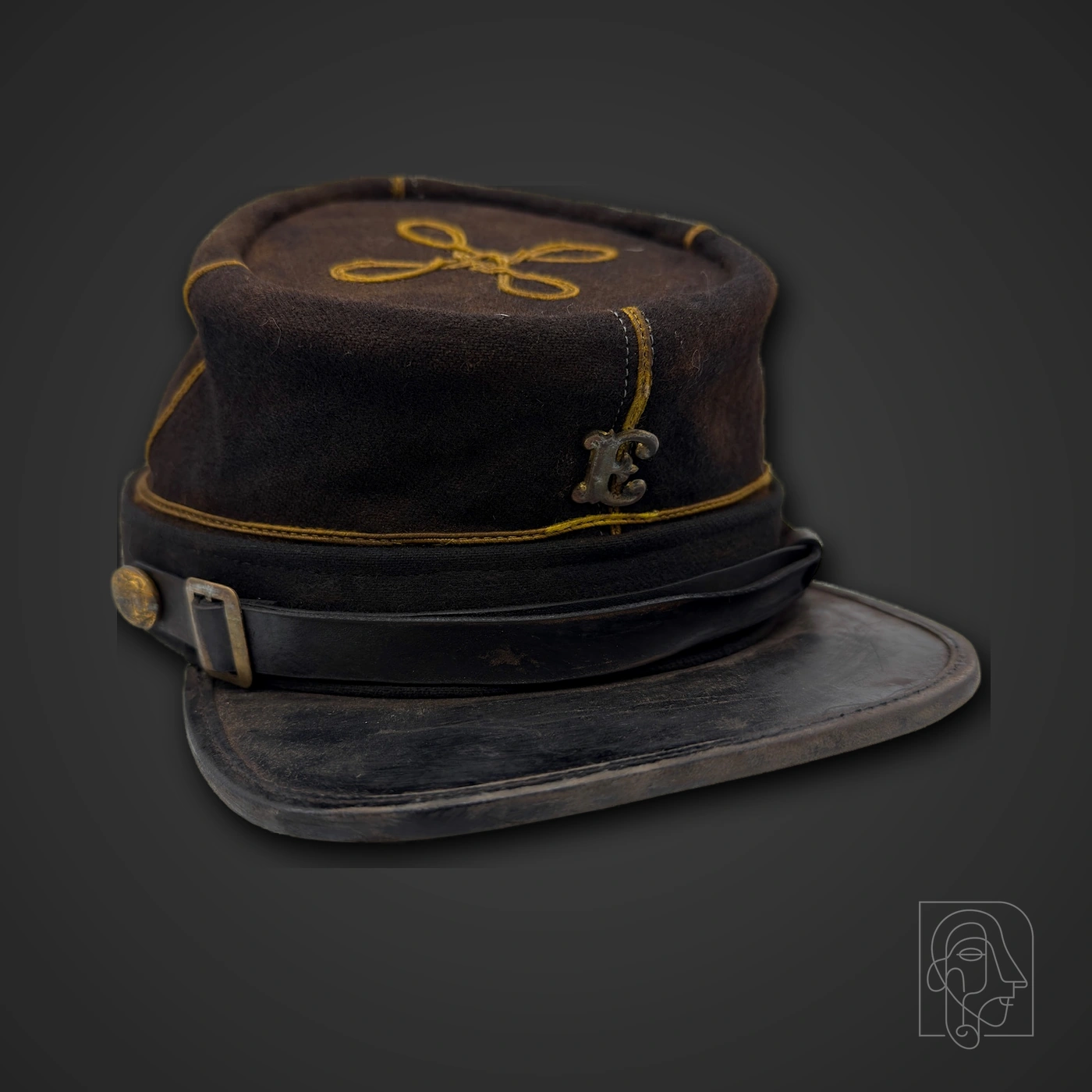
JCA.2026.106 is a soft-bodied, chasseur-style military kepi constructed from dark wool now presenting as gray-brown to nearly black. The cap has a low, slightly irregular cylindrical crown, a black lower band, a bound black leather visor, and an adjustable leather chinstrap secured by two gilt Maryland state-seal buttons. A rectangular gilt-metal buckle is fitted to the chinstrap. Narrow gold-colored soutache follows the principal vertical crown seams and the junction between the crown and lower band. On the crown, the soutache forms a complete four-lobed interlaced knot. The ornament appears to be formed from a single principal line of cord, a configuration consistent with junior-officer styling, although Maryland militia practice was not necessarily uniform enough to assign a definitive rank from braid alone. An applied Gothic metal letter “E” is mounted on the front-left portion of the crown immediately above the lower soutache. The device is most plausibly interpreted as a company letter, identifying Company E, but no regimental numeral is present. The precise regiment therefore remains unresolved. The side buttons bear the reverse design of the Great Seal of Maryland. Visible features include the quartered Calvert and Crossland shield, cross bottony charges in the second and third quarters, coronet, human supporters representing a farmer or plowman and a fisherman, and a lower motto scroll. The heraldry securely establishes a Maryland state association. The interior retains a black leather sweatband and a gathered brown glazed-textile lining. The underside of the crown displays stitching corresponding to the external four-lobed soutache ornament. Construction, materials, stitching, wear, oxidation, and the relationship between interior and exterior components are consistent with nineteenth-century manufacture. Measurements are approximately 9 inches long, 6.5 inches wide, and 4 inches high. Recorded weight is approximately 190 grams.
Technical analysis
JCA.2026.106 is constructed as a soft-bodied chasseur-style kepi using a combination of machine-stitched textile assembly and hand-finished decorative and structural work. The crown is formed from multiple shaped wool panels joined by vertical seams and attached to a separate lower band. Narrow gold-colored soutache is applied over the principal crown seams and around the crown-to-band junction. On the upper surface, the cord forms a complete interlaced four-lobed knot. The soutache appears to consist of wrapped textile cord rather than flat metallic lace and is secured by closely spaced hand stitching. The crown currently displays moderate compression and asymmetry but retains sufficient structural integrity to preserve the original panel layout. No rigid internal frame is evident. The cap therefore relied primarily on the shaped wool shell, lining, seam tension, and lower band for form. The visible exterior cord corresponds with stitching and tension patterns on the interior crown, indicating that the decorative braid was incorporated into the original construction rather than applied recently. The lower band is made from dark wool and provides the principal circumferential support. A black leather sweatband is stitched inside the opening. The sweatband shows age-related shrinkage, creasing, abrasion, and loss of surface finish but remains substantially attached. The brown glazed-textile lining is gathered and stitched into the interior. Its wrinkling and deformation are consistent with long-term compression and movement of the soft crown. The visor is constructed from layered leather or leather-covered stiffening material with a bound perimeter. It is attached to the lower front of the cap by stitching rather than adhesive. Surface abrasion, edge wear, cracking, and finish loss are present, but the visor remains structurally connected to the body. No modern plastic insert, foam reinforcement, synthetic edge binding, or hot-melt adhesive has been observed. The adjustable chinstrap is cut from black leather and passes through a rectangular gilt-metal buckle. It is retained at each side by a Maryland state-seal button. The buttons appear to be pressed or stamped gilt copper-alloy or brass components fitted with loop shanks. Their relief depicts the reverse design of the Great Seal of Maryland. Oxidation, darkened recesses, exposed base metal, and irregular gilt loss are consistent with prolonged handling and environmental exposure. The applied Gothic metal “E” is positioned above the lower soutache on the front-left crown panel. It appears to be a die-formed or cast copper-alloy device with remnants of a plated or gilt surface. Its attachment system has not been fully documented, but the device lies closely against the wool and shows wear compatible with the other metal fittings. The surrounding textile should be examined for original punctures, secondary holes, oxidation transfer, and protected color before the letter is classified conclusively as original to manufacture. The visible sewing includes regular machine lockstitching in the principal seams and irregular hand stitches in the application of braid, lining, and finishing elements. Thread aging appears broadly consistent throughout the cap. No synthetic overlocking, modern monofilament, conspicuous replacement stitching, or recent adhesive repair has been identified in the available photographs. The cap’s single principal soutache arrangement is compatible with nineteenth-century junior-officer styling and may indicate lieutenant grade. This interpretation remains provisional because state militia uniforms were not always manufactured or worn in strict conformity with federal regulations. Overall, the mechanical construction is consistent with a privately purchased nineteenth-century American militia officer’s cap. The wool shell, lining, leather components, braid, buttons, insignia, stitching, oxidation, and wear patterns exhibit coherent aging. No technical feature presently indicates modern reproduction, although definitive authentication would benefit from microscopic fiber examination, metal analysis, complete documentation of the button backmarks, and inspection of the reverse attachment of the Gothic “E.”
Authentication methodology
Authentication was conducted through visual and comparative examination of the cap’s construction, materials, insignia, heraldry, stitching, wear patterns, and interior components. The assessment was based on high-resolution exterior, interior, crown, insignia, button, visor, chinstrap, and seam photographs, together with recorded measurements and weight. The Maryland attribution was established through identification of the heraldic design on both side buttons. The quartered shield combines the Calvert and Crossland arms, including cross bottony devices in the second and third quarters, and is flanked by the farmer or plowman and fisherman supporters associated with Maryland’s seal. This identification superseded earlier foreign attributions made before sufficiently detailed button photographs were available. Period compatibility was assessed by examining the wool weave and nap, leather visor and sweatband construction, glazed textile lining, gilt-metal fittings, loop-shank button attachment, lockstitch and hand-finished seams, soutache application, oxidation, abrasion, fading, deformation, and accumulated soiling. The materials display broadly coherent aging rather than isolated or artificially induced distress. The owner reports that the cap was examined under ultraviolet illumination and showed no conspicuous fluorescence indicative of modern optical brighteners, synthetic replacement thread, or recent adhesive repairs. This result is treated only as corroborative evidence; ultraviolet examination alone cannot establish age. Rank interpretation is based provisionally on the apparent use of one principal line of gold soutache along the crown seams and within the crown knot. Comparable nineteenth-century officer kepis employ increasing numbers of braid rows to indicate higher rank. Because militia uniforms could depart from federal regulations, the cap is described as probably lieutenant-grade rather than assigned a definitive rank. The Gothic “E” appears physically compatible with the cap’s age and wear, but its originality has not been scientifically established. The preferred interpretation is Company E. Exact regiment, named wearer, maker, and service history remain unconfirmed. Overall conclusion: the object is considered a likely authentic nineteenth-century Maryland militia or National Guard officer’s kepi. Maryland association is secure; officer status is probable; lieutenant-grade rank and Company E identification are well-supported working interpretations; attribution to the Fifth Regiment remains provisional.
Comparative works
1. Maryland State Seal Button, National Museum of American History, Smithsonian Institution, catalog no. 1981.0296.1555. Mid-nineteenth-century brass button manufactured by Scovill of Waterbury, Connecticut. The design includes Maryland’s shield, farmer and fisherman supporters, crest, and motto scroll. This example confirms the use and manufacture of closely related Maryland armorial buttons during the period relevant to JCA.2026.106. 2. Maryland Militia Kepi, National Museum of American History, Smithsonian Institution, catalog no. AF.61115M. Associated with Maryland militia service during 1861–1865. This institutional example establishes the use of kepi-form headgear within Maryland militia organizations during the Civil War period. 3. Militia Officer’s Kepi, National Museum of American History, Smithsonian Institution, catalog no. 1997.3044.364. Dated broadly to 1860–1880 and constructed from wool, fabric, and leather. This object provides a general institutional comparison for the materials, period, and officer-militia classification of JCA.2026.106. 4. Maryland Chasseur Cap (Kepi), commercial auction comparison, sold December 2023. Described as having Maryland state-seal staff buttons, double-row gilt rank taping interpreted as captain-grade, a bound leather visor, brown polished-cotton lining over an oilcloth crown, and a crown approximately four inches high. Its construction is closely comparable to JCA.2026.106, although the auction example had a substantial tear and doubled rank braid. 5. State of Maryland Federal Field-Grade Officer’s Civil War Kepi, commercial auction comparison, sold June 2013. Constructed from dark-blue wool with multiple horizontal and vertical gold bullion bands, crown ornament, leather chinstrap, and Maryland state-seal buttons. This more elaborate cap demonstrates the use of Maryland buttons and gold crown braid on commissioned-officer headgear. 6. Fifth Regiment Infantry, Maryland National Guard, historical record published in 1899. The regiment’s 1867 uniform is described as cadet-gray cloth trimmed in black, with gray caps and small pompons. This description provides a partial visual and material parallel for JCA.2026.106 and supports, but does not prove, the proposed Fifth Regiment association. The institutional examples establish the general historical framework. Auction records are used only as secondary visual and construction comparisons and are not treated as authoritative proof of unit, rank, or date.
Provenance
JCA.2026.106 was acquired by the Joshua Cabinet of Antiquities in 2026 from the private market. The identity of the original wearer, intervening owners, place of discovery, and circumstances of removal from military or family custody are presently undocumented. No period photographs, military papers, family records, labels, inscriptions, storage containers, or other associated materials accompanied the cap. No named attribution should therefore be assigned without additional documentary evidence. The Maryland state association is established independently through the heraldry of the side buttons. The applied Gothic “E” probably indicates Company E, but the absence of a regimental numeral or documented chain of ownership prevents attribution to a particular Maryland regiment. Company E of the Fifth Regiment, Maryland National Guard, is currently the leading unit hypothesis because the Fifth Regiment adopted cadet-gray uniforms with black trim and gray caps following its 1867 organization. Company E is documented within the regiment. Nevertheless, Company E existed in other Maryland formations, and an independent company, cadet organization, or state-service body cannot presently be excluded. Provenance status: incomplete. The object’s ownership history begins securely with its accession into the Joshua Cabinet of Antiquities in 2026.
Historical context
The kepi was a French-derived military cap widely adopted by American volunteer, militia, and regular forces during the middle and later nineteenth century. State militia organizations frequently combined broadly national military forms with locally selected colors, insignia, buttons, and private-purchase tailoring. JCA.2026.106 belongs to this state-militia tradition. Its Maryland armorial buttons distinguish it from standard federal headgear and indicate service under Maryland authority or within an organization using Maryland state insignia. Similar buttons were manufactured by American firms by the middle of the nineteenth century. Maryland militia forces underwent repeated reorganization during and after the Civil War. The Fifth Regiment Infantry was organized in Baltimore in 1867 and adopted a distinctive cadet-gray uniform trimmed in black, with gray caps and small pompons. Its uniform was compared historically with that of the Seventh New York and was also noted for its resemblance to Confederate gray. This documented combination of gray cloth, black trim, and military caps is relevant to JCA.2026.106, whose wool now appears dark gray-brown and whose lower band is black. The cap’s gold soutache and complete crown knot indicate an officer-style private-purchase garment rather than a plain enlisted fatigue cap. One apparent line of crown braid favors lieutenant-grade status, while the Gothic “E” probably indicates Company E. However, militia tailoring and insignia practice were not perfectly standardized, and neither rank nor company should be treated as conclusively identified solely from these features. The date is best expressed broadly as circa 1860–1890, with circa 1867–1885 preferred. The earlier range accounts for documented Maryland kepi and state-button use during the Civil War. The preferred range reflects the organization and early uniform period of the Fifth Regiment and the stylistic characteristics of the cap. The object should therefore be understood as material evidence of Maryland’s nineteenth-century citizen-soldier tradition, locally distinctive military dress, and the private-purchase culture of militia officers. Its precise role—dress, parade, encampment, armory, or state active service—remains unknown.
Conservation history
No documented professional conservation, restoration, cleaning, stabilization, or component replacement is known. Visual examination indicates that the cap remains substantially complete. The wool crown retains its principal form and surface nap, although it exhibits age-related deformation, fading, embedded dust, and localized surface wear. No major open tears or extensive moth losses are visible in the available photographs. The gold-colored soutache remains unusually complete. The four-lobed crown knot, vertical seam cords, and lower horizontal trim are intact, with limited fraying and surface dulling. The applied Gothic “E” remains attached and displays oxidation and wear consistent with the other metal components. The leather visor, chinstrap, buckle, and sweatband exhibit abrasion, dryness, creasing, finish loss, and age-related stiffening. The visor remains attached. The side buttons retain substantial heraldic detail but show oxidation, surface accretion, and extensive gilt loss. The brown glazed-textile lining is retained but shows wrinkling, staining, abrasion, and age-related weakening. Interior stitching and the reverse pattern associated with the crown ornament remain visible. The owner reports no modern repair fluorescence under ultraviolet illumination. No obvious synthetic overlocking, hot-melt adhesive, modern foam, or conspicuous replacement fabric has been observed. Recommended preventive care includes stable support of the crown, minimal handling of the soutache and Gothic “E,” avoidance of polishing or chemical cleaning of the buttons, avoidance of leather dressings, storage in an acid-free archival enclosure, and maintenance under stable moderate humidity with protection from ultraviolet light and insect activity. Any cleaning or stabilization should be undertaken by a textile or objects conservator familiar with historic military headgear.
Bibliography
Heritage Auctions. “Rare State of Maryland Federal Field Grade Officer’s Civil War Kepi.” Auction record, June 8, 2013. Maryland State Archives. Fifth Regiment Infantry, Maryland National Guard, U.S. Volunteer, 1867–1899. Baltimore: A. Hoen & Company, 1899. MSA SC 5390-1-1. National Museum of American History, Smithsonian Institution. “Kepi: Maryland Militia.” Catalog no. AF.61115M. National Museum of American History, Smithsonian Institution. “Kepi: Militia Officer.” Catalog no. 1997.3044.364. National Museum of American History, Smithsonian Institution. “Maryland State Seal Button.” Catalog no. 1981.0296.1555. Scovill Manufacturing Company, Waterbury, Connecticut, mid-nineteenth century. Old Barn Auction. “Maryland Chasseur Cap (Kepi).” Lot 574, sold December 16, 2023. Joshua Cabinet of Antiquities. Photographic examination record for JCA.2026.106, 2026. Twelve exterior, interior, crown, insignia, button, visor, and construction views. Joshua Cabinet of Antiquities. Owner-reported ultraviolet examination notes for JCA.2026.106, 2026.