Japanese Iron Ressei-Style Menpō with Yodarekake — Scholarly Analysis
Extended scholarly study of "Japanese Iron Ressei-Style Menpō with Yodarekake" (accession JCA.2026.107): material analysis, authentication methodology, comparative works, and bibliography.
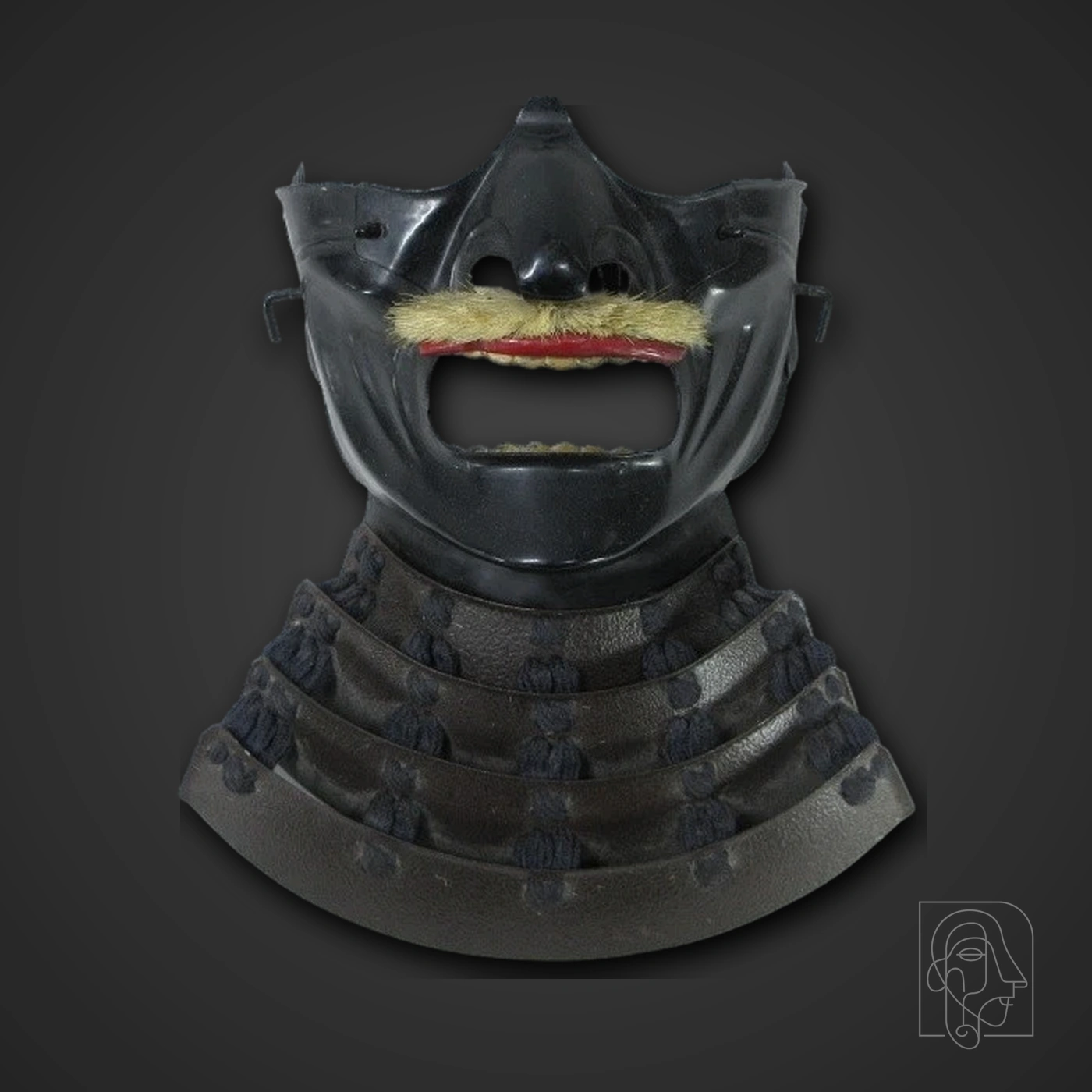
Extended description
A Japanese iron ressei-style menpō, or lower-face defense, modeled with a forceful open-mouthed expression. The mask incorporates a detachable hana-no-ita nose section, pronounced embossed cheek and nasolabial wrinkles, separately formed ear guards, paired ori-kugi helmet-cord hooks, red-finished lips, upper and lower scalloped tooth bars with a gold-colored surface, and a coarse pale natural-bristle moustache. A four-lame yodarekake is suspended below the chin to protect the throat while permitting movement. The exterior and interior are predominantly black-finished. Close examination of worn areas reveals ferrous metal beneath the coating, but no visible evidence of a former red interior layer. The moustache exhibits irregular fiber thickness, discoloration, fraying, breakage, and brittleness consistent with aged animal bristle. The detachable nose is retained by lateral studs projecting from the cheek plates. The object measures approximately 10 inches at its longest point by 9 inches wide and weighs 385 grams. Its construction, functional fittings, materials, and stylistic vocabulary support identification as a traditionally manufactured Japanese menpō. A working date of circa 1750-1800 is proposed, with a broader cautious range of circa 1700-1825. The mask is unsigned, and no individual maker or school can presently be assigned with confidence.
Technical analysis
The mask is assembled from multiple formed ferrous components rather than cast or molded as a single unit. A strong magnetic response confirms iron or steel as the principal structural material. The facial contours are reproduced on the interior, indicating that the nose, cheeks, mouth, chin, and ear elements were shaped from sheet metal by forming, hammering, or related traditional metalworking processes. The detachable hana-no-ita incorporates two lateral wings pierced to engage small projecting studs on the cheek plates. The spring tension of the formed metal retains the nose section when installed. The system is mechanically functional and does not depend upon modern screws, bolts, plastic clips, or adhesives. The ori-kugi are formed from bent ferrous rod and pass through the cheek plates. Their irregularly peened interior ends demonstrate mechanical attachment. These hooks were positioned to engage or control the kabuto chin cords. The ear guards are separately formed, deeply dished plates with cord apertures. The upper and lower teeth are represented by separate scalloped metal bars secured by small peened rivets. The upper tooth bar is incorporated into the detachable nose and lip assembly. The moustache appears mechanically trapped between the nose section and the upper-lip structure rather than superficially glued to the exterior. The four-lame yodarekake is articulated by dark textile lacing. Its broad solid lames overlap downward to permit limited movement while maintaining throat coverage. The differing brown-black surface appearance of the throat lames may reflect a textured lacquer treatment, differential aging, maintenance, or restoration. No fiberglass fabric, resin casting seams, molded plastic, pop rivets, threaded fasteners, or obvious modern spot welds were identified in the supplied photographs. The black surface remains visually coherent across the formed plates and fittings, although its precise age and originality cannot be determined photographically.
Authentication methodology
Authentication was undertaken through comparative visual and constructional analysis using high-resolution exterior, interior, profile, macro, and disassembled photographs supplied during intake. Recorded dimensions, weight, acquisition information, and the results of a magnet test were incorporated into the assessment. The examination considered: 1. Material response: Strong magnetic attraction established a ferrous primary structure. 2. Construction: The mask was evaluated for formed metal contours, separate plates, hand-finished openings, peened rivets, mechanical fittings, detachable components, and the absence of conspicuous modern hardware. 3. Functional configuration: The detachable hana-no-ita, paired ori-kugi, separate ear guards, tooth bars, securing cord, and articulated yodarekake were assessed as parts of a coherent wearable armor system. 4. Surface analysis: Photographs of chips, edges, rivets, mouth components, and the interior were reviewed for coating stratigraphy, oxidation, artificial distressing, overspray, adhesives, and modern primer. No visible red layer was identified beneath the black interior coating. 5. Organic material: The moustache was examined for fiber uniformity, sheen, breakage, discoloration, and attachment method. Its irregular, coarse, brittle fibers are more consistent with natural animal bristle than modern synthetic brush material. 6. Comparative typology: The object was compared with museum-cataloged Edo-period ressei menpō displaying detachable noses, implanted moustaches, red lips, gold-edged or gold-colored teeth, ori-kugi, ear guards, and articulated throat defenses. The findings support probable historical Japanese manufacture and a likely Edo-period date. Confidence in the general identification and traditional construction is high. Confidence in the proposed circa 1750-1800 dating is moderate. Confidence in any maker or school attribution is low. The assessment remains provisional because no destructive testing, metallography, X-radiography, lacquer microscopy, fiber identification, inscription analysis, or in-hand examination by a specialist in Japanese armor has been completed.
Comparative works
The closest institutional comparison is the Tokyo Fuji Art Museum's Shirohige Ressei-menpo, dated to the mid-Edo period or 18th century. That mask is constructed from iron, lacquer, leather, silk, and copper. The museum identifies the defining ressei features as intensely threatening facial modeling, embossed wrinkles on the nose and cheeks, an open mouth, implanted facial hair, and gold teeth. These features correspond closely with JCA.2026.107. A 19th-century Edo-period ressei menpō in the Penn Museum, object 83-44-6, provides a strong functional comparison. It has simulated facial wrinkles, an open mouth, red-lacquered lips, teeth edged in gold, paired ori-kugi, a separate hana-no-ita, moustache, and decorative ear plates. Penn Museum object 83-44-5 is a brown-lacquered iron ressei menpō with a detachable nose, dense moustache, red lips, silver teeth edged in gold, paired ori-kugi, ear plates, securing cord, and a four-lame throat guard. Although dated to the 19th century, its mechanical arrangement demonstrates the continuation of this traditional configuration. Penn Museum object 19879B, dated to the 18th-19th century, is especially relevant to the pale facial hair. It is described as a black-lacquered iron ressei menpō with a separate nose, bushy white moustache, beard, open mouth, facial wrinkles, and paired ori-kugi. The Metropolitan Museum of Art holds numerous iron and lacquer menpō dated broadly to the Edo period. The museum notes that most menpō covered the nose and face below the eyes, helped secure the helmet, and were produced in increasingly varied and expressive forms during the Edo period. These comparisons establish that the combination of an expressive ressei face, detachable nose, pale moustache, red lips, gold-colored teeth, paired ori-kugi, separate ears, and articulated throat defense belongs within a documented Edo-period armor tradition. They do not establish a specific maker.
Provenance
Purchased at auction from a Japanese dealer. The auction or dealer attribution described the mask as pre-1800. No earlier owner, collection, armor association, family attribution, export history, maker documentation, registration record, or published exhibition history is presently known. The pre-1800 description is consistent with the current working date of circa 1750-1800, but it remains an unverified seller attribution rather than independently documented provenance. All auction invoices, listing photographs, lot descriptions, correspondence, shipping records, customs documentation, and payment records should be retained permanently with the catalog file. Provenance status: Partial modern acquisition history only. Known chain of custody: Japanese dealer or auction source - acquired by Joshua Mas - The Joshua Cabinet of Antiquities. Earlier provenance: Unknown.
Historical context
Menpō were protective face defenses worn in conjunction with the kabuto and other components of Japanese armor. In addition to protecting the lower face, a properly configured menpō helped stabilize the helmet by providing fittings around which the helmet cords could be secured. Ressei menpō are distinguished by deliberately fierce, naturalistic, and intimidating expressions. Their surfaces commonly incorporate strongly embossed cheek and nose wrinkles, flared nostrils, open mouths, teeth, moustaches, and other elements intended to project severity and martial authority. The Japanese term ressei conveys a violent, fierce, or forceful expression. During the relatively peaceful Edo period, armor continued to function as military equipment, ceremonial dress, hereditary property, and a visible statement of rank and identity. Armorers increasingly demonstrated technical virtuosity through expressive facial defenses and elaborate surface treatments. The Myōchin and other armor-making traditions produced a wide variety of masks, but ressei characteristics were not exclusive to any single school. The detachable nose permitted adjustment, cleaning, and access while retaining the protective cheek and chin structure. The paired ori-kugi projected from the cheeks to help control the shinobi-no-o or helmet cords. The articulated yodarekake protected the throat while allowing the wearer to turn and incline the head. The pale moustache and gold-colored teeth give JCA.2026.107 an especially theatrical visual character. Comparable white-mustached and gold-toothed ressei masks are documented in Japanese and Western museum collections and are associated particularly with the mature decorative vocabulary of Edo-period armor.
Conservation history
No documented conservation or restoration history accompanied the object at acquisition. The mask presently appears structurally coherent and substantially complete. Localized abrasion, small coating losses, exposed metal, minor oxidation, and edge wear are visible. The red lip surface exhibits cracking, small losses, and localized separation, particularly around the detachable nose and upper-lip assembly. The gold-colored tooth surfaces show darkening and abrasion. The natural-bristle moustache is dry, brittle, discolored, frayed, and locally broken. Its attachment remains intact, but the fibers are vulnerable to handling and mechanical pressure. The throat-guard lacing is aged but substantially functional. It may represent an old replacement or later maintenance, although no conclusive evidence presently establishes its date. No red underlayer is visible beneath the black interior finish in the examined worn areas. There is presently insufficient evidence to describe the interior as relacquered. Equally, photography alone cannot prove that the black finish is entirely original. No treatment has been undertaken by The Joshua Cabinet of Antiquities. The detachable nose should not be repeatedly removed. The moustache must not be combed, washed, trimmed, pulled, or subjected to a burn test. No oils, waxes, metal polishes, solvents, or commercial lacquer products should be applied. Display support should bear the weight beneath the chin and cheek structure while allowing the yodarekake to hang naturally without loading the lacing.
Bibliography
The Metropolitan Museum of Art. "Mask (Menpō)." Japanese, 17th century. Object 14.100.45. https://www.metmuseum.org/art/collection/search/22520 The Metropolitan Museum of Art. "Half Mask (Menpō)." Japanese, Edo period, ca. 1615-1868. Object 36.25.295a, b. https://www.metmuseum.org/art/collection/search/32041 Tokyo Fuji Art Museum. "Face Guard (Shirohige Ressei-menpo)." Mid-Edo period, 18th century. Iron, lacquer, leather, silk, and copper. https://www.fujibi.or.jp/en/collection/artwork/00607/ Penn Museum. "Samurai Face Guard." Object 83-44-6. Edo period, 19th century. https://collections.penn.museum/collections/object/455197 Penn Museum. "Samurai Face Guard." Object 83-44-5. Edo period, 19th century. https://collections.penn.museum/collections/object/455196 Penn Museum. "Samurai Face Guard." Object CG2016-1-58.2. Iron, cloth, cord, and lacquer. https://collections.penn.museum/collections/object/593945 Penn Museum. "Samurai Face Guard." Object 19879B. Japan, 18th-19th century. https://collections.penn.museum/collections/object/14610 British Museum. "Menpo with Throat-Guard." Museum number OA+.1055. Edo period, 18th-19th century. https://www.britishmuseum.org/collection/object/A_OA-1055 British Museum. "Suit of Armour with Black-Lacquered Face-Mask." Museum number 1951,0214.2. Japan, 18th century. https://www.britishmuseum.org/collection/object/A_1951-0214-2 Ginza Chōshūya. "Basic Knowledge: Names of the Parts of a Menpō." https://www.choshuya.co.jp/menpogrounding?lang=en