Japanese Black-Lacquered Ichimonji Jingasa — Scholarly Analysis
Extended scholarly study of "Japanese Black-Lacquered Ichimonji Jingasa" (accession JCA.2026.108): material analysis, authentication methodology, comparative works, and bibliography.
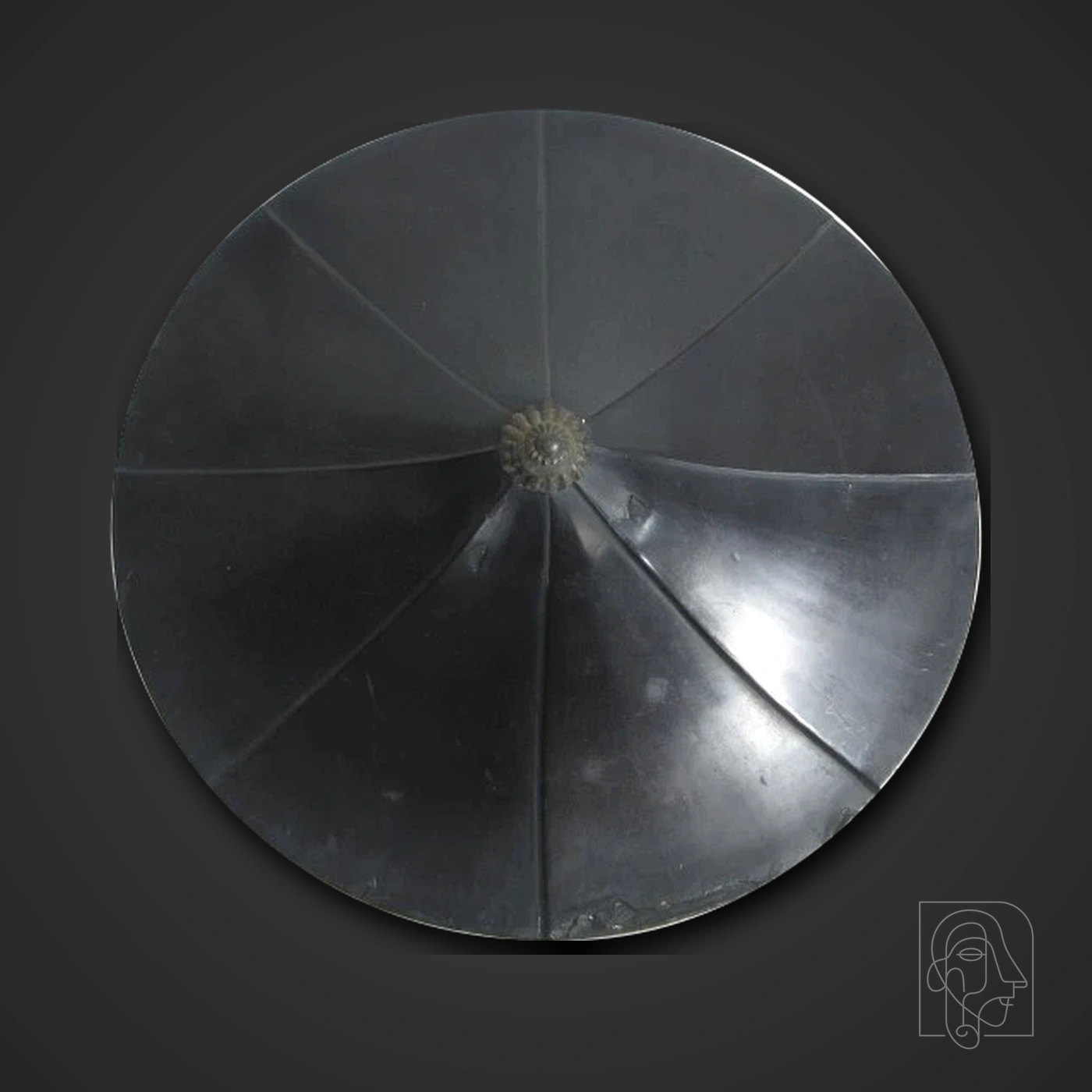
Extended description
JCA.2026.108 is a broad, shallow Japanese jingasa constructed as a lightweight circular hat or helmet. The exterior is finished in black lacquer and rises gently toward a low central crown. Approximately eight radiating curved divisions create the visual effect of overlapping armor plates or umbrella-like ribs. The raised divisions are integrated into the shell rather than applied as separate exposed metal plates. The crown is fitted with a layered floral-form metal ornament consisting of several concentric lobed plates and a rounded central boss. The fitting resembles a chrysanthemum-form tehen ornament, although it is decorative and structural rather than evidence of Imperial ownership or a maker’s mark. The underside is coated in red lacquer and retains a square blue textile crown cushion with surviving gray textile suspension straps. Areas of loss and separation at the rim and along several seams reveal regular perpendicular warp-and-weft fibers, confirming woven textile reinforcement beneath the lacquer. The object measures approximately 16.5 inches or 42 centimeters in diameter, 2.4 inches or 6 centimeters high, and weighs approximately 520 grams. Its low weight, shallow profile, organic-composite shell, lacquered surfaces, textile reinforcement, and surviving suspension elements are consistent with traditional Japanese jingasa construction. The working attribution is late Edo period, probably circa 1800-1850. The object is unsigned, lacks a visible family crest, and cannot presently be assigned to a named maker or armor-making school.
Technical analysis
The shell appears to be a lightweight organic composite rather than solid iron. The precise core material has not yet been scientifically identified, but the most plausible construction is hardened leather, laminated paper, textile, or a combination of these materials beneath multiple lacquer and ground layers. Regular woven fibers visible at damaged seams demonstrate deliberate textile reinforcement. The cloth was probably applied to bridge joins, strengthen the thin shell, limit cracking, and stabilize the rim before the application of additional ground and lacquer. The reinforcement appears localized at vulnerable seams and edges; it is not yet established whether woven cloth forms the principal structural body of the entire hat. The raised radiating divisions appear to have been molded or built into the composite shell to imitate overlapping armor plates. Their slightly curved, asymmetrical course indicates hand formation rather than modern machine production. The shell’s 520-gram weight is compatible with a lacquered organic substrate of this diameter and substantially lighter than a comparably sized thick iron helmet. The exterior carries a smooth to semi-gloss black lacquer finish. The interior is coated in red lacquer. Rim losses reveal multiple layers, including surface coating, ground, woven textile, and probable organic core material. Localized lifting and delamination indicate separation between these layers. The central ornament is a separately manufactured, layered metal fitting, probably copper alloy or another non-ferrous metal, secured through the crown. Its lobed plates, central boss, corrosion, and worn surface suggest age, although its exact alloy and original finish have not been tested. The blue textile cushion and gray retaining straps form part of the internal suspension. Their present arrangement appears incomplete or altered, and some or all of these elements may be replacements. Removal of the cushion is not recommended unless undertaken carefully for documentation, as inscriptions or attachment evidence could be concealed beneath it.
Authentication methodology
Authentication was approached through visual, dimensional, material, constructional, and comparative analysis of seller photographs and processed archive images. 1. Typological identification The broad circular body, low central rise, lacquered surface, crown fitting, interior cushion, and retaining straps identify the object as a Japanese jingasa. Its nearly flat profile places it within the broad ichimonji or hira-jingasa family. 2. Dimensional comparison The recorded diameter of 42 centimeters and height of 6 centimeters closely match documented Edo-period jingasa in major museum collections. This correspondence supports the identification but does not independently establish age. 3. Substrate and construction The low weight and exposed organic layers indicate a lightweight composite shell rather than heavy iron. Regular perpendicular warp-and-weft fibers beneath damaged lacquer confirm woven textile reinforcement. The raised exterior divisions were intentionally shaped to simulate plate construction. 4. Surface examination The black exterior and red interior exhibit scratches, abrasion, edge loss, localized cracking, and layered delamination. The deterioration appears irregular and constructionally coherent rather than uniformly applied artificial aging. No obvious fiberglass matting, synthetic foam, molded plastic, modern screws, or mass-produced fasteners are visible. 5. Metal fitting examination The layered floral crown fitting shows oxidation, surface loss, and nonuniform wear. Its form is consistent with traditional Japanese armor fittings, but it is not diagnostic of a particular workshop or maker. 6. Interior fittings The surviving cushion and suspension straps are functionally appropriate, although their originality remains uncertain. Alteration or replacement of these components does not necessarily invalidate the age of the shell. 7. Comparative research Museum records confirm comparable dimensions, shallow forms, lacquered construction, and Edo-period dating. No exact signed parallel has been located, and no school attribution is presently justified. Conclusion: The evidence strongly supports identification as a traditionally constructed Japanese jingasa. Edo-period manufacture is probable, with a working date of circa 1800-1850. Confidence in the general identification and traditional construction is high; confidence in the proposed date is moderate to moderately high; confidence in any named maker or school is low.
Comparative works
Metropolitan Museum of Art, object 36.25.209: Japanese war hat or jingasa, dated circa 1615-1868, made of lacquer. Dimensions: 42.2 centimeters wide and 6 centimeters high. This is an exceptionally close dimensional comparison to JCA.2026.108, which measures approximately 42 centimeters wide and 6 centimeters high. Metropolitan Museum of Art, object 36.25.196: Japanese war hat or jingasa, dated circa 1615-1868, made of lacquer. Dimensions: 42.6 centimeters in diameter and 6.4 centimeters high. This example confirms that the scale and shallow profile of JCA.2026.108 fall squarely within documented Edo-period jingasa proportions. British Museum, object OA+.976: Japanese jingasa described as a parade hat for samurai, made from lacquered wood and dated to the 18th-19th centuries. Diameter: 41.5 centimeters. The object provides a close comparison in function, period, material category, and overall scale. British Museum Samurai exhibition documentation: The museum describes jingasa as hats worn by samurai retainers in processions. Surviving examples were made in numerous shapes and decorative styles, often from lacquered lightweight materials and sometimes displaying clan crests. These comparisons support the object’s identification and probable late Edo date. They do not prove that JCA.2026.108 was made by the same workshop, from the same exact core material, or for the same rank or social context.
Provenance
Purchased through eBay from a seller located in Japan. The seller identified the object as a high-grade Japanese jingasa, attributed it to the late Edo period, described it as more than 200 years old, and stated that it was constructed from lacquer over kneaded or hardened leather. The seller recorded the measurements as 42 centimeters in diameter, 6 centimeters high, and 520 grams in weight. No earlier owner, family association, samurai clan affiliation, armor set, maker, storage box, collection label, export record, exhibition history, or published provenance was supplied. The seller’s late Edo attribution is compatible with the present visual and comparative assessment, but the statement that the object is more than 200 years old has not been independently demonstrated. The identification of the substrate specifically as kneaded leather also remains provisional pending examination of exposed core material. Known chain of custody: Unidentified Japanese owner or dealer - Japanese eBay seller - acquired by Joshua Mas - The Joshua Cabinet of Antiquities. Earlier provenance: Unknown. Supporting documentation to retain: Original eBay listing; seller photographs; seller description; purchase receipt; payment record; messages with the seller; shipping label; customs declaration; tracking information; packaging photographs; and intake photographs.
Historical context
Jingasa were lightweight Japanese hats or helmets used by samurai, retainers, attendants, and other members of military households. Depending upon form and context, they could serve during travel, processions, guard duty, official service, or limited military activity. The term jingasa encompasses a broad range of shapes and materials rather than a single standardized helmet type. Examples were made from iron, wood, leather, paper-based composites, textile-reinforced structures, and combinations of these materials, generally protected and decorated with lacquer. Broad, shallow forms are commonly described as ichimonji or hira-jingasa. Their extended brims provided protection from sun and rain while also presenting a disciplined visual profile in formal movement and procession. During the Edo period, armor and associated equipment increasingly served ceremonial, administrative, and status-bearing functions alongside their defensive purpose. The exterior of JCA.2026.108 imitates overlapping plate construction through molded radiating divisions. This visual treatment allowed a lightweight composite hat to evoke the appearance and authority of more substantial armor. The black exterior creates a restrained martial presentation, while the red interior follows a well-established Japanese decorative contrast. The absence of a visible family mon limits interpretation of the wearer’s identity. Some jingasa displayed clan or household crests prominently, while others were undecorated or have lost their applied heraldic decoration. The layered floral crown fitting is ornamental and structural but should not be interpreted as an Imperial chrysanthemum without additional evidence.
Conservation history
No documented conservation, restoration, or professional treatment history accompanied the object. The black exterior lacquer remains substantially intact but exhibits scratches, abrasion, shallow impact marks, localized cracks, edge chipping, and areas of lifting or delamination. Several rim losses expose the underlying layered construction and woven textile reinforcement. The red interior lacquer shows generalized wear, stains, scratches, small losses, and abrasion concentrated around the rim and internal fittings. The central metal ornament exhibits oxidation, discoloration, and loss of its former surface finish. The blue crown cushion survives but shows wear and soiling. The gray suspension straps appear incomplete, reconfigured, repaired, or replaced. Their age relative to the shell has not been established. No treatment has been undertaken by The Joshua Cabinet of Antiquities. Conservation recommendations: Do not apply oil, wax, lacquer, adhesive, solvent, metal polish, leather dressing, or commercial restoration products. Do not press down lifting lacquer or attempt to glue exposed textile. Support the jingasa evenly beneath the rim and avoid carrying it by the central fitting or straps. Display it on a broad padded support that does not concentrate pressure at the center. Maintain stable indoor temperature and relative humidity, avoid direct sunlight, and protect the object from vibration and accidental impact. Any stabilization of lifting lacquer should be performed by a conservator experienced with Japanese lacquer and composite armor materials. Loose fragments should be retained in labeled archival containers rather than discarded.
Bibliography
British Museum. Hat, jingasa or parade hat for samurai. Museum number OA+.976. Japan, Edo period, 18th-19th century. Lacquered wood. Diameter 41.5 cm. British Museum. Samurai Large Print Guide. Section: Samurai Hats / Jingasa. Discussion of lacquered procession hats worn by samurai retainers. British Museum. Desloge, Tania. “Conserving a Suit of Samurai Armour.” British Museum Blog, 26 September 2018. Metropolitan Museum of Art. War Hat (Jingasa). Object number 36.25.196. Japanese, circa 1615-1868. Lacquer. Diameter 42.6 cm; height 6.4 cm. Metropolitan Museum of Art. War Hat (Jingasa). Object number 36.25.209. Japanese, circa 1615-1868. Lacquer. Width 42.2 cm; height 6 cm. The Joshua Cabinet of Antiquities. JCA.2026.108 intake photographs, seller images, measurements, acquisition documentation, and authentication notes. Cataloged 26 July 2026.