S. Adam – Pelzpflege — Scholarly Analysis
Extended scholarly study of "S. Adam – Pelzpflege" (accession JCA.2026.119): material analysis, authentication methodology, comparative works, and bibliography.
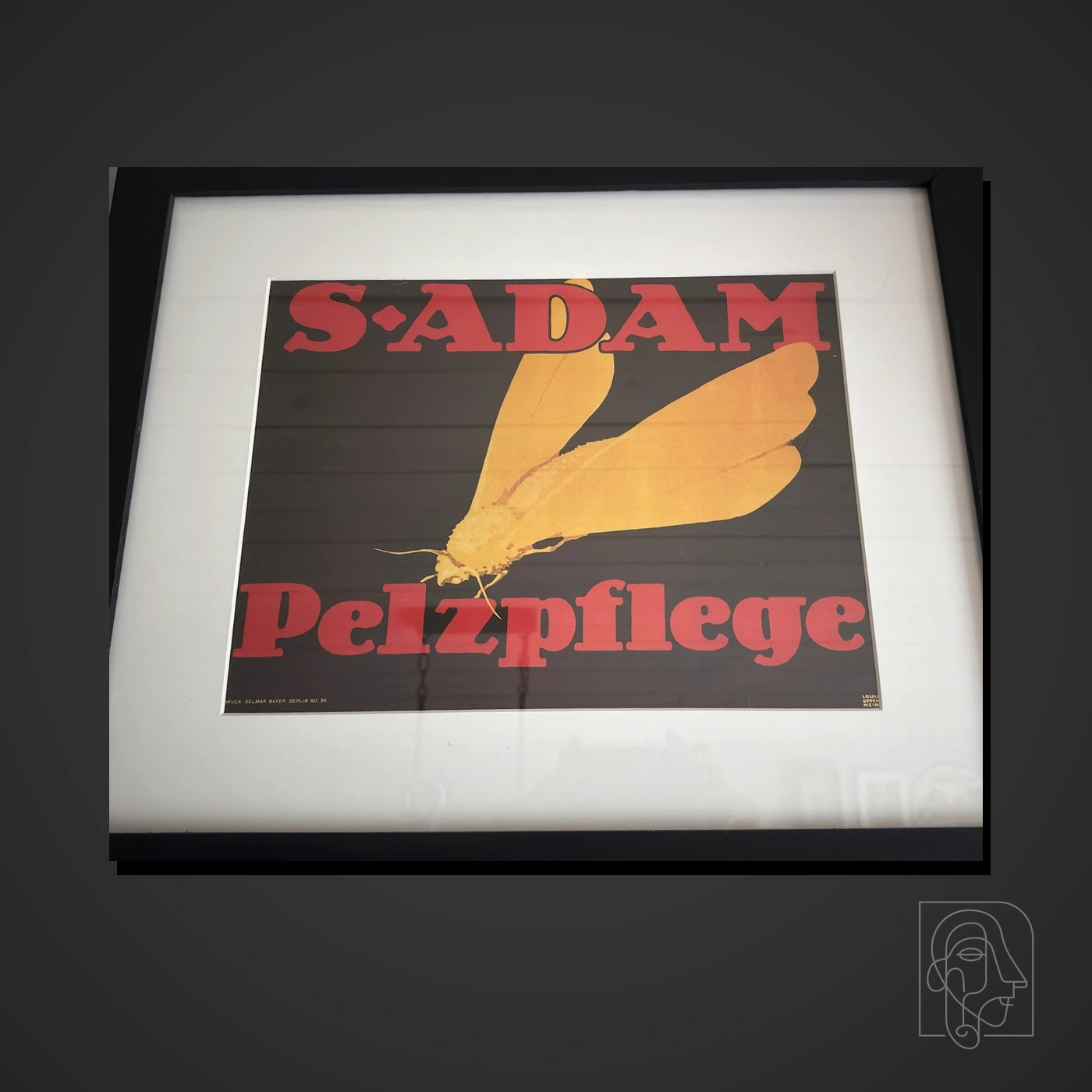
Extended description
S. Adam – Pelzpflege is a large-format German commercial poster designed by Louis Oppenheim for the Berlin clothing and fur-care firm S. Adam. The composition reduces the advertisement to three dominant elements: the company name, the word “Pelzpflege” (“fur care”), and an enlarged yellow clothes moth against a nearly black ground. The moth functions as both image and warning, immediately communicating the danger posed to stored fur garments. The limited palette, strong contrast, simplified silhouette, and monumental typography exemplify the direct visual language of early twentieth-century German poster design. Institutional examples date the design approximately 1910–1915.
Technical analysis
The poster is a color lithograph printed on paper in a horizontal format. Its dimensions of 72 × 95 cm correspond closely to documented institutional examples. The composition employs broad areas of opaque red, yellow, and black, with minimal modeling and no unnecessary background detail. Visible printed elements include the Louis Oppenheim signature at lower right and the printer’s line, “Druck Selmar Bayer Berlin SO. 36,” at lower left. The poster is presently framed under glazing, limiting examination of the reverse, paper fibers, lithographic surface, margins, and mounting system.
Authentication methodology
Authentication was based on comparative visual and dimensional analysis against documented institutional examples. The assessment considered the composition and typographic arrangement, Louis Oppenheim’s printed signature, the Selmar Bayer printer identification, full-size dimensions, horizontal proportions, placement and coloration of the moth, and visible paper aging. The agreement between the JCA example and documented examples supports its classification as an authentic full-size period lithograph. Because the poster remains framed, the conclusion is based on photographic examination and reported measurements rather than direct microscopic, ultraviolet, or fiber analysis.
Comparative works
A directly comparable example is held by the Kunstbibliothek, Staatliche Museen zu Berlin, under inventory number 1921,086. That example is cataloged as S. Adam Pelzpflege, designed by Louis Oppenheim, printed by Selmar Bayer, dated circa 1910, and measuring approximately 71.1 × 94.1 cm. The Basel Poster Collection preserves another example attributed to Oppenheim and Selmar Bayer, dated circa 1915 and measuring 72 × 95 cm. The Jewish Museum Berlin also preserves related advertising created by Louis Oppenheim for S. Adam, confirming the continuing professional relationship between the artist and the firm.
Provenance
The poster was acquired by The Joshua Cabinet of Antiquities and entered into the collection as JCA.2026.119. Its ownership history before acquisition is presently undocumented. No earlier collection labels, inscriptions, dealer records, exhibition records, or archival references have yet been identified. The framing may conceal additional evidence along the margins or reverse. Any future examination outside the frame should document the verso, mounting method, inscriptions, stamps, labels, and paper edges before the poster is returned to display.
Historical context
S. Adam was a prominent Berlin clothing, sporting-goods, travel, and leisure outfitter founded in 1863 by Saul David Adam and subsequently operated by the Adam family. The firm reflects the commercial success and cultural participation of German-Jewish entrepreneurs in Berlin before the Nazi era. The poster therefore has significance beyond commercial graphic design. It documents the visual culture and business activity of a German-Jewish family enterprise whose history was later affected by persecution, emigration, and the destruction of Jewish commercial life under National Socialism. The enlarged clothes moth reflects an advertising strategy based on immediate recognition rather than detailed explanation. By transforming an ordinary household pest into a monumental image, Oppenheim created a visually forceful warning about the danger of insect damage to valuable fur garments.
Conservation history
No documented conservation or restoration treatments are currently known. The poster is framed under glazing, with portions of the outer margins concealed by the mat. Visible condition characteristics include light age-related toning, minor creasing, and localized surface wear. The type of backing, hinges, adhesives, glazing, and mat board has not been verified. The poster should not be cleaned, trimmed, pressure-flattened, dry-mounted, or repaired with pressure-sensitive tape. Any future treatment should be performed by a qualified paper conservator using reversible, archival methods.
Bibliography
Kunstbibliothek, Staatliche Museen zu Berlin. S. Adam Pelzpflege. Inventory no. 1921,086. Louis Oppenheim; Selmar Bayer; circa 1910. Basel Poster Collection. S. Adam, Pelzpflege. Louis Oppenheim; commissioned by S. Adam; printed by Selmar Bayer; circa 1915. Jewish Museum Berlin. “From Men’s Leisure Outfitter to James Bond: A Family Story.” Historical documentation concerning the S. Adam firm, the Adam family, and related advertising by Louis Oppenheim.