Ceramic Anthropomorphic Head Fragment — Scholarly Analysis
Extended scholarly study of "Ceramic Anthropomorphic Head Fragment" (accession JCA.2025.001): material analysis, authentication methodology, comparative works, and bibliography.
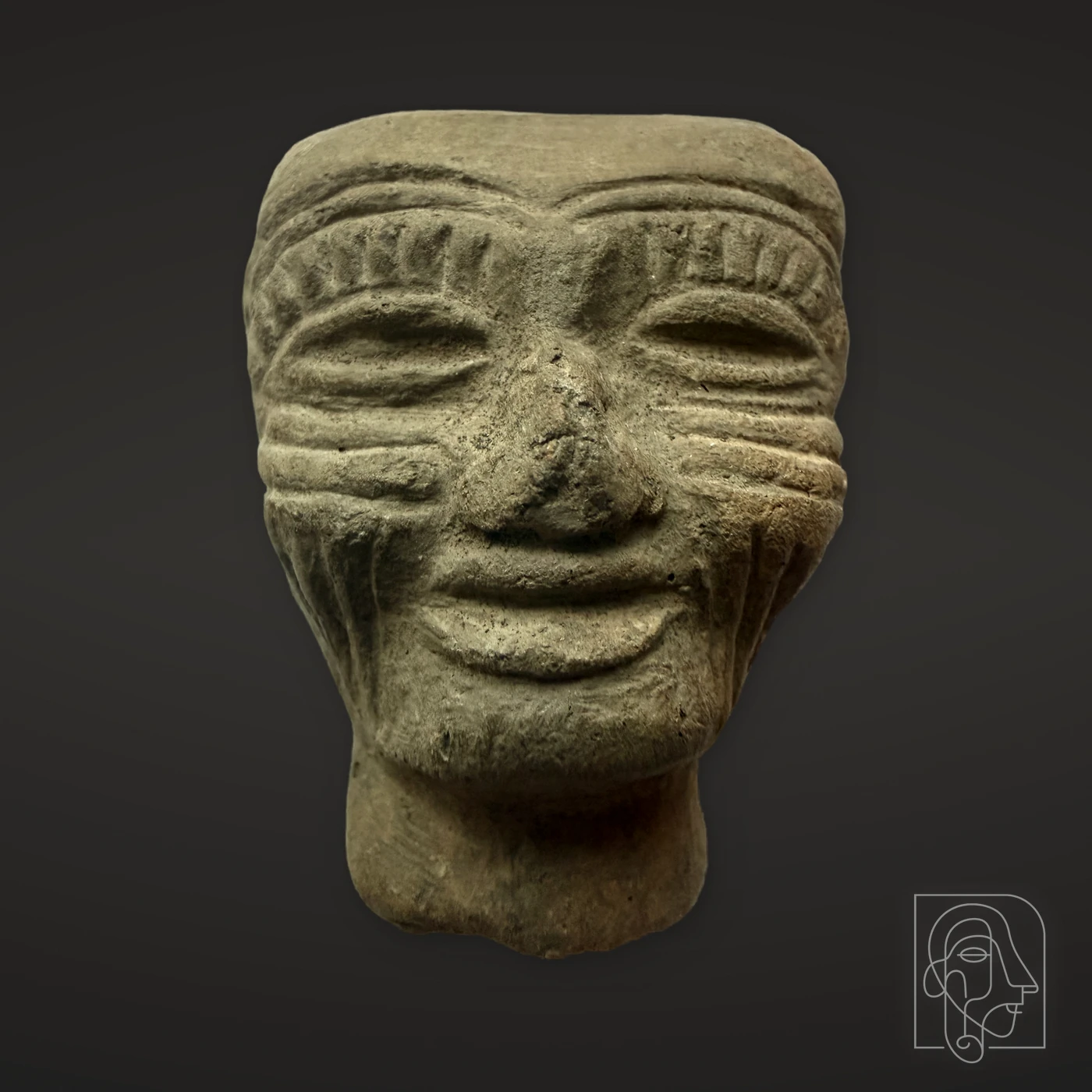
Extended description
Collection working attribution (6 October 2026): possibly Mesoamerican, proposed c. 300 BCE-300 CE. Specific culture, date and antiquity remain unverified.\n\nPhotographic study on 6 October 2026 reviewed three processed JCA views: front, reverse and oblique. The forehead band encloses short cuts above recessed eyes; a broad nose projects over defined lips. Repeated roughly horizontal grooves beneath each eye meet longer descending or slanting outer-cheek grooves. The oblique view shows raised eyelid or brow forms and recessed cheek lines, but does not resolve the forming process. The reverse has shallow depressions and dark mottling whose composition is unknown. The short lower extension may be a former connection to a larger figure; a deliberately finished small head is not excluded. The views contain no scale and do not expose all surfaces.
Technical analysis
Retain earthenware as the recorded material with explicit qualification. Raw, scaled front, rear, side, top and underside images; thickness; and a fresh mass measurement are needed. A conservator should examine existing exposed fabric, fracture surfaces, grooves, deposits, possible joins and coatings under magnification and raking light. Characterize matrix, inclusions, forming traces and firing evidence before choosing petrography or other analysis. Apparent granularity in a processed photograph is not a mineral identification. No scratching, cleaning or sampling should precede a documented examination plan.
Authentication methodology
Separate photographic observations, catalogue assertions and hypotheses. Reconstruct custody from independent records; obtain material and construction assessment and a specialist review using the full feature set. No physical examination, laboratory test or independent specialist authentication was performed for this desktop study. If fired ceramic is confirmed, discuss representative thermoluminescence sampling with a qualified laboratory and retain the complete report and sampling map. Oxford Authentication's old-pottery composite case illustrates that an old sample alone cannot authenticate every part of an object. Scientific results must be interpreted alongside joins, construction and provenance.
Comparative works
Cleveland Museum of Art 1995.97: Xochipala, 1500-1000 BCE, pottery, a small-head comparison with different ornament. 1921.1709: Teotihuacan, 150-350 CE, ceramic and pigment, described as moulded and retouched; this does not identify JCA manufacture. 1990.236: Veracruz, 900-1200 CE, a larger pottery head with a different headdress. Cleveland text and metadata were checked; direct image inspection was unavailable. The Met 1979.206.587 (object 312783), Remojadas, 6th-9th century CE, differs markedly in scale, ornament, pigment and tar. Museo Amparo item 4654, Chupicuaro, 600-100 BCE, supplies a plain-rear ceramic comparison. The Met Esie head 1979.206.296 (312519), and Ife terracottas, serve as cross-cultural controls, not positive attribution. JCA.2025.002 shares a forehead band and projecting face but lacks the same strong cheek grooves in the supplied front. Comparator dates belong to those objects.
Provenance
Private collection; earlier history is undocumented in the supplied catalogue. No acquisition document, seller or lot record, excavated findspot, early photograph or scientific report was attached to the record examined on 6 October 2026. The accession year is an administrative identifier, not a manufacture date. Locate original receipts, labels, correspondence and earlier images, and record each custody event with its source. Similarity to JCA.2025.001 or JCA.2025.002 does not establish a shared ancient pair, workshop or findspot.\n\nCollection communication, 6 October 2026, proposes a Mesoamerican attribution and c. 300 BCE-300 CE range. This is an attribution hypothesis, not an acquisition event or independently established date.
Historical context
Human faces with marked foreheads, recessed eyes and projecting noses occur in multiple traditions. Mesoamerican affiliation remains a research possibility; it is not established by the current photographs. Published Mexican ceramic and stone heads span widely separated periods and places. Esie and Ife material is included as a cross-cultural control against treating facial striations as uniquely Mesoamerican, not as a positive West African attribution. Domestic, funerary, ritual, architectural and ornamental functions cannot be assigned without object-specific evidence.
Conservation history
No formal treatment record was supplied. Photographs do not establish that no restoration or coating is present. Keep the head supported and stable pending a conservator's assessment. Avoid washing, oiling, consolidating, scraping or removing deposits before examination. Photograph exposed fabric, lower termination and grooves at high magnification before any intervention.
Bibliography
Cleveland Museum of Art, Figurine Head, 1995.97. https://www.clevelandart.org/art/1995.97
Cleveland Museum of Art, Figurine Head Fragment, 1921.1709. https://www.clevelandart.org/art/1921.1709
Cleveland Museum of Art, Head Fragment, 1990.236. https://www.clevelandart.org/art/1990.236
The Metropolitan Museum of Art, Head, Fragment, 1979.206.587, object 312783. https://www.metmuseum.org/art/collection/search/312783
Museo Amparo, Cabezas humanas con peinados elaborados y enjoyados, item 4654. https://museoamparo.com/colecciones/pieza/4654/cabezas-humanas-con-peinados-elaborados-y-enjoyados
The Metropolitan Museum of Art, Head of a male figure, 1979.206.296, object 312519. https://www.metmuseum.org/art/collection/search/312519
Adeniji, Adekunle Temilade. The Soapstone Sculptures of Esie. The Metropolitan Museum of Art, 2025. https://www.metmuseum.org/essays/soapstone-sculptures-esie
Apley, Alice. Ife Terracottas (1000-1400 A.D.). The Metropolitan Museum of Art, 2001. https://www.metmuseum.org/essays/ife-terracottas-1000-1400-a-d
Oxford Authentication. TL testing process. https://www.oxfordauthentication.com/about-us/tl-thermoluminescence-testing-process/
Oxford Authentication. A new model from old fragments of pottery. https://www.oxfordauthentication.com/oa_case_studies/a-new-model-from-old-fragments-of-pottery/
All accessed 6 October 2026. Museum dates and attributions apply to the comparison objects, not this accession. Object photographs and catalogue snapshot: JCA Archives. Full source IDs, image credits and research limits appear in the individual object research report.