Anthropomorphic Head Fragment (Reported Stone) — Scholarly Analysis
Extended scholarly study of "Anthropomorphic Head Fragment (Reported Stone)" (accession JCA.2025.002): material analysis, authentication methodology, comparative works, and bibliography.
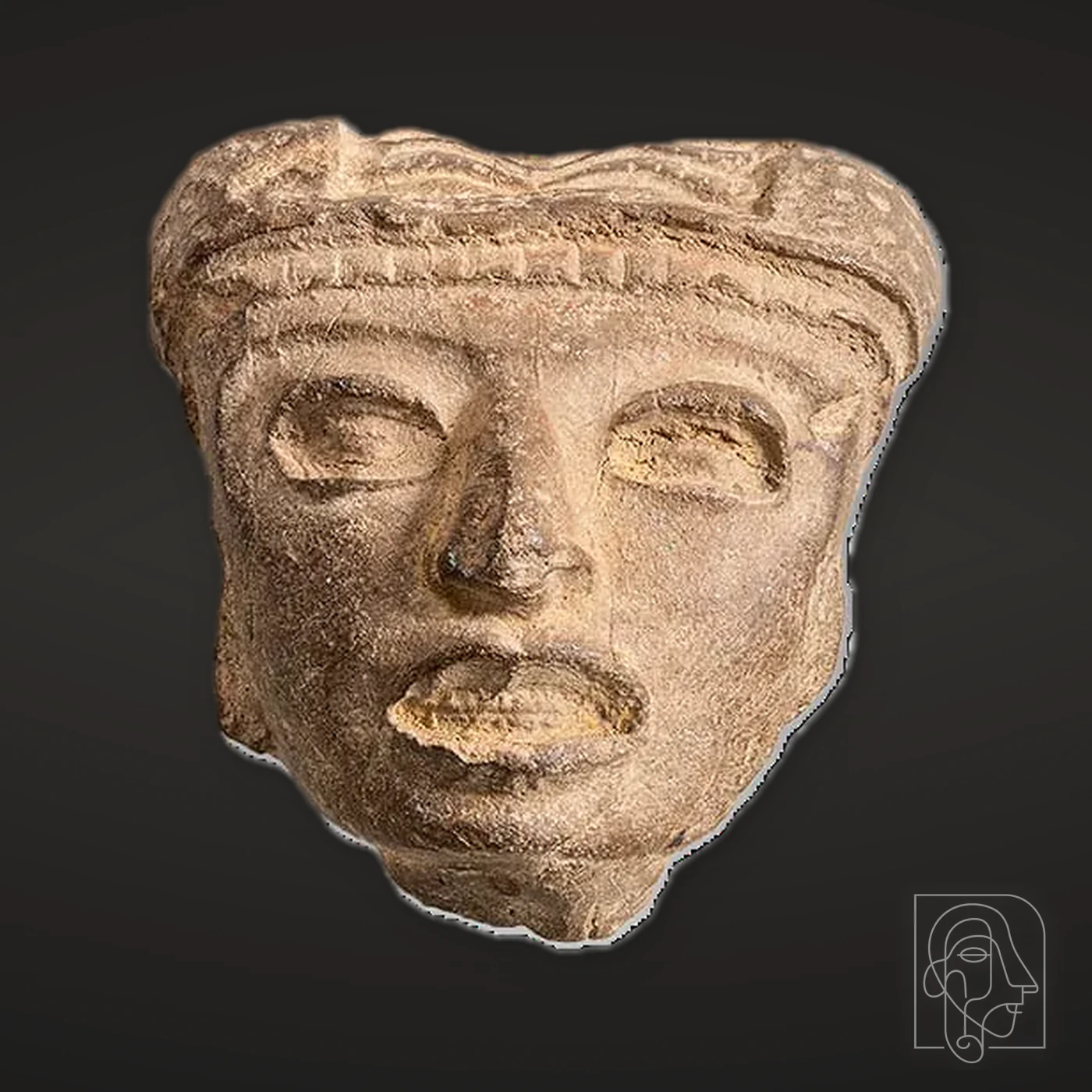
Extended description
Collection working attribution (6 October 2026): possibly Mesoamerican, proposed c. 300 BCE-300 CE. Specific culture, date and antiquity remain unverified.\n\nDesktop study on 6 October 2026 reviewed the supplied processed front and reverse photographs. The face has recessed eyes, a projecting nose, parted lips and a broad incised forehead zone. Upper and lower edges are uneven. No equivalent to JCA.2025.001's strong horizontal-plus-descending cheek pattern is established in the frontal image. The broad reverse is irregular: hollows, ridges or lines, cracks and darker areas interrupt its surface. The image supports a qualified description of a flattened field, not proof of deliberate planar working. No tenon, mounting context or original attachment is documented. Neither an architectural element, applied ornament, pendant nor independent head can be selected securely.
Technical analysis
Verify material before choosing a comparison corpus or scientific test. Examine existing exposed surfaces, breaks and inclusions under magnification to distinguish mineral structure, ceramic fabric, casting or other manufacture. If stone is confirmed, identify lithology and record cutting, pecking, abrasion, rotary traces, deposits and differential wear across face, edges and rear. If ceramic is confirmed, revise the material description and examine forming and firing evidence. Obtain raw scaled six-view images, thickness, weight and a macro record of the rear before interpreting hollows or lines as tool marks. No acid or scratch testing should be attempted as a preliminary identification.
Authentication methodology
Assess custody, material, manufacture and alteration independently. Compare the complete feature and material set with securely documented objects; do not begin from a presumed Preclassic or Mesoamerican label. Microscopic tooling, joins and deposits require a conservator or appropriate specialist. No physical examination, laboratory analysis or independent specialist authentication was performed in this desktop study. Ordinary pottery thermoluminescence testing does not routinely date an unheated stone carving. Only if fired ceramic is demonstrated should representative TL sampling be discussed, with full reporting and checks for reused ancient fragments.
Comparative works
The Met 1988.409.1 (object 316185): Mexican, 6th-2nd century BCE, stone, 3.5 cm high; distinctive elongated lateral elements differ from JCA. The Met 00.5.58 (307648): Guerrero (?), 12th-early 16th century, stone, 15.2 cm high; circular holes and structural differences limit comparison. These images were inspected. Cleveland Museum of Art 1961.31: Olmec, c.900-300 BCE, jadeite; text and metadata checked, direct image inspection unavailable. Museo Amparo 4654: Chupicuaro, 600-100 BCE, ceramic heads with plain rear construction, a control on architectural inference. The Met Esie head 1979.206.296 (312519), and Ife terracottas, are cross-cultural facial-marking controls, not a positive West African attribution. JCA.2025.001 shares a forehead band and projecting face but has stronger cheek grooves and a longer lower extension. No shared ancient association is established.
Provenance
Private collection; earlier history is undocumented in the supplied catalogue. No acquisition document, seller or lot record, excavated findspot, early photograph or scientific report was attached to the record examined on 6 October 2026. The accession year is an administrative identifier, not a manufacture date. Locate original receipts, labels, correspondence and earlier images, and record each custody event with its source. Similarity to JCA.2025.001 or JCA.2025.002 does not establish a shared ancient pair, workshop or findspot.\n\nCollection communication, 6 October 2026, proposes a Mesoamerican attribution and c. 300 BCE-300 CE range. This is an attribution hypothesis, not an acquisition event or independently established date.
Historical context
Human faces with marked foreheads, recessed eyes and projecting noses occur in multiple traditions. Mesoamerican affiliation remains a research possibility; it is not established by the current photographs. Published Mexican ceramic and stone heads span widely separated periods and places. Esie and Ife material is included as a cross-cultural control against treating facial striations as uniquely Mesoamerican, not as a positive West African attribution. Domestic, funerary, ritual, architectural and ornamental functions cannot be assigned without object-specific evidence.
Conservation history
No formal treatment history was supplied. Photographs cannot establish absence of repair or coatings. Keep the fragment supported and stable, with carved and broken edges free of load. Avoid acids, scratching, wire brushing, waxing or removal of deposits before material identification and conservation assessment. Document the rear, cracks, edges and any old mount traces before intervention.
Bibliography
The Metropolitan Museum of Art, Head, 1988.409.1, object 316185. https://www.metmuseum.org/art/collection/search/316185
The Metropolitan Museum of Art, Head, 00.5.58, object 307648. https://www.metmuseum.org/art/collection/search/307648
Cleveland Museum of Art, Head Fragment, 1961.31. https://www.clevelandart.org/art/1961.31
Museo Amparo, Cabezas humanas con peinados elaborados y enjoyados, item 4654. https://museoamparo.com/colecciones/pieza/4654/cabezas-humanas-con-peinados-elaborados-y-enjoyados
The Metropolitan Museum of Art, Head of a male figure, 1979.206.296, object 312519. https://www.metmuseum.org/art/collection/search/312519
Adeniji, Adekunle Temilade. The Soapstone Sculptures of Esie. The Metropolitan Museum of Art, 2025. https://www.metmuseum.org/essays/soapstone-sculptures-esie
Apley, Alice. Ife Terracottas (1000-1400 A.D.). The Metropolitan Museum of Art, 2001. https://www.metmuseum.org/essays/ife-terracottas-1000-1400-a-d
Oxford Authentication. TL testing process. https://www.oxfordauthentication.com/about-us/tl-thermoluminescence-testing-process/
Oxford Authentication. A new model from old fragments of pottery. https://www.oxfordauthentication.com/oa_case_studies/a-new-model-from-old-fragments-of-pottery/
All accessed 6 October 2026. Museum dates and attributions apply to the comparison objects, not this accession. Object photographs and catalogue snapshot: JCA Archives. Full source IDs, image credits and research limits appear in the individual object research report.