Waisted Stone Object with Cavity and Cupules — Scholarly Analysis
Extended scholarly study of "Waisted Stone Object with Cavity and Cupules" (accession JCA.2025.003): material analysis, authentication methodology, comparative works, and bibliography.
Extended description
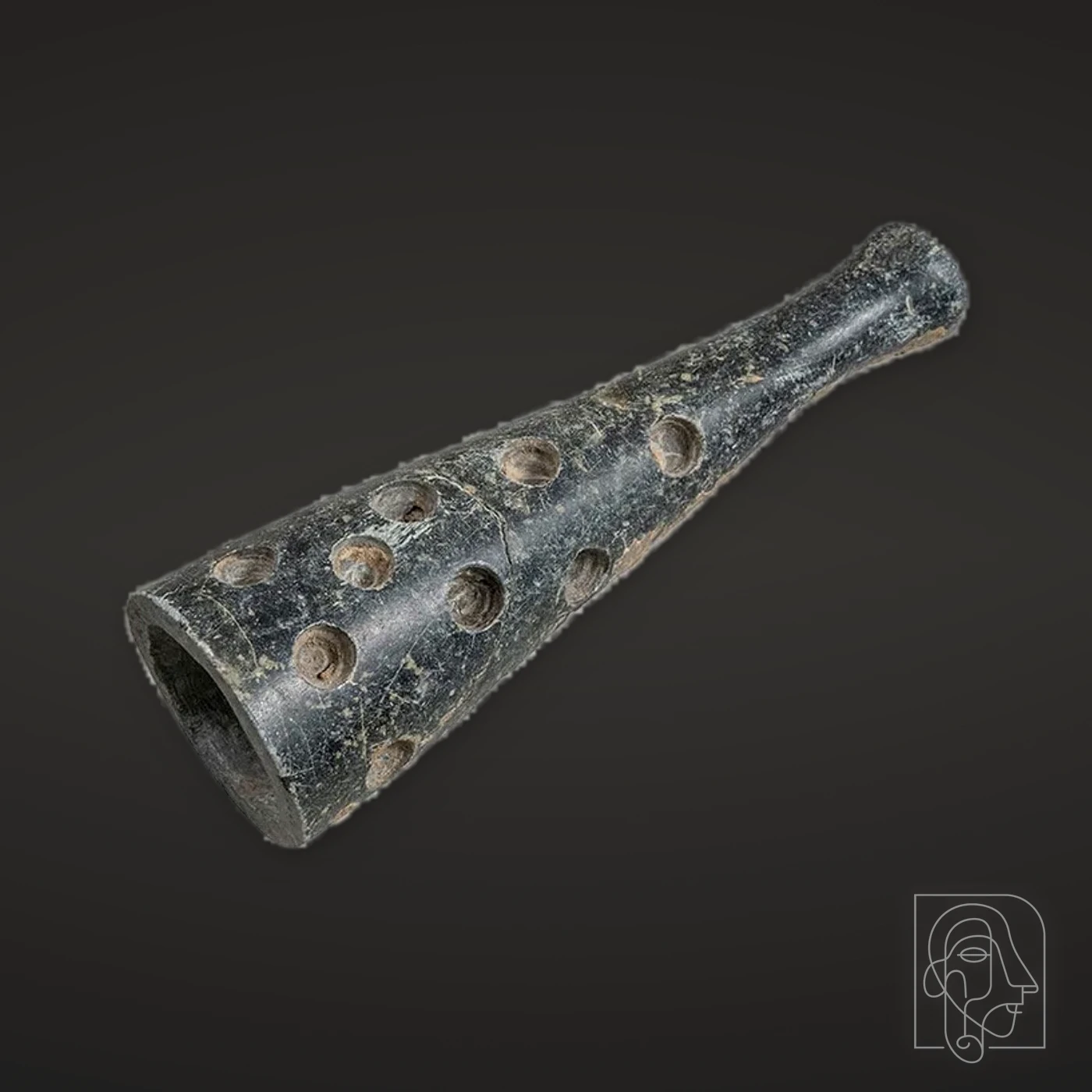
Tapered body of concave (waisted) profile in dark fine-grained stone, with a shallow cavity at the wider terminal and a slightly flared narrow terminal opposite. The cavity is 24 mm across at the mouth, tapers inward to a domed floor approximately 12 mm across, and is approximately 19 mm deep — roughly one sixth of the object's length, leaving the remaining body solid. Wall thickness at the rim is approximately 5 mm. The exterior bears multiple hemispherical drilled cupules distributed in rows across the body, several retaining a lighter-coloured fill. No cupule breaches the cavity. A longitudinal crack originates at the cavity end, runs approximately half the length of the body, then curves back and terminates about an inch from the same end; it does not reach the narrow terminal.
Current working identification: an unfinished conical stone vessel. A shallow blind cavity is observed; vessel function and abandonment during production remain hypotheses. Manufacture date, mineral identity and cultural origin are unconfirmed.
Research history, reconciled 8 October 2026: earlier scholarly passages described a haft socket, socketed implement or mace and proposed Mexican mace-head comparisons. Those functional readings are superseded in the current catalogue by the measured shallow-cavity interpretation. They are retained as research history, not as a second current identification.
Technical analysis
Record cavity taper, floor shape, wall thickness, cupule dimensions, surface finish and crack intersections before assigning function. Determine whether the crack is visible inside the cavity and crosses or avoids cupules. The material is a dark, fine-grained soft stone with mineral identity unconfirmed; an igneous-rock identification is not established. Mineralogical work may identify the stone, while microscopy and deposit comparison may test tool sequence and later alteration. Rounded drill traces alone do not establish age, power source or original function.
Authentication methodology
Separate observed morphology from hypotheses about vessel function, tool operation, age and origin. Preserve recorded in-hand observations with their source. Obtain complete measurements, controlled microscopic images and photogrammetric documentation. Compare the shallow cavity and cupules with specifically cited vessels and manufacturing sequences. Material identification, wear and deposits can support comparison but do not independently date carving. Further chronological evidence is required before ancient manufacture can be asserted.
Comparative works
Current leads concern conical soft-stone vessels and drilled-circle decoration in Old World collections. Exact publications, pages and matching object measurements remain to be supplied before those leads support attribution.
Superseded research-history comparisons: Metropolitan Museum of Art Mexican mace heads 1994.35.780, 1994.35.779 and 1979.206.764 were used during the earlier implement/mace assessment. They are not established vessel matches and do not date or locate JCA.2025.003.
Provenance
Acquired December 2025 at online auction (Palmyra Heritage Gallery, New York; LiveAuctioneers, lot 0575), catalogued by the seller as "Ancient Bactrian Stone Vessel c. 2000 BC" and described as a carved black stone conical vessel with circular incuse design, length given as 4 inches. Seller-stated provenance, recorded verbatim: "Private collection; bought via Parisian collection, France 1980s." No collection name, dealer name, documentation, or chain of ownership accompanied the object. The stated provenance is unsubstantiated. No findspot or excavation context is recorded, and no ownership history prior to the 2025 sale has been independently verified. The seller's attribution, date, and provenance statement are recorded as trade classification and are not independent determinations.
The December 2025 sale is the recorded modern acquisition event. The asserted Parisian collection history in the 1980s is a seller statement without supporting ownership documentation. Preserve any invoice, lot page and correspondence; further archive checking is needed. No archaeological findspot or independently verified earlier chain is established.
Historical context
The manufacture sequence and shallow cavity should guide interpretation. Proposed regional parallels for drilled-circle decoration remain comparative leads; they do not reconstruct a cultural, ceremonial or archaeological context. The seller-stated Bactrian identity is a trade attribution. No securely documented findspot or historical use is known.
Conservation history
No formal treatment history documented. Keep the object mechanically supported, particularly across the longitudinal crack. Do not clean the cavity or cupules; residues and microwear may survive there, and the cupule fill is itself under analysis. Do not immerse the object for volume determination — displacement would compromise any surviving residue, and photogrammetry yields volume without contact. Avoid wax or oil before lithological and use-wear examination.
Bibliography
Research-history references from the superseded mace/implement assessment: Metropolitan Museum of Art objects 1994.35.780, 1994.35.779 and 1979.206.764. These are not current vessel matches. The revised conical-vessel and Old World soft-stone comparisons require exact publications, pages and object locators before being treated as evidential references.