Imperial Bavarian Infantry-Pattern Pickelhaube — Scholarly Analysis
Extended scholarly study of "Imperial Bavarian Infantry-Pattern Pickelhaube" (accession JCA.2025.007): material analysis, authentication methodology, comparative works, and bibliography.
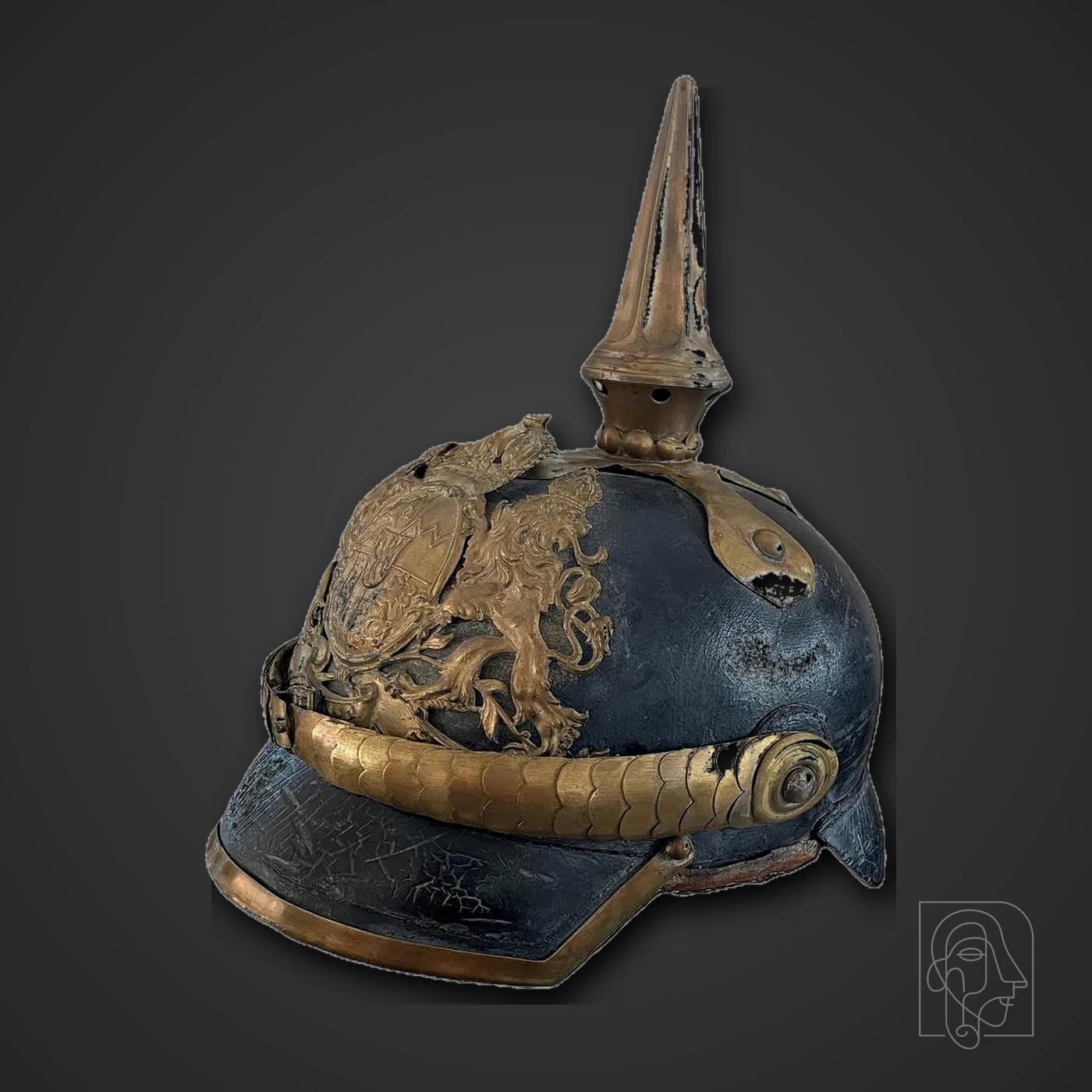
Extended description
JCA.2025.007 is a black leather Pickelhaube with brass spike, visor/rear trim and a Bavarian heraldic front plate showing the crowned shield with flanking lions. The leather shell exhibits pronounced age crazing; an interior liner survives. Australian War Memorial object RELAWM16918, catalogued as a Bavarian-regiment Model 1895 Pickelhaube made c.1915, provides a close institutional comparison in black leather, brass fittings, spike and Bavarian Wappen. The JCA record does not presently document enough interior or side hardware to assign a precise model year, rank or regiment.
Technical analysis
The main diagnostic systems are the formed/lacquered leather shell, spike/base and ventilation arrangement, rear spine, visor trim, Wappen attachment, cockades/chinstrap fittings and liner. Bavarian helmets could change fittings through prewar and wartime economies; brass versus steel components and cockade configuration can therefore matter chronologically. Leather shrinkage and crazing can also alter how fittings sit and should not be mistaken automatically for replacement or poor assembly. Current documentation needs exact spike-base/vent details, rear spine, Wappen reverse/attachment, both side posts and full liner construction.
Authentication methodology
Authentication should compare construction feature by feature rather than rely on the Bavarian plate alone, because plates and fittings can be transplanted. Photograph exterior front/back/sides/top, Wappen front/reverse if removable without risk, spike/base, rear spine, visor undersides, side hardware, cockades/chinstrap if present, liner and every interior stamp. Compare shell/fitting/liner architecture to museum-held Bavarian examples. Wear, patina and leather crazing are supportive condition evidence but cannot establish a model or service history independently.
Comparative works
Australian War Memorial RELAWM16918 is a Bavarian-regiment leather Pickelhaube dated c.1915 with black leather body, brass spike/trim, Bavarian front plate, chinstrap, cockades and nine-tongue liner. AWM RELAWM00692 documents the general Model 1895 leather/brass construction and notes that Pickelhauben were gradually phased out with the 1916 steel helmet. These provide strong type/construction comparanda while leaving the JCA subtype and issue history open.
Provenance
From a private collection; earlier ownership is undocumented. No regiment stamp, named soldier, capture history, bring-back record, period photograph or continuous chain is currently published for this helmet. State-pattern identification must not be converted into a Bavarian regiment or battlefield provenance without direct marks or documentation.
Historical context
The German Empire’s armies retained substantial state identities, and helmet plates visibly encoded those distinctions. Bavarian Wappen differed from Prussian and other German-state plates even when the broader Pickelhaube form converged. By 1914–1916, material shortages and the need for improved protection drove changes in fittings and ultimately replacement by the Stahlhelm, making surviving leather helmets evidence of the transitional prewar/early-war equipment system.
Conservation history
The lacquered leather shell is structurally intact but heavily crazed, with stable brass patina and an aged liner. Do not flex or reshape the shell, oil/dress the leather, polish brass, or tighten fittings against shrunken leather without conservation review. Support the helmet on an inert form that does not load the liner or spike. Record loose/missing hardware and all markings before any stabilization; avoid removing the Wappen solely for authentication if doing so risks leather or attachment damage.
Bibliography
Australian War Memorial, RELAWM16918, “German Model 1895 Pickelhaube: Bavarian Regiment,” c.1915. Australian War Memorial, RELAWM00692, “German Pickelhaube helmet,” discussion of Model 1895 construction, state/unit fittings and gradual 1916 replacement by steel helmet. These museum records establish comparative architecture and chronology, not provenance for JCA.2025.007.