Miquelet Blunderbuss Converted to Percussion — Scholarly Analysis
Extended scholarly study of "Miquelet Blunderbuss Converted to Percussion" (accession JCA.2025.008): material analysis, authentication methodology, comparative works, and bibliography.
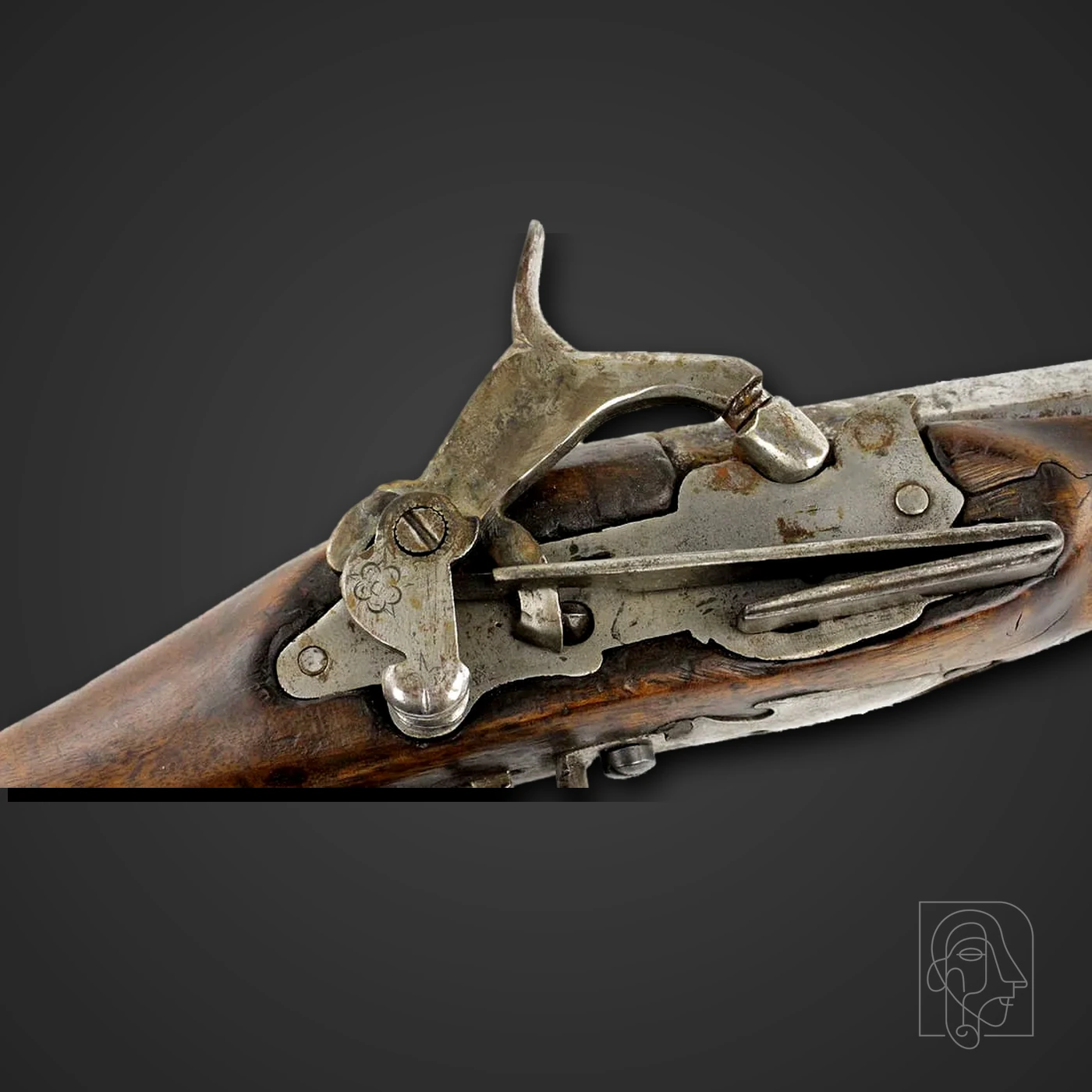
Extended description
JCA.2025.008 is a compact, carbine-stocked muzzle-loading arm with a strongly flared and faceted iron/steel barrel, external miquelet or patilla-family lockwork, plain and pierced iron furniture, a probable long steel belt hook, and a hardwood stock altered by extensive repair. The photographic set materially revises the prior generic “flintlock blunderbuss, European type” cataloging: the lock is not a conventional English/French true flintlock. Its external mainspring and horizontal catch architecture, considered together with the barrel band and probable spring catch, ring-molded muzzle, pierced reverse mount, and recurved trigger-guard terminal, provide a positive Spanish/Iberian constructional basis. Catalan/Ripoll or Spanish-colonial derivation remains a hypothesis rather than a secure workshop attribution. The component chronology is unresolved and the object may incorporate later repairs, restocking, or mixed-period parts.
Catalogue reconciliation, 8 October 2026: the current patilla identification uses subsequently recorded in-hand mainspring and two-sear observations, superseding photograph-only uncertainty. Spanish/Iberian origin is probable in the collection's working assessment; the culture field is undetermined because workshop origin and association of all components are not demonstrated.
Technical analysis
The lock belongs to the broad miquelet/patilla family: the mainspring and sear/catch system are mounted externally, unlike the internally sprung English or French true-flintlock system. The lock retains its full ignition assembly and remains mechanically functional, cocking and releasing on trigger pull. The lockplate has a narrow waisted profile with an apparently unbevelled edge and a scalloped tail, and carries a small engraved rosette at the base of the cock; a forward-projecting spur at the base of the cock neck is consistent with the patilla form. The forend shows a barrel band associated with an apparent spring catch, while the reverse side carries a pierced spear/leaf-shaped mount and, separately, a long tapering iron strap running forward, confirmed as a belt or sash hook. The muzzle is faceted, strongly flared, and finished by a raised ring molding with diagonal incisions. Metalwork is hand-filed and irregular; the stock shows open cracks, patches, replaced wood, and losses around the lock mortise, wrist, forend, and butt, including a full-length lighter-wood splice along the comb. An earlier photographic assessment could not establish the mainspring bearing point. Subsequent direct handling, as recorded by the collection, identified an external mainspring bearing upward on the cock foot and two horizontal sears for half-cock and full-cock, supporting a patilla-family configuration. The arm is currently recorded as converted to percussion. Lock configuration does not independently establish the origin of every component. No conclusion is offered about barrel welding, breech integrity, bore, or touch-hole continuity because these have not been physically examined.
Authentication methodology
The assessment compared fifteen supplied photographs against dated museum and government-catalogued miquelet arms and blunderbusses, separating typology, regional attribution, date, component history, and provenance. Strongest weight was given to lock architecture, barrel retention, furniture, and muzzle construction rather than patina or acquisition story. Direct handling subsequently established that the lock is mechanically functional, that the mainspring bears upward on the cock foot, and that two sears provide distinct half-cock and full-cock positions, and identified the ignition as a percussion conversion rather than an incomplete flint mechanism. Authentication otherwise remains provisional. A qualified historic-arms specialist should first confirm the arm is unloaded, then document both sides, muzzle, bore, breech and tang, lock exterior and interior, barrel underside and channel, stock mortise, screws, unused or doubled holes, wood species, and every concealed stamp under raking light. Radiography of the breech and forend would resolve barrel construction, conversion work, and assembly evidence without disassembly. No firing, dry-firing, live-function testing, refinishing, or undocumented disassembly should be undertaken.
Comparative works
Closest secure comparisons include the Metropolitan Museum of Art’s Spanish Ripoll flared-muzzle miquelet pistols of c. 1750–75 (19.53.50–.51), dated 1687 Catalan miquelet pistols (19.53.24–.25), 17th-century Spanish model miquelet blunderbuss (26.145.365), and dated 1757 Colonial Spanish pistols probably made in Mexico (2011.361–.362); and the Museo Arqueológico Nacional’s Ripoll patilla firearm dated 1651–1700 (inventory 56417). These are largely pistols, and a Catalan-stocked escopeta or trabuco would be the more exact comparandum for a shoulder arm. For the percussion conversion, documented parallels include a patilla belt pistol by Luis Rodriguez of Salamanca dated 1761 and converted in the mid-1800s, the Spanish Model 1752 miquelet musket converted to percussion, and Spanish colonial escopetas converted on their original miquelet locks. Turkish and Albanian miquelet arms provide necessary controls for Mediterranean diffusion. National Trust object 347383 — an English barrel and stock carrying a Spanish Model 1789 lock — is the principal caution that one visible lock cannot assign a single origin or date to every component.
Provenance
The object is from a private collection and was reportedly sourced in Mexico. No seller archive, customs or export record, colonial inventory, family history, early photograph, named owner, archaeological context, or premodern chain is presently documented. Mexico is therefore retained only as modern acquisition context. Museum comparanda demonstrate that Spanish arms and miquelet technology reached Spanish America and that later repair in Mexico is historically possible, but those parallels are not provenance for this object.
Historical context
Spanish patilla locks formed a durable Iberian ignition tradition and circulated through Mediterranean and Spanish imperial networks. Ripoll in Catalonia was an important production and export center; museum collections preserve its distinctive flared barrels, belt hooks, banded retention systems, and locally characteristic furniture. Those traits strengthen the present working attribution when read as a cluster, but none is individually exclusive to Spain. The object should be interpreted as evidence of a wide technological network rather than assigned a romantic coach, naval, colonial, or military story without documents specific to it.
Conservation history
No formal treatment record is documented. Photographs show substantial historic and possibly later intervention: cracks, open splits, missing wood, multiple patches, a full-length lighter-wood splice along the comb, localized yellow-metal or solder-like material near the forward catch, surface abrasion, corrosion, pitting, and prior cleaning. Conservation should prioritize documentation and stabilization. Avoid sanding, refinishing, aggressive rust removal, chemical cleaning, or tightening screws against cracked wood. Support the arm along its full length, isolate it from ammunition, and maintain a stable moderate environment. A conservator familiar with composite historic arms should assess active corrosion, loose fragments, and moving cracks.
Bibliography
The Metropolitan Museum of Art: “Pair of Miquelet Pistols,” Spanish, Ripoll, c. 1750–75, 19.53.50–.51, https://www.metmuseum.org/art/collection/search/33316; “Pair of Miquelet Pistols,” Spanish, Catalonia, dated 1687, 19.53.24–.25, https://www.metmuseum.org/art/collection/search/22731; “Model of a Miquelet Blunderbuss,” Spanish, 17th century, 26.145.365, https://www.metmuseum.org/art/collection/search/32423; “Pair of Miquelet Pistols,” Colonial Spanish, probably Mexico, dated 1757, 2011.361–.362, https://www.metmuseum.org/art/collection/search/35702; Turkish and Albanian miquelet comparanda 36.25.2164, 36.25.2221, and 36.25.2194. Museo Arqueológico Nacional / CER.es, Ripoll escopeta-revólver, 1651–1700, inventory 56417, https://ceres.mcu.es/pages/Main?idt=58754&inventary=56417&museum=MAN&table=FMUS. National Trust Collections, miquelet blunderbuss NT 347383, https://www.nationaltrustcollections.org.uk/object/347383. National Park Service, “Weapons-Evolution of Weapons,” https://www.nps.gov/fosc/learn/education/weaponevolution.htm.