U.S.C.E.-Marked Meuse-Argonne Commemorative Lighter — Scholarly Analysis
Extended scholarly study of "U.S.C.E.-Marked Meuse-Argonne Commemorative Lighter" (accession JCA.2025.014): material analysis, authentication methodology, comparative works, and bibliography.
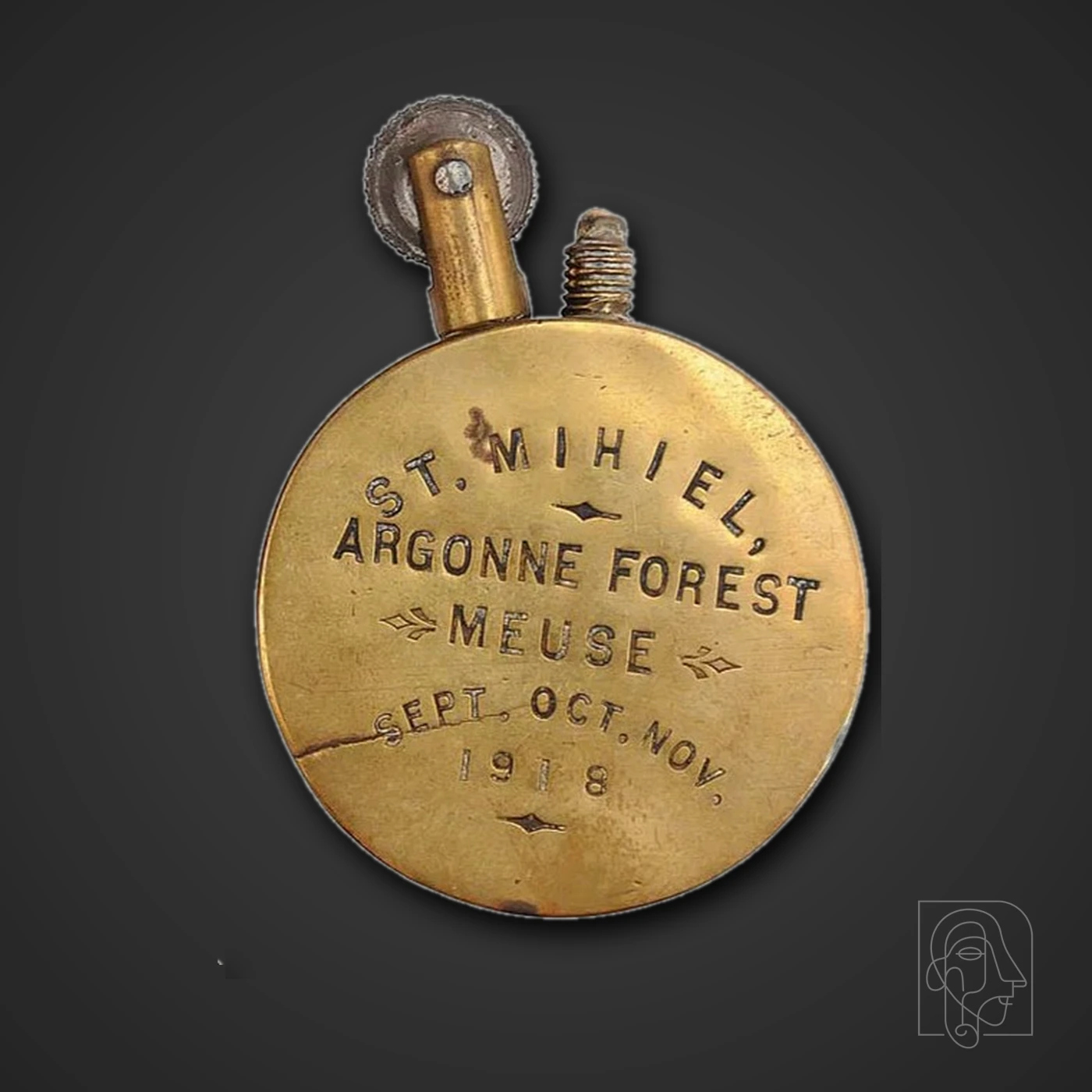
Extended description
JCA.2025.014 is a circular brass petrol lighter with a knurled striker wheel, wick assembly and campaign inscriptions. JCA’s retained object register records the phrases “WITH THE 1st ARMY CORPS,” “MEUSE – ARGONNE FOREST,” “SEPT. OCT. NOV. 1918,” together with “U.S.C.E.” These inscriptions materially distinguish the object from an unmarked generic pocket lighter and provide a direct documentary layer on the artifact itself. The Meuse-Argonne dates align with U.S. Army campaign chronology, but the lighter has no named owner, serial-linked service record or proven workshop.
Technical analysis
The object is a refillable petrol lighter using a wick and spark/striker system within a circular brass body. Technical study should document the exact mechanism, fuel chamber, wick tube, striker/ferrocerium arrangement, seams, solder, cap/closure and whether the engraved campaign text cuts through an aged surface consistently across panels. Mechanical function is recorded but should not be used as a dating test. Brass composition, wear and hand engraving are compatible with period personal equipment but not uniquely diagnostic of 1918.
Authentication methodology
Authentication should separate the base lighter from the engraved commemorative layer. Photograph the full exterior in raking light, every inscription, seams, mechanism and interior accessible without destructive disassembly. Compare lettering depth, wear and oxidation inside/outside the cuts for evidence of relative age. Historical verification should test only the inscription’s plausibility: CMH confirms Meuse-Argonne from 26 September to 11 November 1918 and First Army/I Corps activity in the 1918 AEF. None of that historical match independently proves the engraving was cut in France or by the original servicemember.
Comparative works
U.S. Army Center of Military History, “Meuse-Argonne: 26 September–11 November 1918,” establishes the offensive’s dates and First Army context. First Army’s official history confirms its establishment in August 1918 and participation in St. Mihiel and Meuse-Argonne. CMH division histories document assignment of units to American I Corps during the campaign period. These sources validate the historical content of the inscription but are not object provenance.
Provenance
Acquired at auction; prior ownership is undocumented. No veteran name, unit roster, family statement, wartime photograph, bring-back record, trench-art workshop history or auction provenance packet is currently linked to the lighter. The U.S.C.E./I Corps/Meuse-Argonne inscriptions are evidence on the object, not a continuous ownership chain.
Historical context
Personal objects were frequently engraved or adapted to preserve names, places, units and campaigns, sometimes during service and sometimes after return. The lighter’s wording makes the Meuse-Argonne memory unusually explicit, but “commemorative” is safer than asserting trench manufacture. The U.S.C.E. mark can support a Corps of Engineers association while the separate phrase “1st Army Corps” should not be collapsed automatically into a single unit identity without knowing how the original owner used those terms.
Conservation history
Recorded as functional with original patina. Preserve the engraved lettering, brass surface and mechanism; do not polish the case or clean engraving cuts aggressively, because oxidation within the cuts may be useful for assessing relative age. Store unfueled where practical. Avoid repeated ignition for display and record any replacement wick, flint or other consumable maintenance separately from original components.
Bibliography
U.S. Army Center of Military History, Richard S. Faulkner, “Meuse-Argonne: 26 September–11 November 1918,” CMH Pub 77-8. First Army official history, “World War One,” on establishment and Meuse-Argonne participation. U.S. Army CMH 92d Division WWI history, documenting I Corps assignments during the Meuse-Argonne period. JCA retained object register for exact inscriptions.