French WWI Trench-Art Shell-Case Souvenir Inscribed “REIMS” — Scholarly Analysis
Extended scholarly study of "French WWI Trench-Art Shell-Case Souvenir Inscribed “REIMS”" (accession JCA.2025.015): material analysis, authentication methodology, comparative works, and bibliography.
Extended description
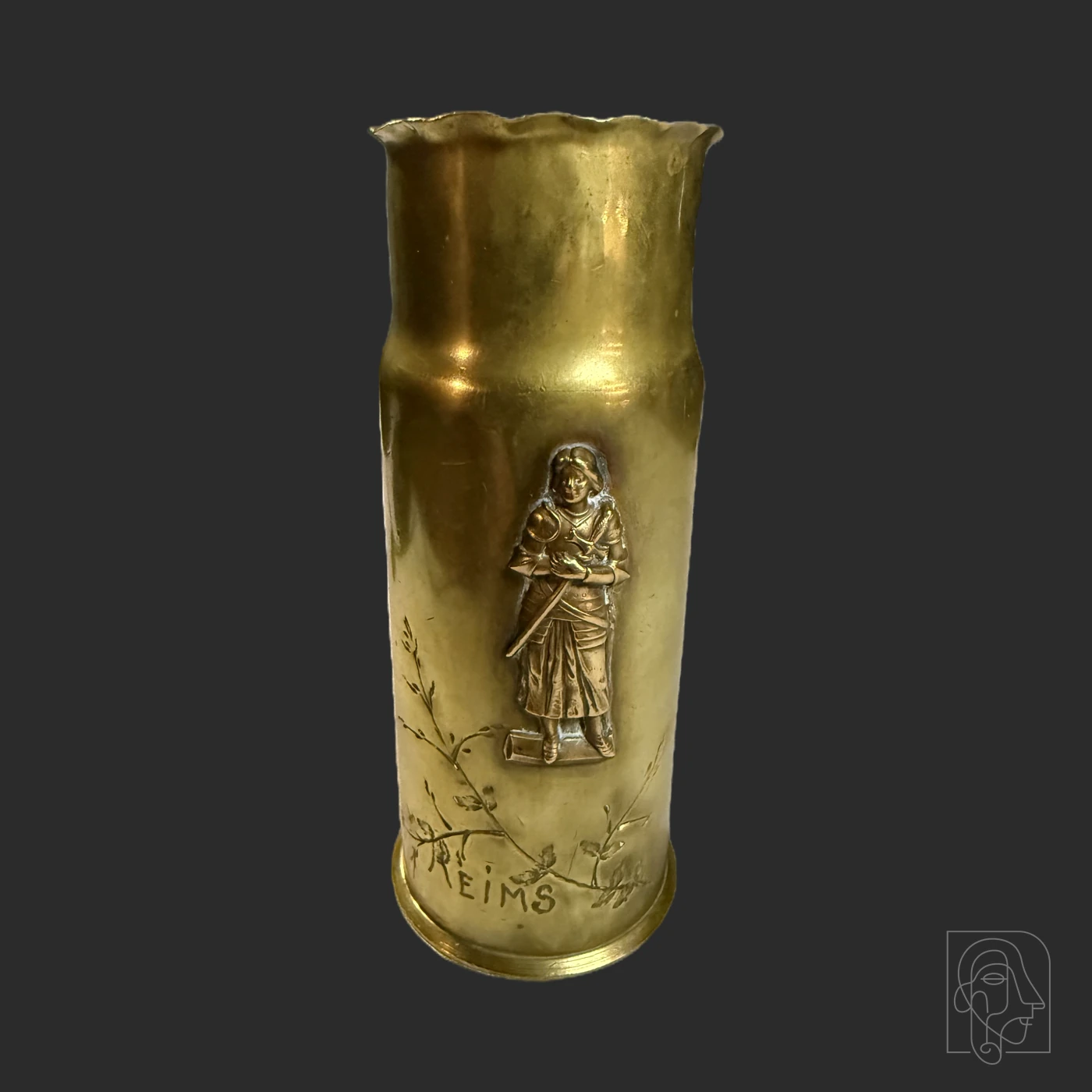
JCA.2025.015 is a compact brass trench-art vessel approximately 5.5 in. high by 2 3/8 in. in diameter, made from an artillery cartridge case and decorated with worked floral motifs and the inscription “REIMS.” The base preserves two recorded mark groups, “47.R.” and “MA.I. 2.6-16,” whose exact interpretation is presently unresolved. The Reims inscription is a direct commemorative statement on the object. The Musée du Fort de la Pompelle preserves numerous French First World War “souvenir du front” and “souvenir des tranchées” works dated 1915–1916, demonstrating a well-documented local/regional culture of soldier-made commemorative objects. The JCA object belongs plausibly within that material world, but no direct connection to the museum’s named maker Marcel Mardelle or his regiment is claimed.
Technical analysis
The object is a repurposed brass cartridge case whose cylindrical wall has been worked decoratively rather than left in ammunition-service condition. Technical documentation should distinguish the original industrial case manufacture from later chasing, repoussé, engraving or punching. The base markings may contain manufacturer, inspection, lot, caliber or date information, but their meaning cannot be inferred reliably from a text transcription alone. A complete base photograph with known diameter, primer-pocket form and all headstamps is needed before cartridge type or exact production date is assigned. The decorative working sequence should be documented under raking light and from the interior if accessible.
Authentication methodology
Authentication proceeds in layers. First, confirm that the substrate is an original artillery cartridge case by documenting base morphology, primer area, dimensions and industrial stamps. Second, document the decorative tool marks, patina inside cuts/raised work and any soldering or annealing evidence to assess whether conversion is plausibly period or early postwar. Third, evaluate the “REIMS” inscription and base marks independently: the place-name establishes commemorative subject, while headstamps may date only the original ammunition case. Comparative trench-art objects with documented makers are useful for process/context but cannot authenticate an unprovenanced object by visual similarity alone.
Comparative works
The Musée du Fort de la Pompelle in Reims preserves Marcel Mardelle works dated 1915 and 1916 explicitly catalogued as “artisanat de tranchée,” including “1916 Souvenir des tranchées,” “1916 Souvenir du Front,” and “Souvenir du Front 1914 1915 1916.” These establish contemporaneous French commemorative trench craft in the Reims-front museum context. Australian War Memorial RELAWM14161 is a documented c.1918–1919 vase made from a French 75 mm shell case, demonstrating the established conversion of French artillery cases into decorative vessels and the important distinction between the case’s ammunition markings and the later date of conversion.
Provenance
Acquired at auction. No auction-house citation, lot number, consignor, veteran identity, family chain, wartime photograph, French workshop history or earlier collection record is presently published. “REIMS” is an inscription on the object and should not be treated as proof that the case was found, made or purchased in Reims. The object remains unassociated with any named soldier or unit.
Historical context
Reims endured prolonged shelling and stood near active First World War fronts, making the city a powerful place-name within wartime and postwar memory. Trench art broadly encompasses objects made by soldiers, civilians, workshops, prisoners or later souvenir producers, often from military scrap; the label does not prove literal manufacture inside a trench. JCA.2025.015 should therefore be read as a Western Front commemorative object centered on Reims, with its exact maker and production circumstances left open.
Conservation history
No formal conservation history is documented. The brass retains stable patina, surface wear and tool marks. Avoid abrasive polishing, chemical brightening, wire brushing or cleaning inside engraved/repoussé recesses because patina and tool traces are evidentiary. Support the base rather than decorative walls during handling. Before any treatment, obtain complete exterior/interior and base macro photography, especially the marks “47.R.” and “MA.I. 2.6-16.”
Bibliography
Musées de Reims / Musée du Fort de la Pompelle, Marcel Mardelle: “1916 Souvenir des tranchées,” “1916 Souvenir du Front,” and related 1915–1916 works catalogued as artisanat de tranchée. Australian War Memorial, RELAWM14161, “Trench art chrysanthemum vase: Sapper S. K. Pearl,” c.1918–1919, made from a French 75 mm shell case. Australian War Memorial, REL39666, French 75 mm shell case dated 1916, useful for cartridge-case/base-mark comparison. These sources establish context and conversion practice, not direct provenance for JCA.2025.015.