WWI U.S. Property Safety Razor Shaving Kit (Gillette Components) — Scholarly Analysis
Extended scholarly study of "WWI U.S. Property Safety Razor Shaving Kit (Gillette Components)" (accession JCA.2026.005): material analysis, authentication methodology, comparative works, and bibliography.
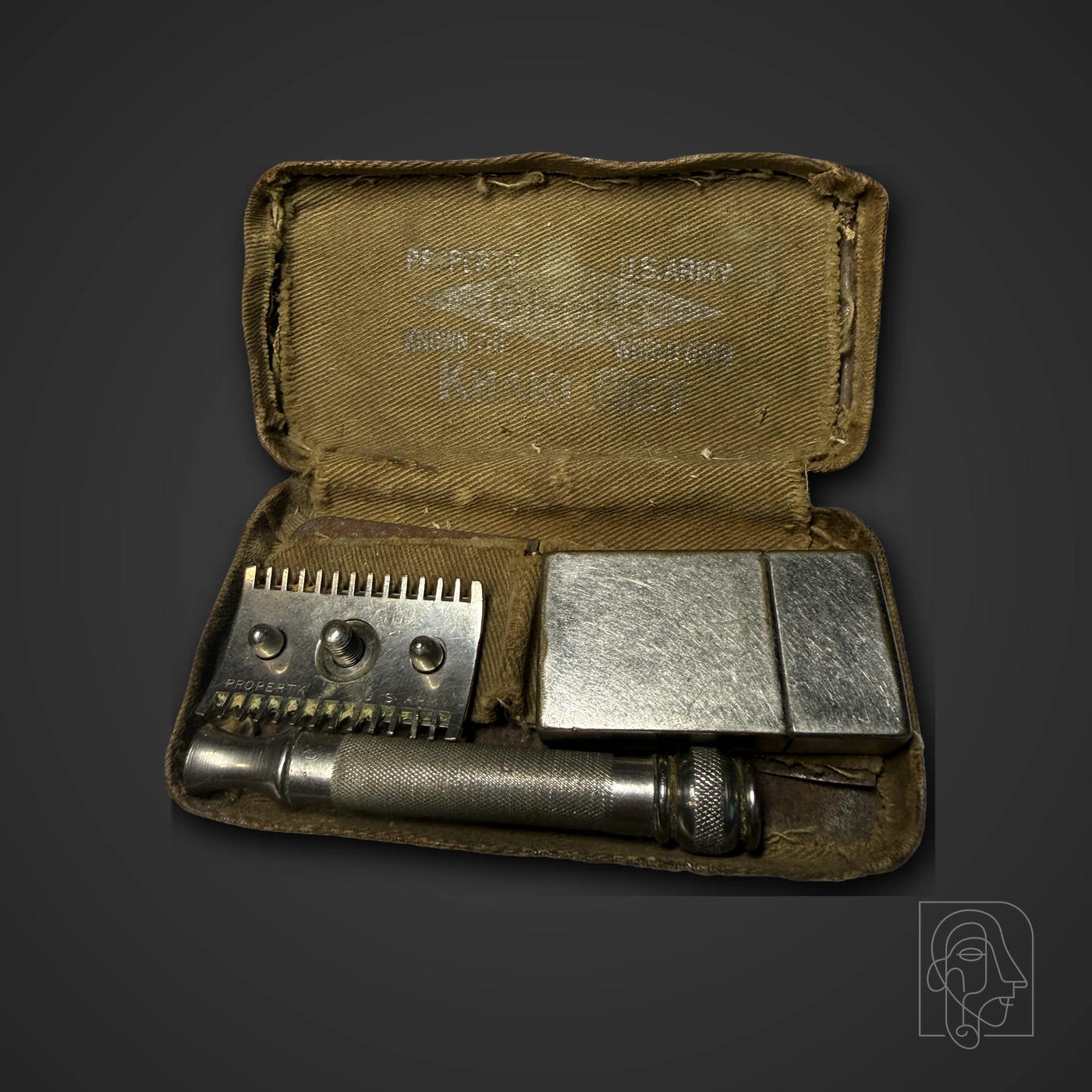
Extended description
JCA.2026.005 is a portable shaving kit in a fabric-covered hard case approximately 4.5 × 3.125 in., retaining a safety razor, blade containers/material and period Gillette packaging. The retained JCA object study records “PROPERTY U.S.A.” on the razor head and faded interior case stenciling. Smithsonian’s 1917 Gillette U.S. Service Razor Set demonstrates that Gillette produced both issued khaki and commercially available metal service sets during the war. The JCA configuration is not described identically enough to force either Smithsonian variant, but its marked razor and period packaging place it securely within the same service-era shaving culture.
Technical analysis
A safety-razor kit is a composite object: razor head, handle, blade boxes/wrappers and case may have different production marks and may have been assembled or replaced over time. Technical review should record the razor serial number, patent dates, plating, handle construction, head/baseplate markings, blade-box inscriptions, case material, closure and interior stencil. The “PROPERTY U.S.A.” wording is significant but should be compared to documented “Property U.S. Army” and other U.S.-service markings before assigning a specific procurement category.
Authentication methodology
Authenticate components individually and then assess the set as an assemblage. Compare the razor form/serial/patent marks with Gillette wartime production; compare case measurements/construction and property markings with Smithsonian and other institutional U.S. Service Set examples; date blade wrappers independently because consumables can be replaced. Wear and patina support use but cannot prove that all pieces were together in 1918. Current photography should include all marks, serial, interior case stencil and each component laid out separately.
Comparative works
The Smithsonian National Museum of American History’s Gillette U.S. Service Razor Set, dated 1917, documents wartime Gillette service sets, including the soldier-issued khaki version. The Museu d’Història de Catalunya catalogs 1917–1919 Gillette military-set components and explains that U.S. government shaving-kit procurement was tied to wartime service and gas-mask fit. A 1918 Gillette company publication advertises military and khaki sets for “Uncle Sam’s Men,” providing contemporary commercial context.
Provenance
From a private collection before JCA. No named soldier, unit, quartermaster issue record, service number, original issue packet or continuous family chain is currently documented. “PROPERTY U.S.A.” is property/issue evidence on the component, not a named recipient history.
Historical context
Chemical warfare made protective masks a routine concern for soldiers, and close-fitting mask systems were sensitive to facial hair. Historical accounts and museum interpretation connect military shaving with maintaining mask seals, while razors also served ordinary hygiene and discipline. The kit should therefore be interpreted as personal equipment shaped by both everyday grooming and the technological demands of gas warfare, without implying that this individual kit was carried in a specific gas attack or battle.
Conservation history
The metal parts show patina/light oxidation and the case has fraying, staining and faded markings. Do not polish away property/patent/serial marks or launder the case. Stabilize loose textile edges, separate corroding metal from paper blade wrappers with inert interleaving, and store blades safely so sharp edges cannot damage the case or handling staff. Do not use period blades or razor components for demonstration.
Bibliography
National Museum of American History, Smithsonian Institution, “Gillette U.S. Service Razor Set,” dated 1917, issuing authority United States Government. Museu d’Història de Catalunya, Gillette military/Khaki Set components, 1917–1919, including discussion of U.S. government procurement and gas-mask fit. The Gillette Blade, February 1918, contemporary advertisement for Military and Khaki Sets.