Standing Greenstone Figure, Mezcala Style — Scholarly Analysis
Extended scholarly study of "Standing Greenstone Figure, Mezcala Style" (accession JCA.2026.013): material analysis, authentication methodology, comparative works, and bibliography.
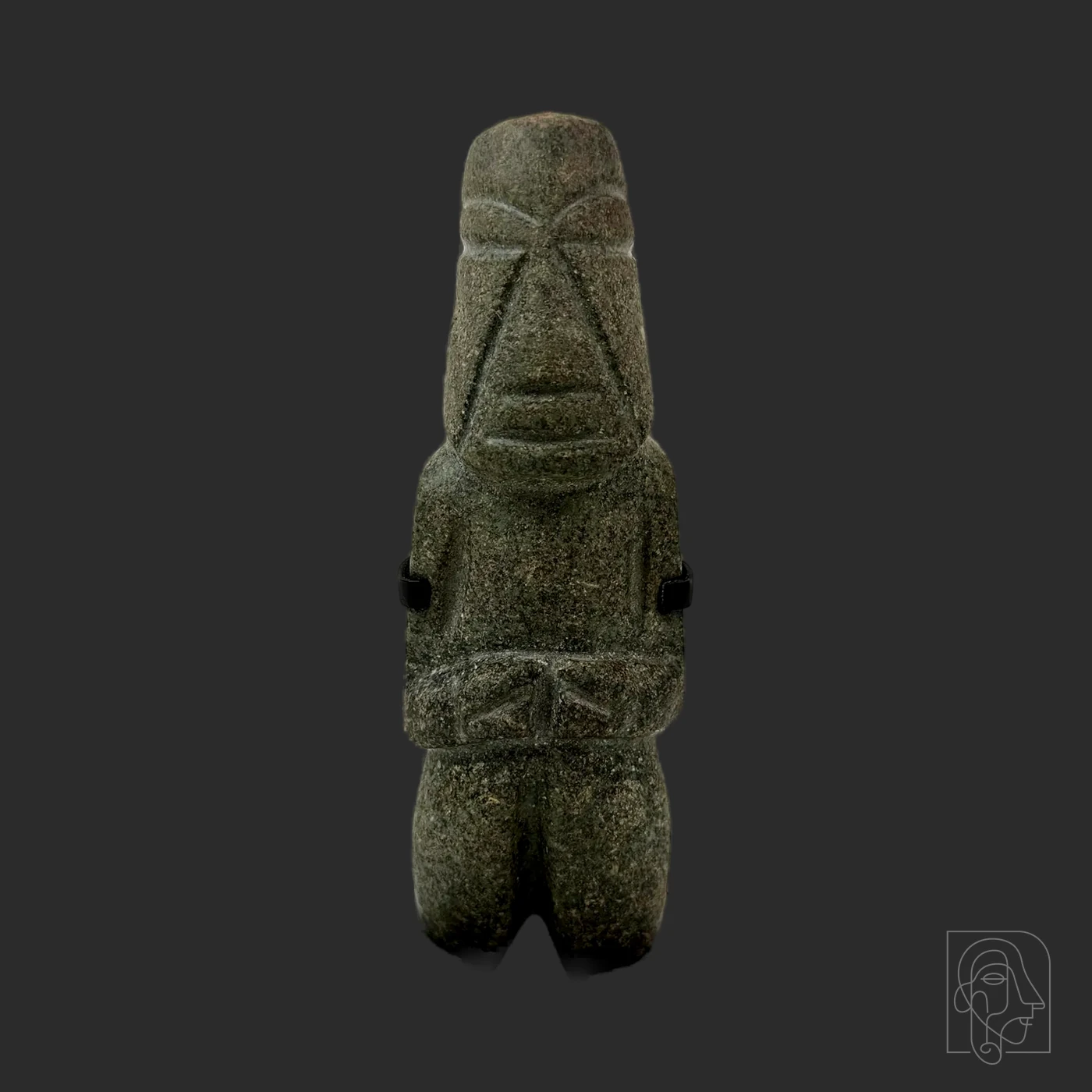
Extended description
JCA.2026.013 is a dense greenstone standing anthropomorphic figure approximately 7.5 in. high, with a strongly abstracted head and body, simplified facial cutting and planar limbs. The form compares closely with Mezcala sculpture from Guerrero, where artists reduced the human figure to angular and axe-like volumes. A Metropolitan Museum standing greenstone figure dated 300 BCE–300 CE shows the same conceptual simplification, while other Met Mezcala standing figures are catalogued more broadly to the first through eighth centuries CE. The variation cautions against the former generic “Preclassic 500 BCE–600 CE” formula.
Technical analysis
Authentication should focus on the actual stone and worked surfaces: petrographic/mineral identification, polish and pecking/grinding traces, micro-chipping in recesses and edges, weathering continuity across exposed and protected areas, modern rotary/tool traces, residues, and the relationship between the object and its modern mount. A dense greenstone appearance is compatible with Mezcala traditions but is not unique to ancient manufacture.
Authentication methodology
Obtain high-resolution multi-angle and microscopic surface photography before any cleaning. Identify the stone mineralogically, compare tool traces with documented Mezcala lapidary methods, inspect the mount interface, and subject the piece to an in-hand Mesoamerican stone-sculpture specialist review. Provenance and authentication should be evaluated independently: the Barakat-related modern trail may explain recent custody but does not establish ancient origin.
Comparative works
The Metropolitan Museum of Art preserves Mezcala standing figures in greenstone and related stone, including a 300 BCE–300 CE example from Guerrero and other standing figures assigned to the first–eighth centuries CE. The Cleveland Museum of Art describes Mezcala small-scale greenstone sculpture as sleekly abstract and notes that archaeological contexts and meanings are often poorly known. These are strong style comparanda but do not authenticate JCA.2026.013.
Provenance
JCA acquired the object at auction in 2025 from an intermediary associated with a storage-unit purchase. Current records identify former storage tenant Fayez Barakat and a modern stand marked PF-731; separate auction material documents other Barakat-associated greenstone figures. This is a modern provenance trail, not an object-specific pre-1970 chain. No excavated findspot, export permit, early collection inventory, field record or continuous ownership history has been established for JCA.2026.013.
Historical context
Museum scholarship places Mezcala-style sculpture in Guerrero and documents use in burials as well as later reuse of older Mezcala works in Mexica offerings. Because the JCA object lacks archaeological context, those practices must remain cultural comparanda rather than a narrative of what happened to this particular figure. Cultural-property review is also relevant because a genuine Mexican antiquity without documented early provenance raises stewardship and documentation questions independent of stylistic quality.
Conservation history
The object is mounted on a modern professional stand; no other formal treatment history is documented. Preserve the PF-731 stand marking and document the mount interface. Avoid oiling, waxing, abrasive cleaning or removing mineral/residue evidence before microscopic and material examination. Any remounting should be reversible and avoid pressure on carved edges.
Bibliography
The Metropolitan Museum of Art, “Standing figure,” Mezcala, 300 BCE–300 CE, object 1978.412.42; additional Met Mezcala standing figures dated first–eighth centuries CE. Cleveland Museum of Art, “Seated Figure,” Mezcala, 100 BCE–300 CE, discussing abstract greenstone sculpture and limited archaeological-context knowledge. Standard Mezcala bibliography cited by The Met includes Carlo T. E. Gay, Mezcala Stone Sculpture: The Human Figure (1967), and Gay & Frances Pratt, Mezcala: Ancient Stone Sculpture from Guerrero, Mexico (1992).