Bearded Draped Terminal Bust on Stepped Four-Footed Pedestal — Scholarly Analysis
Extended scholarly study of "Bearded Draped Terminal Bust on Stepped Four-Footed Pedestal" (accession JCA.2026.015): material analysis, authentication methodology, comparative works, and bibliography.
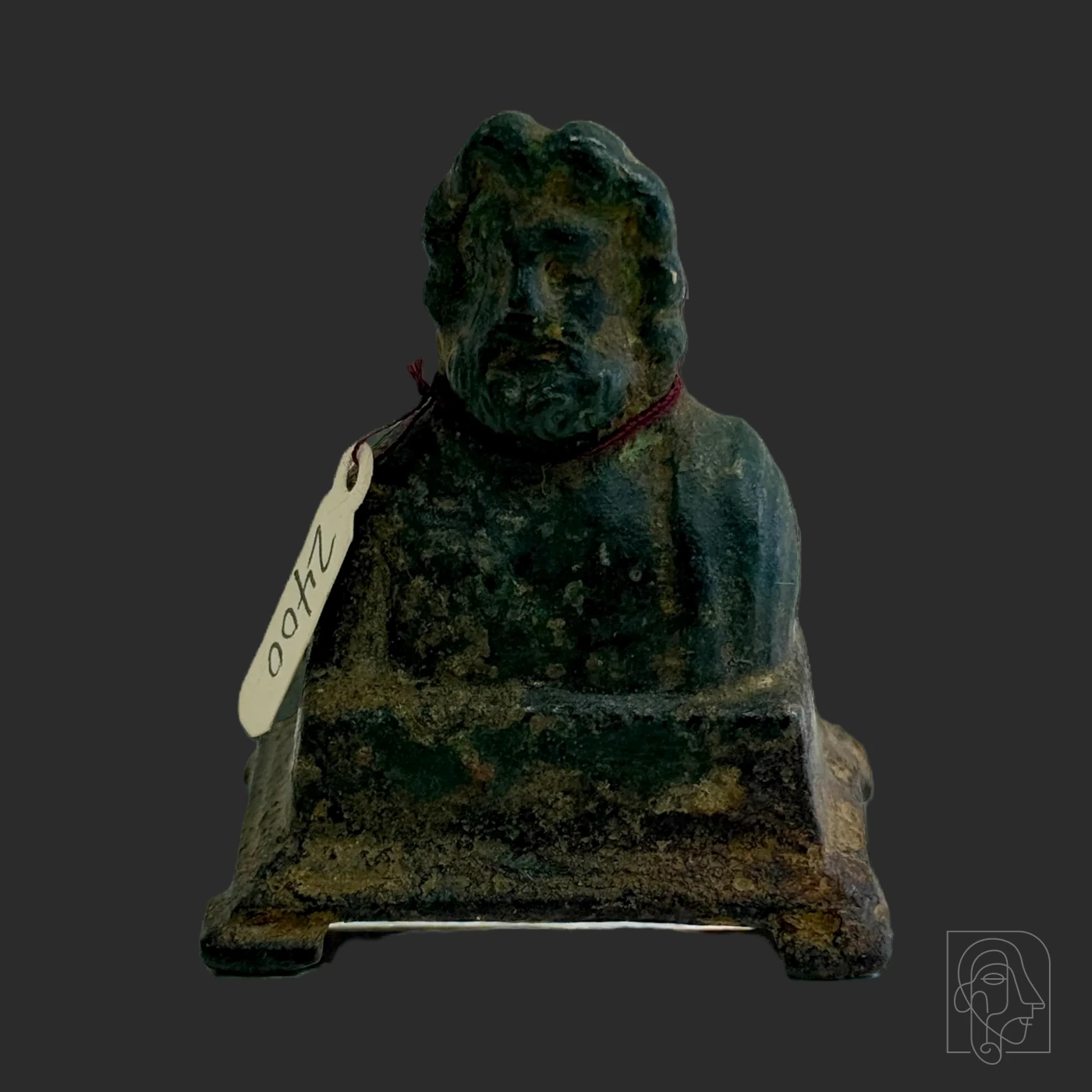
Extended description
JCA.2026.015 is a miniature cast copper-alloy terminal bust approximately 5.7 cm high and 4.4 cm wide. The head and upper body are modeled with a pronounced brow, deeply outlined eyelids, projecting nose, prominent moustache, and a full beard articulated in broad curved locks. Supplied microscope photographs clarify two raised, grooved locks flanking a central part above the forehead, as well as the eyelid outlines and curved beard grooves. The shoulders, upper arms, and rounded draped torso terminate above a deliberately complete architectural pedestal. The pedestal comprises a main rectangular block, two continuous lower stepped moldings, and four projecting corner feet. In-hand observations recorded by the collection establish that there are no hands, waist, hips, human legs, lap, seat, or chair. This is a terminal bust rather than a seated figure with missing lower anatomy. The underside contains pale/tan retained material of unresolved composition. The provisional cultural and chronological comparison is Roman Imperial, possibly 1st–3rd century CE, with the 2nd century as a working focus. Zeus/Jupiter is a tentative subject comparison. Exact identity, function, manufacture date, and antiquity remain unconfirmed.
Technical analysis
Technical examination should treat the upper figure, stepped pedestal, and recessed underside as a single construction problem. The first priority is to determine whether the torso and pedestal were cast continuously or joined, using microscopy and radiography to identify seams, solder or brazing, casting gates, sprue removal, repairs, and internal structure. The pedestal comprises a main rectangular block, two continuous lower steps, and four feet; documenting whether the moldings and feet share uninterrupted metal and corrosion is important for reconstructing manufacture. The recessed underside contains pale/tan retained material visually distinct from the surrounding copper alloy. That material should be recorded in situ and not scraped or removed. Possible interpretations include retained casting core, sediment, restoration plaster/fill, or mixed deposits. Surface examination should map the dark brown/black, green, reddish-orange, yellow/tan and pale zones, especially at protected recesses and boundaries, without assuming that patina chronology establishes object age. Portable XRF can characterize alloy composition; radiography or micro-CT can reveal internal construction; targeted microscopy can assess casting and tooling; and retained-material analysis may clarify whether the underside mass belongs to manufacture, burial, or restoration.
Microscope photographs reviewed on 2026-10-05 improve the visibility of the grooved forehead locks, outlined eyelids, broad curved beard locks, heterogeneous surface zones, and deposits within recesses. These are visible observations rather than measured corrosion depth or identified mineral phases. The photographs do not establish the surface alteration's stratigraphy or formation history. Correlate these views with examination of casting seams, tooling, joints, and retained underside material before drawing a manufacturing-age conclusion.
Authentication methodology
Authentication should proceed independently from morphological classification. Full macro photography should document front, both profiles, back, upper hair, body-to-pedestal transition, all stepped moldings, four feet, and the complete underside. Microscopy should search for casting seams, modern rotary tooling, filing, solder, brazing, repair interfaces, corrosion continuity, and the boundary between copper alloy and the pale underside material. Portable XRF may characterize alloy composition but cannot by itself date the object. Radiography or micro-CT is recommended to establish whether the bust, pedestal, and feet form one casting and to identify hidden joins or fill. If sampling can be justified conservationally, analysis of corrosion stratigraphy and the retained underside material could further characterize surface and manufacturing history. Comparative study should focus on securely provenanced Greek and Roman herms, terminal busts, and bronze furniture ornaments while keeping later classical-revival bronzes in the comparison set. Provenance research remains a separate and necessary line of evidence.
Comparative works
Structural comparisons: (1) The Metropolitan Museum of Art, Bronze bust of Minerva, Roman, 1st–2nd century CE, 97.22.10, 7.8 × 4.6 × 4.1 cm. Its modeled bust, stepped rectangular pedestal, and projecting feet provide a useful formal comparison, including a width close to JCA.2026.015. (2) LACMA, Bronze Bust (Weight?), Egypt, 2nd–3rd century CE, M.82.77.28, 8.89 × 4.45 cm, provides a further small bust-and-stepped-base comparison; the uncertain weight interpretation is not transferred to the JCA object. (3) Sema Talu, Bronze Statuettes and a Scale Weight from Andriake, The Port of Myra (2026), fig. 12, illustrates a separately excavated rectangular bronze pedestal with molded transitions and four feet. It is a base comparison, not a matching bearded bust or identification as a weight.
Facial comparisons: The Met Bronze bust of Jupiter, 17.230.2, late 1st century BCE–1st century CE, provides a named bronze comparison for the brow, projecting nose, moustache, and framing curls, although its beard is shorter and the pose differs. The Uffizi Head of Zeus, 1914 n. 73, 2nd century CE, is useful for hair and beard arrangement; the museum records restoration of the nose, left brow, right cheekbone, and upper lip, limiting comparison of those features. Hessen Kassel Heritage, Bearded God ('Zeus'), Sk 86, circa AD 160, documents the overlapping facial vocabulary of Zeus/Jupiter, Asklepios, Poseidon/Neptune, Serapis, and Saturn. The Borghese Small Bust of Serapis, CCXCVII, shows that a Serapis interpretation is not excluded solely by the absence of a modius, but the catalogue reports that 2019 alloy analysis suggests an alternative 18th-century date; it is not used as a secure ancient dating anchor.
Earlier general herm comparisons remain relevant: Met 97.22.13 and 19.192.1 (Roman, 1st–2nd century CE), 1989.281.56 (Greek, Arcadian, circa 490 BCE), and 96.9.243 (bearded man or god, Greek or Roman, circa 100 BCE–100 CE). No exact duplicate or shared casting model for JCA.2026.015 has been established.
Provenance
Auction acquisition; prior ownership history is unknown. A loose paper tag tied around the neck bears the handwritten number “2400.” Its meaning has not been established and should be treated as a provenance lead rather than interpreted as a specific kind of number. The tag should be photographed separately and researched against the auction source, consignor records, old catalogues, dealer inventories, and acquisition paperwork. No excavated findspot, export history, early collection inventory, publication, dealer archive, or continuous chain of custody is presently documented. For a potentially ancient object, this provenance gap materially limits historical interpretation and stewardship assessment.
Historical context
The object participates in the broad classical tradition of herms and terminal figures, although its rounded draped torso differs from a strict herm's head or abbreviated bust above a quadrangular shaft. Small Roman bronzes provide structural comparisons for a modeled bust rising from a stepped pedestal. The Met bronze Minerva 97.22.10, dated 1st–2nd century CE, and LACMA Bronze Bust (Weight?) M.82.77.28, dated 2nd–3rd century CE, establish a relevant museum comparison range. The beard, raised forehead locks, and pronounced eye region invite comparison with Roman representations of mature male deities. Zeus/Jupiter is the leading visual research hypothesis among the examined examples; similar facial conventions also serve other deities. As the Kassel catalogue emphasizes for its bearded god Sk 86, attributes or archaeological context are needed to resolve the name. These comparisons support a possible Roman Imperial date for JCA.2026.015 if ancient, rather than an independent authentication. They do not establish a votive, household cult, furniture-fitting, or weighing function. The word “Weight?” in the LACMA title records uncertainty about that separate object and does not identify the function of JCA.2026.015.
Conservation history
No formal treatment history is documented. The object should not be polished or mechanically cleaned before technical examination. Preserve all corrosion products and the pale/tan material retained in the recessed underside, which may contain manufacturing, burial, or restoration evidence. Photograph and microscopically map the boundaries between metal, corrosion layers, and retained material before any intervention. Keep the object in a dry, stable environment and monitor any active powdery green corrosion. If conservation becomes necessary, treatment should prioritize stabilization while preserving casting, tooling, corrosion, and retained-material evidence.
Bibliography
The Metropolitan Museum of Art, “Bronze herm,” Roman, 1st–2nd century CE, object 97.22.13. The Metropolitan Museum of Art, “Bronze herm,” Roman, 1st–2nd century CE, object 19.192.1. The Metropolitan Museum of Art, “Bronze herm,” Greek, Arcadian, ca. 490 BCE, object 1989.281.56. The Metropolitan Museum of Art, “Bronze head of a bearded man or god,” Greek or Roman, ca. 100 BCE–100 CE, object 96.9.243. Getty Museum and Getty Conservation Institute publications on ancient bronze manufacture, core materials, corrosion, and technical examination. These sources establish formal and technical comparison categories and do not authenticate JCA.2026.015.
Specific comparisons reviewed for the 2026-10-05 revision: The Metropolitan Museum of Art, Bronze bust of Minerva, 97.22.10, Roman, 1st–2nd century CE: https://www.metmuseum.org/art/collection/search/246688 LACMA, Bronze Bust (Weight?), M.82.77.28, Egypt, 2nd–3rd century CE: https://collections.lacma.org/object/39855 Talu, Sema. 2026. Bronze Statuettes and a Scale Weight from Andriake, The Port of Myra. Phaselis XII: 1–13, fig. 12. DOI: 10.5281/zenodo.18230432. https://journal.phaselis.org/2026/pha-0191 The Metropolitan Museum of Art, Bronze bust of Jupiter, 17.230.2, late 1st century BCE–1st century CE: https://www.metmuseum.org/art/collection/search/250540 Uffizi Galleries, Head of Zeus, 1914 n. 73, 2nd century CE; documented restorations: https://www.uffizi.it/en/artworks/head-of-zeus Hessen Kassel Heritage, Bearded God ('Zeus'), Sk 86, circa AD 160; catalogue discussion of uncertain deity identification: https://datenbank.museum-kassel.de/26295/ Galleria Borghese, Small Bust of Serapis, CCXCVII; catalogue records an alternative 18th-century date suggested by 2019 EDXRF analysis: https://www.collezionegalleriaborghese.it/en/opere/small-bust-of-serapis Getty, Guidelines for the Technical Examination of Bronze Sculpture, volume 1, chapter 8, Patina, especially section 2.4 on natural and artificial corrosion patinas: https://www.getty.edu/publications/bronze-guidelines/vol-1/8/ These are stylistic, structural, and technical references. None independently dates or authenticates JCA.2026.015.