Terracotta Head with Radially Incised Flaring Headdress — Scholarly Analysis
Extended scholarly study of "Terracotta Head with Radially Incised Flaring Headdress" (accession JCA.2026.025): material analysis, authentication methodology, comparative works, and bibliography.
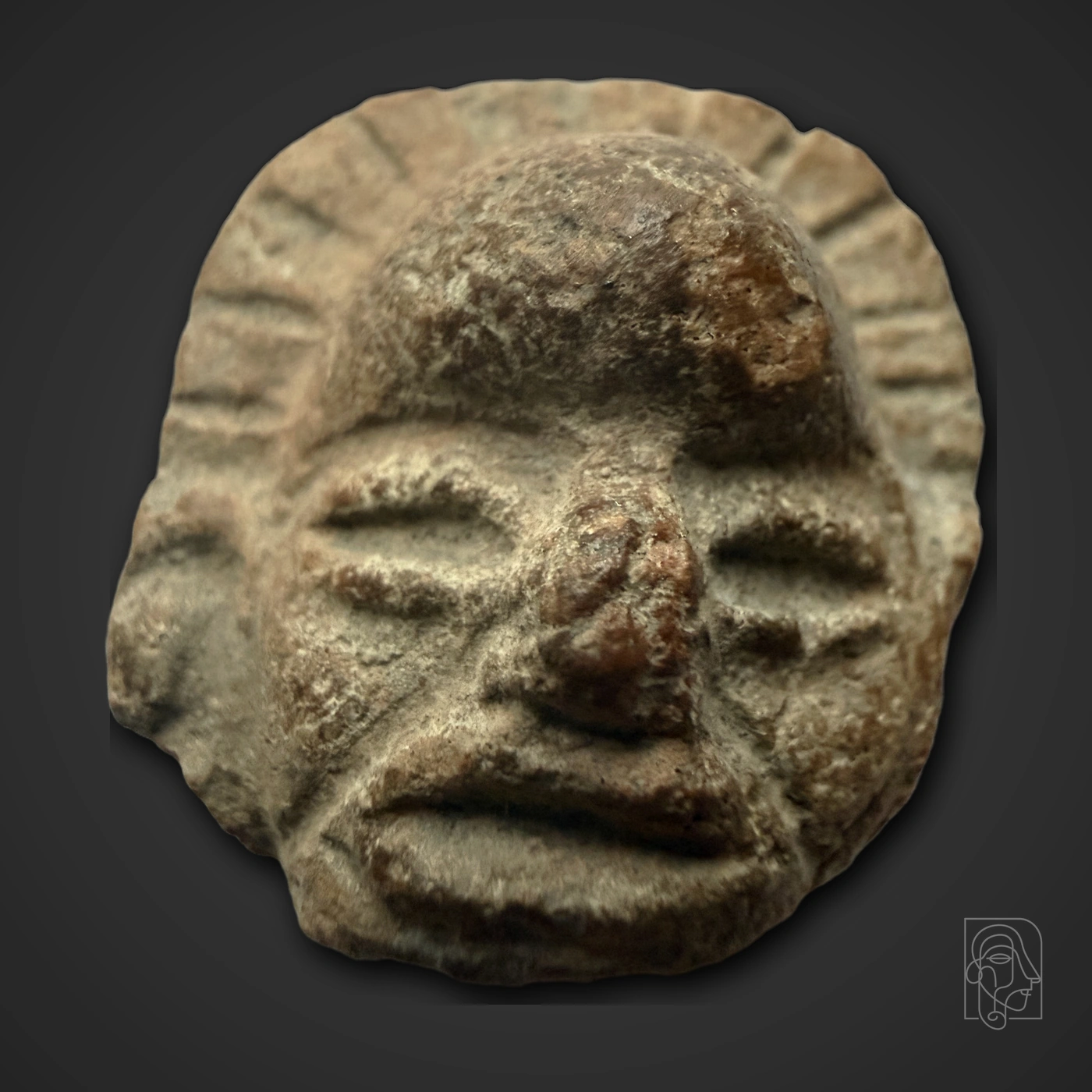
Extended description
A small hand-modeled solid terracotta head, approximately 25 mm across and recorded at 9 g.
The headgear is a thin sheet of clay drawn outward from the head and notched transversely, standing proud of the cranium with a slightly undulating outer edge and running from roughly ear level over the crown to ear level on the opposite side. The incisions run radially — outward from the cranium toward the rim, perpendicular to the edge — rather than as divisions along a band. The distinction matters: an applied fillet and a drawn-out flange are different manufacturing gestures, and radial striation on a flaring plate can conventionally render feathers or spread and combed hair. In superior view the plate reads as a continuous flaring disc with a separately modeled element rising from the rear.
The face carries a continuous arched brow ridge in high relief spanning both eyes. The eyes are raised lenticular forms with single incised slits and secondary arcs above them. The mouth is likewise modeled in relief and slit horizontally. The nose is broad and projecting with a blunt rounded tip. No ears or earflares are visible, and little chin survives before the lower margin.
The reverse is fully modeled, closed and convex, carrying a raised triangular element and incised lines on the crown.
New close-up photographs materially improve documentation of the lower margin. The edge is irregular, stepped and strongly worn rather than geometrically finished. A broad exposed ceramic plane appears paler and greyer than portions of the reddish-brown exterior and somewhat more open in texture. Exterior treatment does not clearly continue uniformly across the exposed lower surface. These features favor an old fracture over an as-made edge. Because temper inclusions and microscopic fracture behavior are not resolved, the interpretation remains provisional. A broken figurine head is presently the strongest functional reading; an appliqué or adorno origin remains possible but less well supported.
Technical analysis
Construction is fillet-and-incise (pastillaje) throughout rather than carving from the mass. Incised pupils are widespread across Formative figurine traditions and are diagnostic of manufacture at a broad level, not of a specific region.
Fabric. The underside photographs expose a lower ceramic plane that appears paler and greyer than portions of the reddish-brown exterior and more open in texture. This is compatible with exposed interior fabric and a relatively porous, low-fired body, but photographic appearance alone cannot establish porosity, firing temperature, firing atmosphere or density. Direct examination under magnification should record clay colour, inclusions or temper, firing core, surface treatment, possible slip or pigment, and the behavior of inclusions where they meet the lower fracture.
Mass and dimensions require independent verification. The record gives approximately 25 × 25 mm and 9 g; no verified depth measurement is recorded. A previous calculation using 25 × 25 × 17 mm treated an enclosing rectangular box as the ceramic volume. Because the irregular head and flange occupy only part of that box, this calculation cannot establish bulk density, porosity, or an inconsistency between mass and dimensions. Reweigh the object and remeasure all three maximum dimensions for documentation; material properties require appropriate examination.
Surface. Pale chalky deposits survive in the eye slits, mouth slit and flange grooves, while projecting areas expose reddish-brown material. The reddish material should be tested as possible slip or hematite-bearing pigment rather than assumed to be discoloration. Examine under ultraviolet light before cleaning.
Authentication methodology
The authenticity assessment remains photographic and comparative. Several observations are favorable, but no single one is conclusive.
Incision irregularity — favorable. Radial cuts vary in length, depth, spacing and termination. Several run the full width of the flange, others stop short, and some are shallow or drifting. This is consistent with hand tooling and unlike a mechanically regular single-pass treatment.
Wear direction — favorable. Pale deposit survives in recesses while projecting points show corresponding abrasion. This differential relationship is more consistent with accumulated wear than with a uniform applied coating.
Lower edge — favorable overall, with microscopic criteria unresolved. Edge profile: irregular, stepped and substantially worn rather than planar or deliberately regular. Core/surface relationship: the exposed lower plane appears paler buff-grey and more open in texture than portions of the reddish-brown exterior. Surface treatment: exterior treatment does not clearly continue uniformly across the lower face. Temper behavior is not resolvable at current photographic scale, and deposits on the break face are not sufficiently resolved to determine their formation history.
These observations favor an old fracture over an as-made edge, but they do not by themselves establish the original object type. A broken figurine head is currently the leading interpretation. A detached appliqué or adorno remains possible, although no unequivocal concavity, luting residue or attachment scar is visible on the surviving reverse. The complete-as-made interpretation is least persuasive.
Modern "born broken" Mesoamerican forgeries remain an important caution. The present edge does not read as a uniformly finished false break, which weakens that scenario but does not exclude modern manufacture.
Outstanding work is microscopic examination of the edge, particularly fracture interaction with temper inclusions and the structure of the exposed clay body; ultraviolet examination before cleaning; re-measurement of dimensions and mass; and specialist in-hand review.
Thermoluminescence should be deferred. It would answer whether the clay was fired in antiquity, not whether the current cultural attribution is correct, and would require destructive sampling from a very small object.
Comparative works
The working framework is the Hay–Vaillant typology, built from Vaillant's excavations at El Arbolillo, Ticomán and Zacatenco and dividing figurines into lettered and numbered types. It remains the most widely employed figurine typology for ancient Mesoamerica and a reasonable starting point, though overwhelmingly stylistic rather than functional. Coe later refined it, placing most Tlatilco figurines in Type D and its subtypes; the six commonest Tlatilco types are D1, D2, D3, D4, DC9 and K.
Chupícuaro (Guanajuato, roughly 400 BCE to 200 CE) is the leading candidate. Slanted, coffee-bean or slit eyes are the tradition's signature, and its figurines are frequently rudimentary overall with detail and emphasis reserved for the headdress, including truncated forms that flare toward the top and are incised with decorative lines, in buff earthenware often carrying traces of red and white paint. Four criteria met.
West Mexican and Nayarit types remain open: flattened planar faces, slit eyes and strong projecting noses fit the face well, though the flange fits less comfortably.
Central Mexican Preclassic (Tlatilco–Tlapacoya) is unsupported. Scale, material and pastillaje technique are consistent, but no tested diagnostic feature points there specifically, and a drawn, radially incised flange has no established place in the D or K series. Consistency with a tradition is not attribution to it.
Early Teotihuacán and related Central Mexican traditions remain in the comparison set. Cleveland Museum of Art 1951.162 has a broad headdress but is moulded and substantially larger; those differences distinguish that individual specimen rather than exclude the whole tradition. British Museum Am1968,13.20 is a hand-modelled, incised terracotta head 2.8 cm high, with Teotihuacán recorded as its findspot and no production date supplied in the inspected record. Its historical findspot record is not controlled modern excavation evidence. Janet Montoya's Pyramid of the Moon project report independently documents early handmade figurines and mixed manufacturing techniques, while cautioning that redeposited construction fill complicates chronology. These sources show that hand manufacture and approximately 25 mm head size cannot by themselves exclude Teotihuacán. They do not identify JCA.2026.025 as Teotihuacán, establish its firing date or authenticate it; no exact archaeological counterpart has been established.
Gulf Coast and Veracruz remain weak, possible on the flaring-headdress trait alone with nothing else supporting it. Any Gulf Coast reading must state the forgery problem explicitly: Brígido Lara claims to have produced as many as 40,000 forged pieces, an antiquities expert declared his work genuine, the Metropolitan Museum of Art and the Dallas Museum of Art both eventually identified Lara pieces in their collections, and the Xalapa Museum of Anthropology ultimately hired him to identify forgeries.
Provenance
The record preserves only the acquisition mode. No auction house, sale name or date, lot number, consignor chain, export history, earlier collection, excavation context or site is linked to the object.
No pre-1970 export documentation is held. That gap is stated here rather than left to inference, because it governs whether the object can be lent or published regardless of how the stylistic argument resolves.
Any Chupícuaro, West Mexican or Central Mexican association is therefore an attribution from form, not from provenance. The two should not be conflated: type attribution, publication status, provenance tier and the export gap are separate axes and are recorded separately.
Historical context
Small solid figurines occur in domestic, ritual, funerary and other archaeological settings across Mesoamerica, but the context of this head is unknown and no findspot is recorded. The object should not be presented as evidence for a specific ceremony, burial practice, gender, deity or social role.
The new lower-edge photographs narrow, but do not completely resolve, the question of original form. The irregular stepped margin, apparent core-to-surface difference and lack of clear continuous exterior treatment across the underside favor an old fracture. This makes a complete object with an as-made lower edge unlikely.
A broken figurine head at or near the neck is the strongest current interpretation. A detached appliqué or adorno remains possible but less well supported because no unequivocal concavity, luting residue or attachment scar is visible on the surviving reverse. Photographs alone do not justify eliminating that possibility, nor do they reconstruct the missing body or original attachment context.
The object's strongest interpretive use remains as a study piece for modeling technique, headdress convention, fracture morphology and the limits of regional attribution from a fragment without archaeological context.
Conservation history
No treatment history is documented.
Preserve surface deposits, possible pigment traces and the lower fracture before further cleaning or treatment. The deposits in recesses and abrasion on projecting points carry wear evidence; the lower edge preserves the strongest evidence for whether the object broke or was deliberately finished; and the reddish-brown material may represent surface treatment or pigment rather than simple discoloration. Cleaning could remove evidence relevant to each question.
Do not drill, sample or consolidate the lower edge before microscopic documentation. Avoid soaking, abrasive cleaning, consolidants and restoration until the ceramic fabric and surface have been examined. Ultraviolet examination should precede cleaning, both for pigment and for any possible inked or painted collection number on the reverse or lower margin.
Bibliography
Vaillant, George C. Excavations at Zacatenco. Anthropological Papers of the American Museum of Natural History, 1930. Type literature; to be consulted directly.
Vaillant, George C. Excavations at Ticomán. Anthropological Papers of the American Museum of Natural History, 1931. Type literature; to be consulted directly.
Prehistoric Figurine Styles as Fashion: A Case from Formative Central Mexico. eScholarship, University of California. On the Hay–Vaillant classification, its stylistic rather than functional basis, and its continued utility.
Bearing Memory: Woman and Child Figurines from Tlatilco. Texas State University Digital Library. On the Hay–Vaillant typology and the ceramic sequence of the Valley of Mexico.
Images and Labels: The Case of the Tlatilcan Female Figurines. University of Arizona Repository. On pastillaje construction and the 2 to 15 cm scale range.
Identity, Ceramic Variability, and Social Transformation in Early Formative Tlatilco, Mexico. On the six commonest Tlatilco figurine types.
Chupícuaro Figurines of Preclassic Mexico. Museum of Natural and Cultural History, University of Oregon. On coffee-bean and slit eyes, and on figurines rudimentary overall with emphasis reserved for an incised, flaring headdress.
Figurine Head Fragment, Teotihuacán style, 1–550 CE in the current museum record. Cleveland Museum of Art, 1951.162. Formal comparison; the different size and moulded manufacture of this specimen do not exclude the wider tradition. https://www.clevelandart.org/art/1951.162
British Museum, terracotta head Am1968,13.20. Hand-modelled and incised; height 2.8 cm; Teotihuacán recorded as findspot, without a production date in the inspected record. A counterexample to exclusion on size/manufacture, not an attribution of JCA.2026.025. https://www.britishmuseum.org/collection/object/E_Am1968-13-20
Montoya, Janet. Terracotta Figurines from the Pyramid of the Moon at Teotihuacán, México. FAMSI project report on the 1998–2000 excavation material; PDF copyright 2001 and submission line dated 12/01/2004. Early handmade and mixed techniques; redeposited fill limits chronological transfer. https://www.famsi.org/reports/98060/98060Montoya01.pdf
Fakers and Mold-Makers: The Use of Structured Light Scanning to Detect Forgeries of Pre-Hispanic Effigies from Oaxaca. Journal of Conservation and Museum Studies. Source of the Howard Leigh observation on unreproduced break surfaces.
Thermoluminescence Dating for European Sculpture: A Consumer's Guide. Objects Specialty Group Postprints, American Institute for Conservation. On sample-size requirements.
Luminescence Dating. ScienceDirect topic overview. On the 4 mm drill-hole sampling geometry.
Brígido Lara. Biographical entry documenting the scale and museum penetration of Gulf Coast forgeries.
Of Fragments and Forgeries. Harvard Art Museums, object 1998.15.16 gallery text.