Group of Five Flaked Stone Objects — Scholarly Analysis
Extended scholarly study of "Group of Five Flaked Stone Objects" (accession JCA.2026.027): material analysis, authentication methodology, comparative works, and bibliography.
Extended description
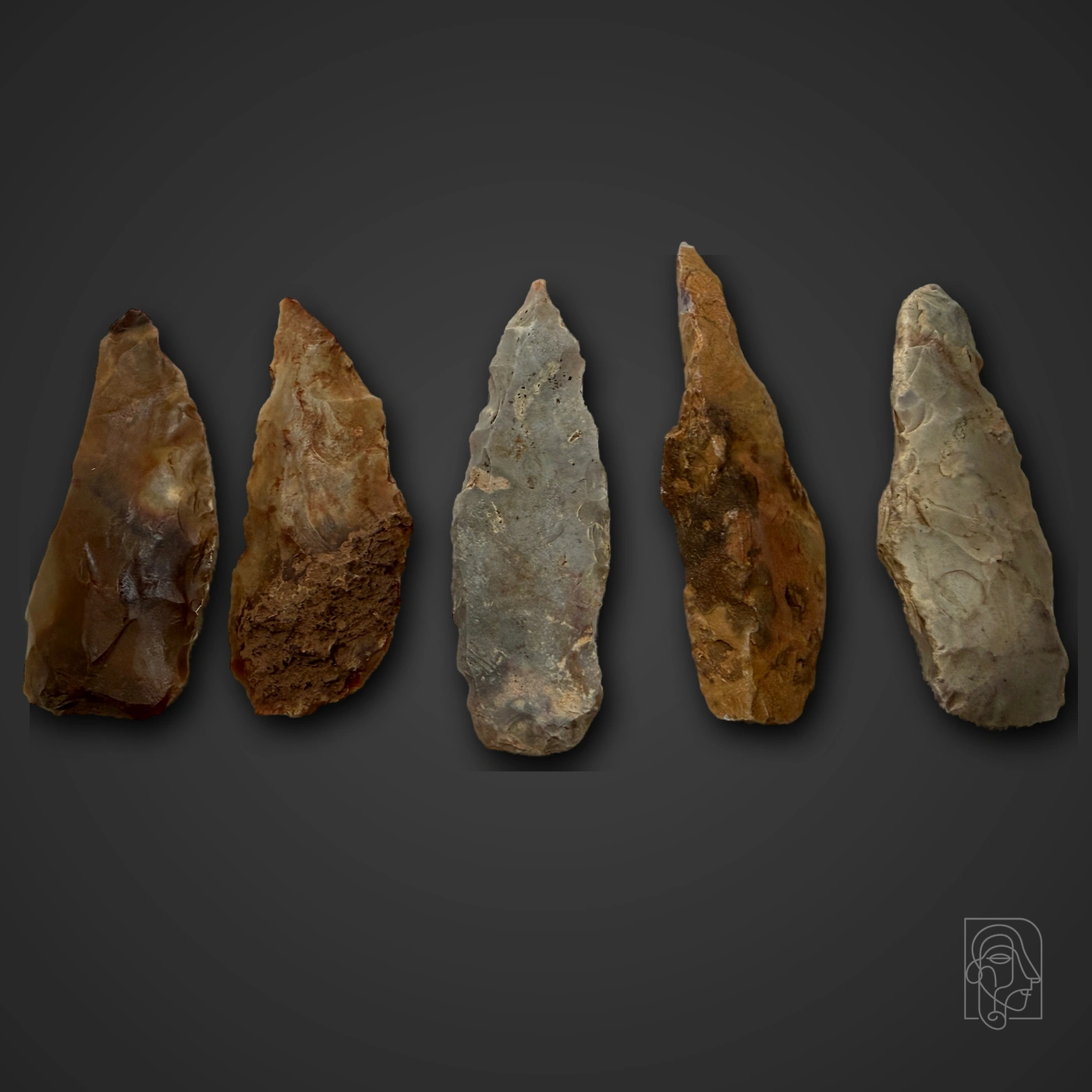
JCA.2026.027 comprises five elongated worked siliceous-stone objects approximately 9–12 cm long, with recorded weights between 50 and 104 g. The group includes pieces with broad overlapping removals across both faces as well as pieces retaining substantial cortical or less-worked surfaces. Their shared tapered morphology makes side-by-side comparison useful, but the assemblage should not be treated as a single established tool type. Each piece requires individual technological description before terms such as biface, preform, knife, backed implement, or projectile form can be used as more than provisional working labels.
Technical analysis
Photographic study shows deliberate stone reduction expressed with differing intensity across the five pieces. Some faces carry broad invasive or overlapping removals, while others preserve cortex or comparatively limited working. The assemblage is not sufficiently documented to establish a single finished tool type or production sequence. Apparent similarities in outline and size are useful comparative observations, but they do not by themselves demonstrate a common workshop, source, culture, or function. Surface color, translucency, staining, cortex, and patination vary across the group and should be documented piece by piece under consistent lighting before technological or regional conclusions are drawn. Possible heat-treatment effects on the more translucent material remain untested and should not be treated as established.
Authentication methodology
Assessment currently relies on controlled photographic comparison of both faces of the five pieces and the existing collection record. The next stage should document each piece independently with scale, profile and edge views, raking light, and low-magnification examination. Analysis should separate deliberate flake removals from later edge damage, record cortex and patination, and test any proposed functional or regional attribution against technological comparanda. Archaeological age and North African origin should remain unconfirmed unless supported by additional physical or documentary evidence.
Comparative works
Comparative material demonstrates why the chronology must remain open. The Metropolitan Museum of Art preserves a Western Desert flint bifacial knife catalogued broadly as “Neolithic or later,” approximately 14 cm long. Mid-Holocene bifacial industries are documented at Augila Oasis in Libya and in the Egyptian Western Desert, while North African Middle Stone Age assemblages also include bifacial foliates and other bifacial forms. These are technological comparanda only; none establishes an exact source or date for the present group.
Provenance
The group is recorded as formerly belonging to Vincent Funiciello, with North Africa given as a reported find region. No site, excavation, export history, collection inventory, individual find association, or earlier ownership documentation is presently attached to the record. North Africa is therefore retained only as reported provenance and not as an archaeological findspot or cultural attribution.
Historical context
Lithic objects are most securely interpreted through reduction technology, raw material, edge modification, use-wear, and archaeological association. Because this group lacks a documented site context, its strongest value is comparative: the five pieces allow close study of differences in flaking, cortical retention, surface alteration, and morphology. Functional labels should be assigned piece by piece and only where the observed evidence warrants them.
Conservation history
No formal treatment history is documented. The historic wire grouping should be photographed and recorded before alteration. If wire tension contacts edges or surfaces, a conservator should assess whether it can be safely loosened or removed without losing evidence of collection history. Do not clean patina, soil staining, cortex, or edge deposits before documentation.
Bibliography
Eleanor M. L. Scerri and Enza E. Spinapolice, “Lithics of the North African Middle Stone Age: assumptions, evidence and future directions,” Journal of Anthropological Sciences 97 (2019), DOI 10.4436/JASS.97002. John P. Mason and Giulio Lucarini, “Mid-Holocene bifacial tradition evidenced in Augila Oasis, Cyrenaica, Libya,” Libyan Studies 46 (2015). The Metropolitan Museum of Art, Bifacial Knife, object 25.10.12p, Western Desert, Egypt, catalogued as Neolithic or later.