Snake Brand Sheffield Utility Knife — Scholarly Analysis
Extended scholarly study of "Snake Brand Sheffield Utility Knife" (accession JCA.2026.031): material analysis, authentication methodology, comparative works, and bibliography.
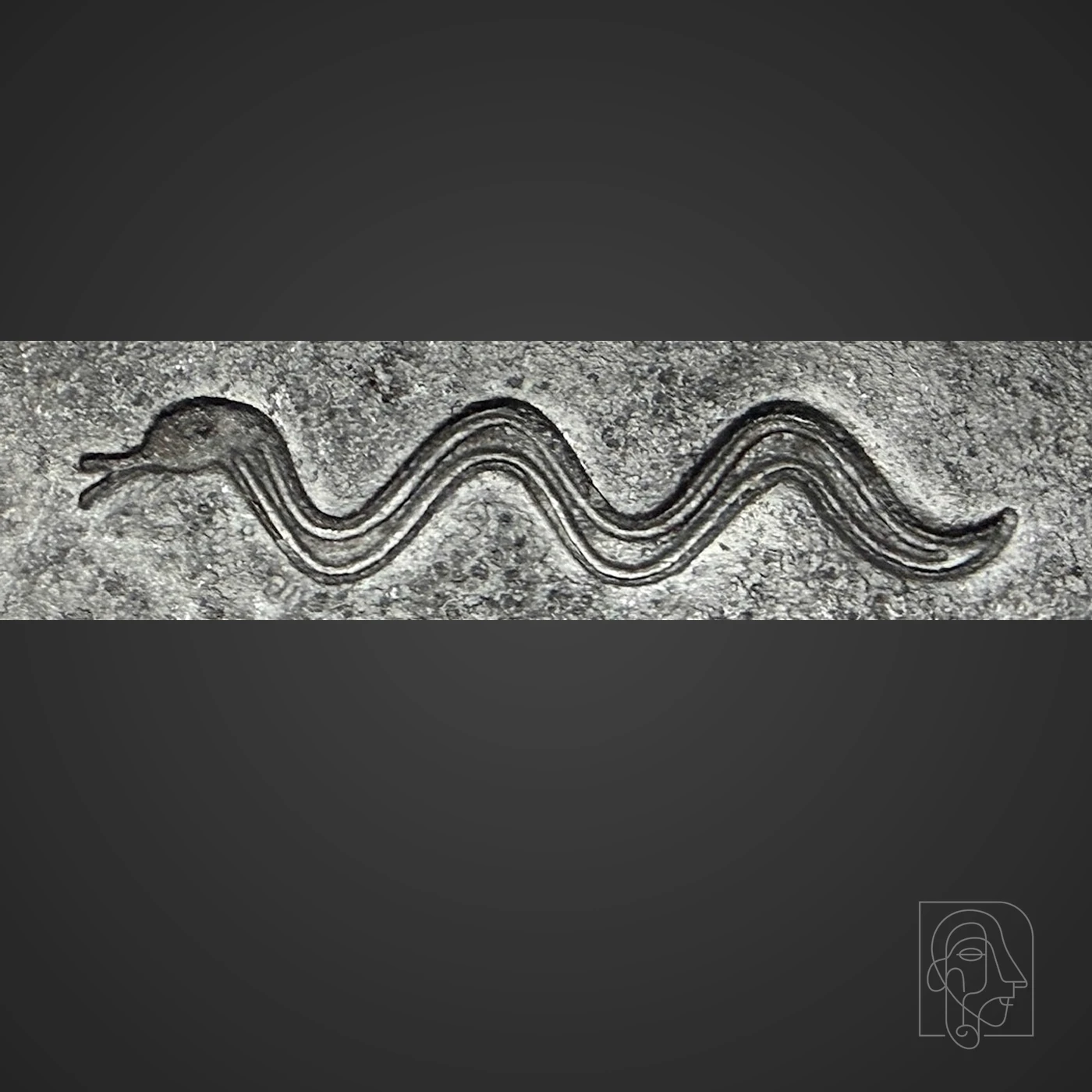
Extended description
JCA.2026.031 is a large fixed-blade utility knife approximately 14.5 in. overall with a 9.5 in. steel blade and a wooden handle wrapped with brass wire. The blade carries a snake emblem and the words “SNAKE BRAND” and “SHEFFIELD.” Those marks correspond to the historic Snake Brand associated with S. & J. Kitchin of Sheffield. The present handle configuration, including brass-wire wrapping and reported evidence of long farm use, may reflect repair, reinforcement or regional adaptation rather than a factory-standard Kitchin pattern. The knife should therefore be catalogued as a Snake Brand Sheffield object with maker/date attribution under review.
Technical analysis
Authentication should separate blade manufacture from handle history. Record blade profile, taper, spine/thickness, tang type, stamp depth/typography, snake-logo form, grinding/forging marks, patination, scale attachment and wire wrapping. Historic Sheffield trade knives often used carbon-steel blades and wood scales, but those generic features persist in later reproductions. A full-tang or tapered-tang construction, rivet pattern and maker stamp can be diagnostically useful only when compared with documented Kitchin examples. The brass wire may be later field repair and should not be assumed original.
Authentication methodology
First photograph both blade faces, ricasso/tang stamps, spine, edge, handle junction, rivets/pins and wire wrapping at high resolution. Search specifically for additional words, country-of-origin marks, “Historical Reproduction,” Pakistan/India markings or importer marks that would identify later manufacture. Compare the snake logo and lettering with documented Sheffield Kitchin stamps. Evaluate patina and farm wear as use history, not proof of nineteenth-century manufacture. If the handle can be inspected non-destructively, document tang taper and any hidden modern fasteners.
Comparative works
Hawley Collection / Tweedale’s Directory of Sheffield Cutlery Manufacturers records S. & J. Kitchin’s 1868 snake mark and the firm’s production of butcher, hunting, Bowie and trade knives and machetes through the period before its knife interests were acquired by Ralph Martindale in 1957. Modern reproduction vendors openly sell Snake Brand Sheffield-pattern butcher/trade knives copied from originals, demonstrating why trademark resemblance alone cannot authenticate an early specimen.
Provenance
Donated by a New Jersey farmer and reportedly retained for many years in a family farm shed; earlier ownership before that family history is undocumented. This modern use provenance is valuable evidence of the knife’s later working life but does not establish when or where it first entered the United States. No invoice, importer record, nineteenth-century estate record or early photograph currently links the object to the historic North American trade-knife market.
Historical context
Sheffield was a major center for cutlery made for domestic and export markets, including heavy butcher, hunting, trade and agricultural knives. S. & J. Kitchin participated in that industrial ecosystem and its Snake Brand became sufficiently durable to continue as a recognizable mark after ownership changes. The JCA object can therefore illuminate both Sheffield export branding and the afterlife of such tools in practical farm use, even if its exact production decade remains unresolved.
Conservation history
No formal treatment history is documented. Preserve the blade patina, stamp, handle wear and brass-wire wrapping as evidence; avoid aggressive sharpening, polishing, rust removal or replacement of the wire/wood before documentation. Stabilize active corrosion conservatively and store with a fitted inert blade support or sheath that does not trap moisture. Any suspected later repair should be mapped rather than “restored” to an assumed factory appearance.
Bibliography
Hawley Collection, Sheffield, Geoffrey Tweedale, “S. & J. Kitchin Ltd,” Tweedale’s Directory of Sheffield Cutlery Manufacturers 1740–2013: snake mark granted 1868; product range; acquisition by Ralph Martindale in 1957. Crazy Crow Trading Post, modern Snake Brand Sheffield reproduction butcher knife, used only to document continuing/reproduction use of the mark and the consequent authentication caution.