French An XI-Type Briquet Sword, Klingenthal 1816 — Scholarly Analysis
Extended scholarly study of "French An XI-Type Briquet Sword, Klingenthal 1816" (accession JCA.2026.043): material analysis, authentication methodology, comparative works, and bibliography.
Extended description
JCA.2026.043 is a short French infantry sabre of the briquet family, recorded at approximately 29.25 in. overall with a 23.5 in. blade. Its one-piece ribbed brass hilt, simple knuckle bow, slightly curved blade, and leather-and-brass scabbard are consistent with French infantry briquets of the early nineteenth century. The blade spine reportedly reads “Manufacture Royale de Klingenthal” with the date 1816. That dated royal-manufactory inscription is especially important because it places manufacture after the fall of the First Empire while the weapon retains the established Napoleonic infantry pattern. The model designation is therefore best expressed as Model An XI type/pattern rather than using the political period alone to date the form.
Technical analysis
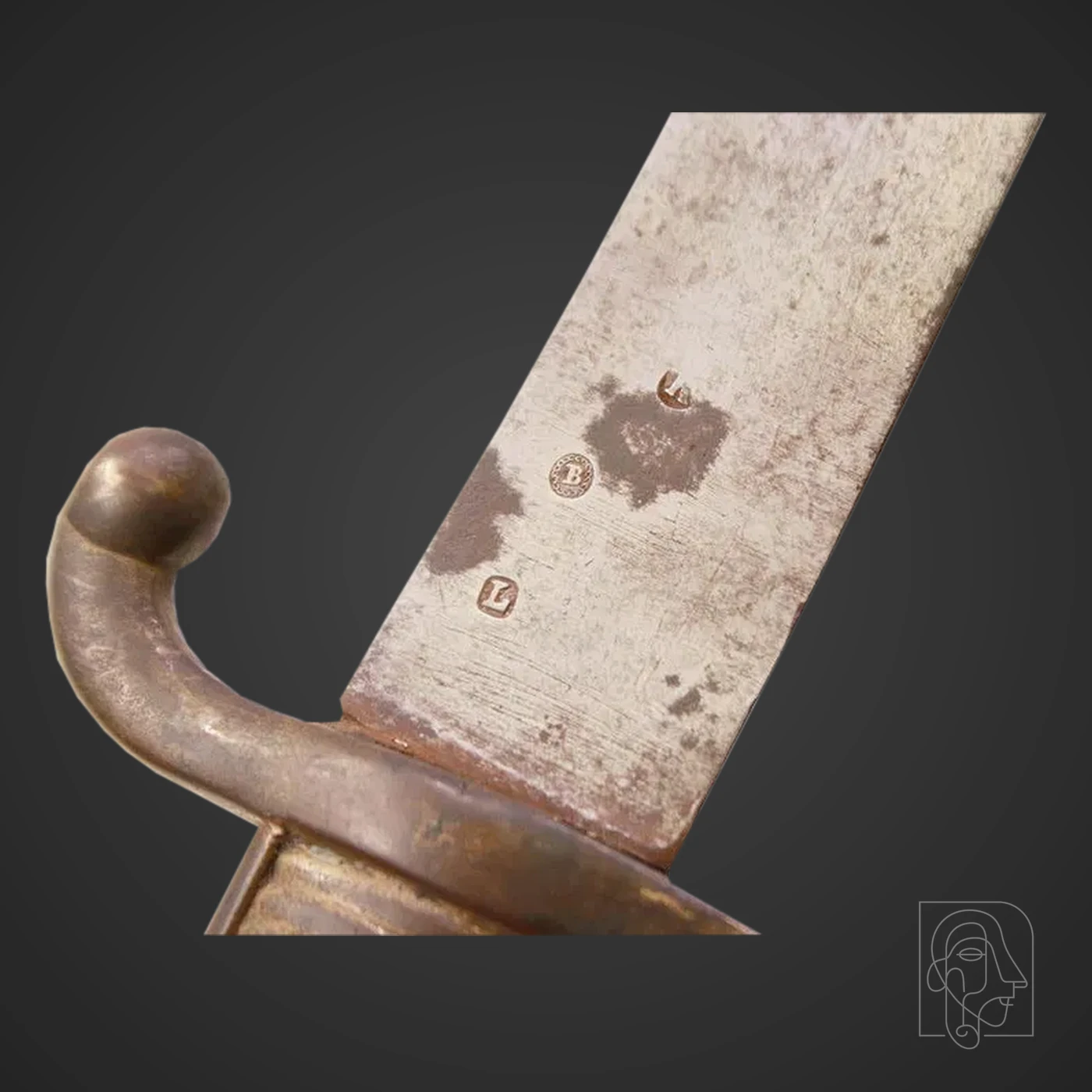
Recorded marks include a laurel-wreathed B, a small L, and a partially legible additional cartouche. French museum records show B and L inspection punches on early nineteenth-century Klingenthal sabres and document inspectors/controllers whose tenures span the object’s period. A 1815 Model An XI museum record from Klingenthal identifies Borson, Bick and Lobstein marks in this general inspection system. Because JCA.2026.043’s third mark is only partly legible, it should not be assigned confidently to Krantz or another inspector until raking-light macro photographs are compared character by character. Blade profile, brass-hilt casting, scabbard construction, assembly/rack numbers and the spine inscription should be considered together.
Authentication methodology
Current assessment combines the recorded object measurements and markings with French national museum comparanda. Final confirmation should use new orthogonal and raking-light photographs of the complete blade spine inscription, ricasso/talon punches, guard marks, assembly numbers, scabbard throat and drag, and hilt casting seams. Inspector attribution should follow securely legible punch morphology and documented tenure rather than inferred initials. No destructive testing is required for the present typological assessment; XRF or metallography would not independently establish model or date.
Comparative works
French Ministry of Culture POP/Joconde records provide close institutional comparanda. Musée Dobrée accession 56.5396.1 is catalogued as an infantry briquet of Model An IX / An XI type with a thick slightly curved blade, one-piece bronze ribbed hilt and B/L punches, probably Klingenthal. Musée George Sand accession MLC 1967.1.1131.1 is an infantry sabre briquet dated 1800–1815, 76 cm high, with slightly curved blade, branch guard, 28-rib grip and leather scabbard. A separate POP Model An XI record dated May 1815 documents the Klingenthal inspection system immediately preceding the date on JCA.2026.043.
Provenance
The documented modern provenance is limited to an auction acquisition. Earlier ownership, military issue, unit, original bearer, and continuous custody are not recorded. The engraved personal name/date reported in earlier catalogue work, if present and legible on the object, should be documented as an inscriptional association rather than treated as independently verified ownership history until corroborated.
Historical context
The briquet’s historical importance lies in standardized infantry material culture rather than in a claim of elite battlefield use. Musée de l’Armée describes the infantry briquet as characteristic equipment of certain infantry categories and notes its frequent practical use in camp for cutting brush, wood or food. An 1816 specimen also illustrates continuity: regulation patterns and existing equipment traditions persisted across the political break between Napoleon’s empire and the Bourbon Restoration.
Conservation history
No formal treatment history is documented. Preserve the blade’s stable patina, inspection punches, spine inscription and any old sharpening or service wear. Do not polish the brass hilt or blade to brightness. The leather scabbard should be supported without forcing bends; active red corrosion, loose brass mounts or powdering leather should be assessed by a conservator before intervention.
Bibliography
French Ministry of Culture, POP/Joconde, notice 07450066222, infantry sabre briquet, Model An IX / An XI, Musée Dobrée. French Ministry of Culture, POP/Joconde, notice M0250005153, “Sabre briquet et son fourreau,” Musée George Sand et de la Vallée Noire. French Ministry of Culture, POP/Palissy, notice IM40004083, Model An XI Klingenthal sabre dated May 1815, including documented inspector tenures. Musée de l’Armée, “La Garde impériale, épisode 4 : Les armes du chasseur, fusil et sabre.”