Terracotta Rooster Plaque — Scholarly Analysis
Extended scholarly study of "Terracotta Rooster Plaque" (accession JCA.2026.052): material analysis, authentication methodology, comparative works, and bibliography.
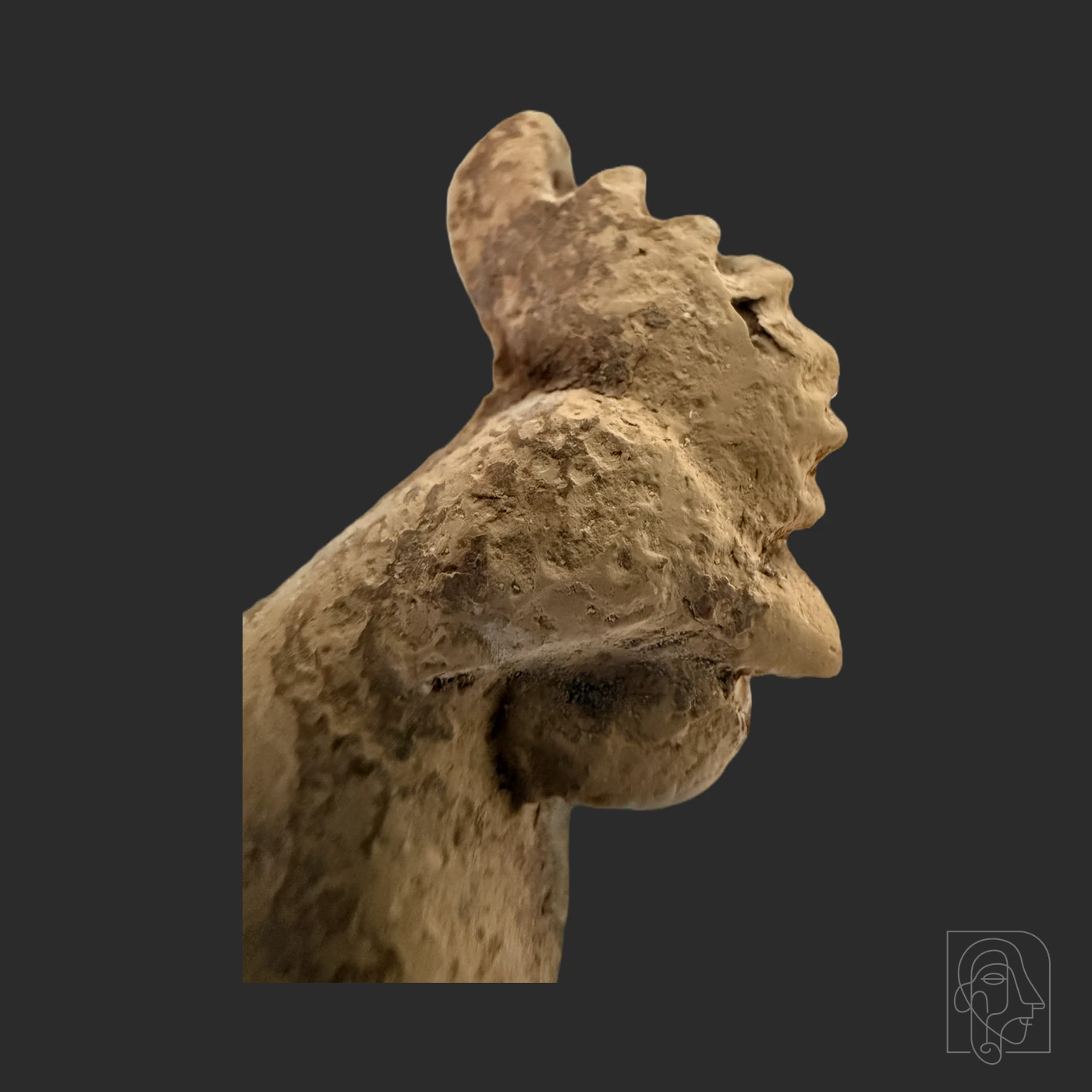
Extended description
This object is a small hand-modeled terracotta plaque representing a rooster rendered in profile. The figure exhibits simplified but deliberate modeling characteristic of small-scale Greek coroplastic production. The head displays a pinched comb and projecting beak, while the body is defined by a rounded chest and stepped lower edge forming the plaque base. Two horizontal perforations pass through the body, likely intended for suspension or attachment. The clay body appears buff to light tan where exposed at minor chips, consistent with earthenware fabrics commonly used in Greek terracotta production. The surface retains mineralized accretions and age-consistent patination, with localized soil staining suggesting long-term burial prior to entry into the antiquities market. Tool marks and irregularities in the modeling indicate hand fabrication rather than mold-based production.The overall scale (approximately 3.5 inches square and 11 mm thick) corresponds with small votive or decorative terracotta plaques known from the Aegean world. The simplified representation of the rooster and the plaque-like format align with typological characteristics of Classical-period terracotta animal plaques associated with Greek coroplastic workshops.
Technical analysis
Visual examination indicates that the plaque is formed from a buff terracotta fabric with a fine to moderately coarse mineral temper. The exposed clay at a small chip reveals a light tan interior consistent with oxidizing kiln conditions typical of ancient Mediterranean earthenware production. The plaque displays slight irregularities in thickness and contour consistent with hand-formed shaping prior to firing.Two horizontal perforations penetrate the body of the plaque and appear to have been formed prior to firing. The interior surfaces of these perforations exhibit the same patination and mineral accumulation as the surrounding surface, suggesting that they are original to manufacture rather than modern additions. Surface characteristics include mineralized accretions, minor soil deposits, and a stable earthen patina that has developed through age and burial. These features are consistent with archaeological terracotta artifacts recovered from Mediterranean contexts. No evidence of modern casting seams, artificial aging compounds, or recent tool marks was observed during visual inspection.
Authentication methodology
Authentication assessment was conducted through visual examination of materials, fabrication technique, surface condition, and comparison with documented Greek terracotta production. Particular attention was given to clay fabric, patination patterns, modeling characteristics, and structural features such as perforations.The terracotta body displays mineral accretions and age-consistent surface weathering that are difficult to reproduce convincingly in modern reproductions. The irregular modeling and subtle asymmetries of the plaque suggest hand-formed shaping rather than modern mold replication. The perforations appear integral to the original manufacture, with patinated interior surfaces consistent with the exterior. Attribution to Greek production follows the typological classification given in the auction record identifying the object as a Melian rooster plaque of the Classical period. This attribution remains provisional pending direct verification of the cited exhibition catalog reference. No indicators of modern manufacture or reproduction were observed.
Comparative works
The most relevant category comparanda are Classical Greek terracotta plaques identified as Melian in the Metropolitan Museum of Art, including object 12.229.20 (ca. 450 BCE), object 25.78.26 (ca. 450 BCE), and object 30.11.9 (ca. 460–450 BCE). These establish the distinctive Melian coroplastic plaque tradition but are larger narrative reliefs rather than close rooster-form parallels. For rooster imagery and terracotta manufacture, the Met's Greek Cypriot terracotta rooster statuette 74.57.18 provides a useful but later Hellenistic comparison. No exact published Melian rooster-plaque parallel has yet been verified for JCA.2026.052. The claimed 1965 Iris Love exhibition/catalogue reference remains potentially important and should be checked directly before being treated as confirmed provenance or attribution evidence.
Provenance
The plaque was acquired by the present owner through the Davis Brothers Auction “Legacy of the Buffalo” sale held on February 14, 2026, where it was cataloged as Lot 484 and described as an “Ancient Greek Terracotta Melian Rooster Plaque.” The auction listing identified the object as originating from the collection of Iris Cornelia Love (1933–2020), a noted American classical archaeologist and collector.Iris Love assembled a substantial private collection of classical antiquities during the mid-twentieth century. Portions of her collection were exhibited publicly and referenced in academic contexts. The auction description cites exhibition of objects from her collection at the Duke University Art Department Gallery in 1965 in an exhibition titled “Classical Antiquities from the Collection of Miss Iris Love.”The exhibition was accompanied by a catalog prepared by B. Hannegan in 1965. The auction record attributes the rooster plaque to item number 18 in that catalog. Direct verification of the catalog entry has not yet been obtained, and therefore the exhibition reference should presently be considered unconfirmed secondary documentation.
Historical context
Terracotta objects played an important role in daily life within the ancient Greek world. Small terracotta figures and plaques were produced in large numbers by coroplastic workshops and were widely used for votive offerings, household decoration, and ritual purposes.Animal imagery, including roosters, appears frequently in Greek visual culture. The rooster in particular was associated with vigilance and the coming of dawn and appears in various artistic media including pottery, sculpture, and terracotta. In certain contexts the rooster also carried symbolic associations with masculinity, competition, and protection.Terracotta plaques depicting animals or human figures could be suspended in domestic or cultic environments or deposited as offerings in sanctuaries. Their relatively inexpensive materials made them accessible objects within ancient Greek society, yet they still reflected the stylistic traditions and symbolic language of the Classical period.
Conservation history
The plaque survives in stable condition with minor surface wear consistent with archaeological terracotta artifacts. Mineral accretions and soil staining are present across portions of the surface, suggesting prolonged burial prior to entry into the antiquities market. Small chips along the edges reveal the buff clay body typical of fired terracotta.No evidence of modern restoration, adhesive repair, or structural stabilization has been observed. The perforations and body structure remain intact and structurally stable. Surface deposits have been left undisturbed to preserve the object's archaeological patina.The object is currently maintained within the Joshua Cabinet of Antiquities collection under stable indoor environmental conditions suitable for terracotta artifacts, including controlled humidity and minimal handling.
Bibliography
Hannegan, B. 1965. Classical Antiquities from the Collection of Miss Iris Love. Durham: Duke University Art Department Gallery Exhibition Catalog — cited by the 2026 auction record but not yet directly verified for this object. Burn, Lucilla and Reynold Higgins. Greek Terracottas. British Museum Press. Higgins, Reynold. Greek Terracottas. Metropolitan Museum of Art, “Terracotta plaque,” Greek, Melian, ca. 450 BCE, object 12.229.20. Metropolitan Museum of Art, “Terracotta plaque,” Greek, Melian, ca. 450 BCE, object 25.78.26. Metropolitan Museum of Art, “Terracotta plaque,” Greek, Melian, ca. 460–450 BCE, object 30.11.9. Metropolitan Museum of Art, “Terracotta statuette of a rooster,” Greek, Cypriot, 2nd–1st century BCE, object 74.57.18.