Copper-Alloy Penannular Bracelet with Conical Terminal — Scholarly Analysis
Extended scholarly study of "Copper-Alloy Penannular Bracelet with Conical Terminal" (accession JCA.2026.062): material analysis, authentication methodology, comparative works, and bibliography.
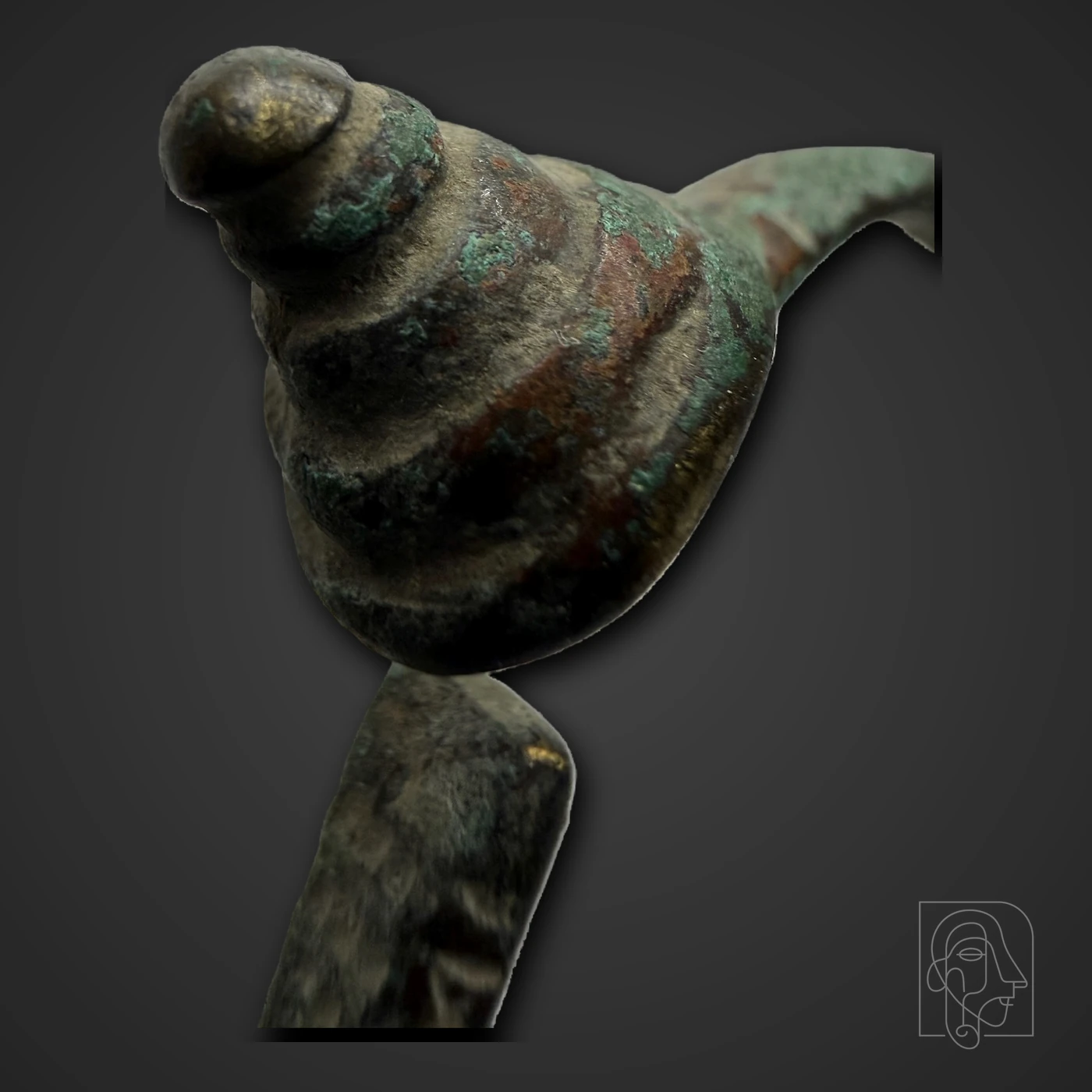
Extended description
JCA.2026.062 is an open-ended copper-alloy bracelet approximately 2 in. in diameter and 24 g in weight. A rounded band forms most of the hoop. One terminal is plain and rounded, while the opposite end expands into a stepped conical knop composed of concentric ridges. This deliberate asymmetry is the object's most distinctive formal feature. The surface is mottled green-blue with reddish and darker areas and deposits concentrated in recesses. Because no archaeological context accompanies the bracelet, the object should be described from its observable construction first and compared cautiously with ancient Iranian and broader Near Eastern penannular jewelry.
Technical analysis
The bracelet may have been cast and subsequently shaped or finished, but the exact manufacturing sequence is not established from photographs. The regular curvature of the band and modeled terminal should be inspected for casting seams, hammering, filing, and finishing marks. Portable XRF could characterize the copper alloy and identify major tin, lead, zinc, or other constituents, while microscopy can document corrosion stratigraphy and tool marks. Neither alloy composition nor patina alone can supply a secure date. The stepped terminal should be compared structurally with excavated bracelets rather than treated as a culture-specific diagnostic.
Authentication methodology
Assessment presently rests on direct morphology, surface condition, dimensions, and broad typological comparison. Green-blue and red copper corrosion can develop naturally over long periods but can also occur on comparatively recent copper alloys; it is therefore supporting condition evidence, not proof of antiquity. A stronger study would combine microscopy, XRF, radiography if needed, examination of any exposed metal, and provenance research. Until then, both date and Iranian attribution should remain at “Possible.”
Comparative works
Comparanda should be drawn from securely excavated and institutionally catalogued penannular copper-alloy bracelets from western Asia, including Iranian Iron Age material but also neighboring Near Eastern traditions. Key comparison points are cross-section, band diameter, terminal asymmetry, terminal construction, alloy, and wear. No exact published parallel has yet been established, and a generic resemblance to “Luristan bronzes” is insufficient for a secure attribution.
Provenance
Ownership history before acquisition is undocumented. No findspot, excavation association, export record, earlier named collection, or historical label currently supports a geographic attribution. “Iranian / Near Eastern” is retained as a working comparative description only.
Historical context
Penannular bracelets are a long-lived jewelry form found across Europe and western Asia from prehistoric through historical periods. Because the basic open-hoop geometry is simple and recurrent, terminal design, manufacture, alloy, and archaeological context are more informative than overall shape alone. JCA.2026.062 illustrates the limits of assigning an unprovenanced bronze ornament to a named culture from appearance.
Conservation history
No conservation or restoration treatment is documented. The surface corrosion and mineral deposits should be preserved for study and monitored for active bronze disease. Avoid polishing, chemical cleaning, oil, wax, or aggressive mechanical removal. Stable dry storage and periodic photographic condition checks are appropriate until a metals conservator or archaeometallurgist examines the object.
Bibliography
Future comparison should prioritize published archaeological catalogues of Iranian and Near Eastern jewelry and P. R. S. Moorey's work on ancient Persian bronzes, supplemented by archaeometallurgical studies of copper-alloy manufacture and corrosion. No object-specific publication or exact excavated parallel is presently known.