Early Byzantine Terracotta Slipper Oil Lamp, Vessberg Type 19 — Scholarly Analysis
Extended scholarly study of "Early Byzantine Terracotta Slipper Oil Lamp, Vessberg Type 19" (accession JCA.2026.074): material analysis, authentication methodology, comparative works, and bibliography.
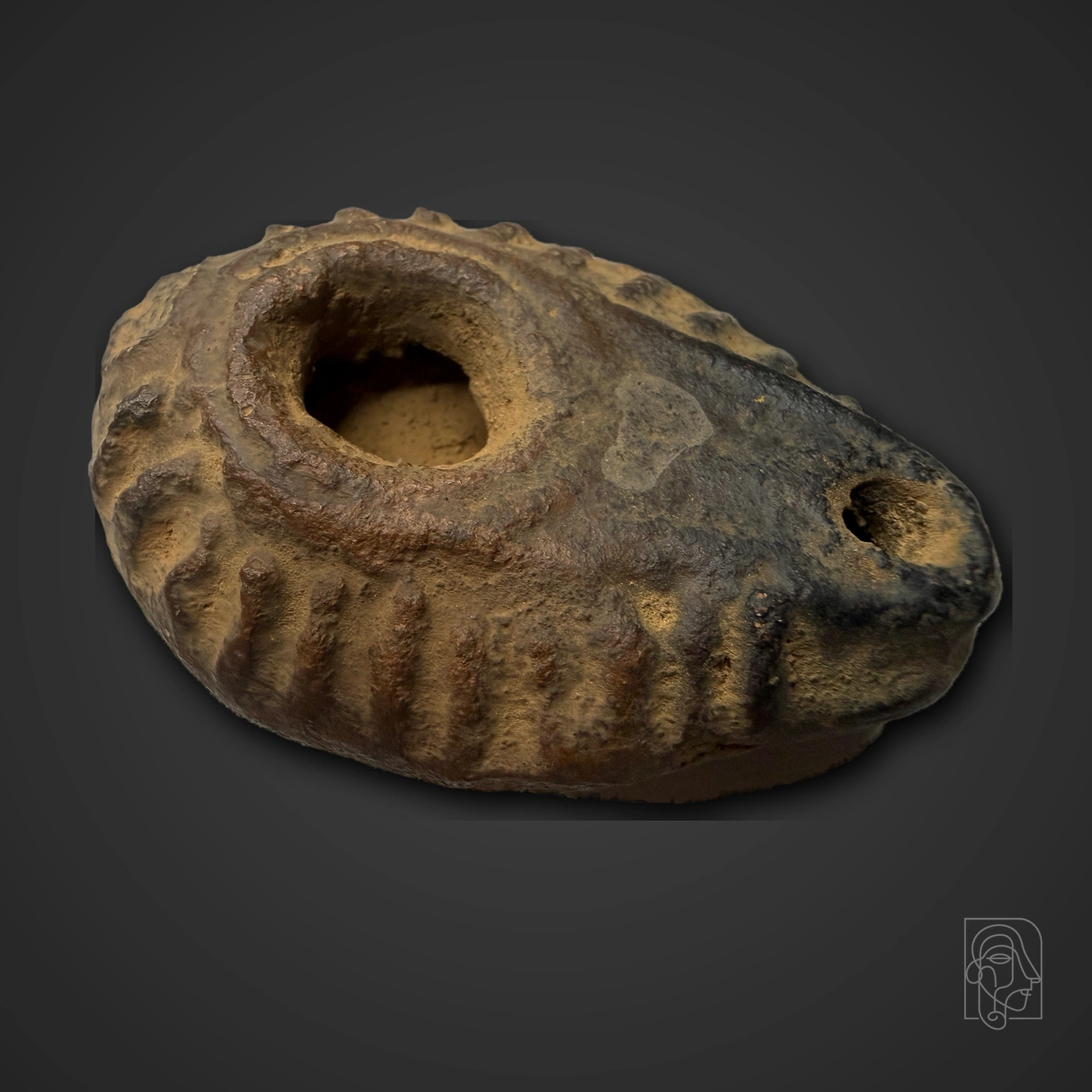
Extended description
JCA.2026.074 is a small mold-made slipper lamp measuring approximately 7.6 cm long, 5.1 cm wide and 2.5 cm high, with a weight of 76 g. The body is sharply carinated and pear-shaped. A very large central filling aperture with a raised rim dominates the upper surface; a shallow molded channel runs toward the small rounded wick hole. Short radiating or oblique ribs occupy the broad shoulders. At the rear, directly opposite the wick hole, a broad rough scar marks the former attachment of an applied conical handle or lug, a standard feature of later Vessberg Type 19 lamps. The closest published Cesnola parallels are Cat. 444 and Cat. 445, both assigned to the 7th century CE. Cat. 445 is especially instructive because it combines a wide raised filling-hole rim, short wick channel, simple ridged shoulders, pear-shaped carination and applied tall conical handle at a length of 8.3 cm, very close to the 7.6 cm length of JCA.2026.074.
Technical analysis
The lamp was made in a two-part mold, with upper and lower shells joined before firing; the join should be documented microscopically where surface accretions permit. Shoulder ribs and the raised filling-hole rim were formed in the upper mold, while the large filling aperture and wick hole were opened or finished before firing. Published Type 19 comparanda show that the conical rear handle was applied separately or finished after removal from the mold. On JCA.2026.074 that element is missing, leaving a rough attachment/fracture area at the rear. The fabric appears reddish-buff beneath darker surface alteration and pale accretions. Darkening at and behind the nozzle is compatible with wick use but is not independently diagnostic of age.
Authentication methodology
Assessment combines direct visual review of ten current photographs, user-supplied dimensions and weight, and page-by-page comparison with Christopher S. Lightfoot's catalogue of the Cesnola terracotta oil lamps. Diagnostic comparison focused on body carination, filling-hole size and rim, wick-channel configuration, shoulder ribbing, rear handle attachment and base treatment rather than on surface patina alone. Cats. 441–447 establish a coherent Type 19 series, with Cats. 444–447 dated to the 7th century CE. Further in-hand examination should confirm the mold seam, ceramic fabric, handle-break morphology and any surviving soot. Scientific firing-age testing is optional rather than required for routine cataloguing.
Comparative works
Primary comparanda: Lightfoot, The Cesnola Collection of Cypriot Art: Terracotta Oil Lamps, Cat. 444 (MMA 74.51.2128), Early Byzantine, 7th century CE: Vessberg Type 19, mold-made, tall conical handle, sharply carinated pear-shaped body, wide filling hole with raised rim, wick channel, and raised shoulder lines. Cat. 445 (MMA 74.51.2131), Early Byzantine, 7th century CE: Vessberg Type 19, tall conical handle, sharply carinated pear-shaped body, wide raised filling-hole rim, channel to wick hole, rounded shoulder with indistinct ridges, ovoid base ring; length 8.3 cm. Cat. 443 (MMA 74.51.2130), early 7th century CE, provides a related ribbed/radiating-shoulder variant. Cats. 446–447 show further 7th-century Type 19 variants. Cat. 441 and related finds from Paleokastro, Salamis, Soli and Cilicia demonstrate the wider eastern Mediterranean distribution of the type.
Provenance
A prior “Holy Land” identification or label is reported, but no excavation record, site, auction lot, dealer archive, export documentation, earlier named collection or pre-market ownership history is presently attached to the object. That phrase is retained as collection history only. It should not be represented as evidence that the lamp was excavated in Israel/Palestine or any particular Levantine site.
Historical context
Vessberg Type 19 is best understood as an eastern Mediterranean ceramic lamp tradition rather than a marker of one religious or ethnic community. The lamps were inexpensive mold-made lighting devices used in houses, workshops, institutions, funerary settings and religious environments. The same general form circulated across Cyprus and adjacent eastern Mediterranean regions. Without excavation context or diagnostic iconography, JCA.2026.074 should not be identified as specifically Christian, Jewish, Samaritan, monastic, funerary or domestic.
Conservation history
No treatment history is documented. Preserve soot/darkening, soil or mineral accretions, and any surviving label/adhesive residues. Do not soak, scrub, oil, wax, chemically clean or mechanically remove deposits before they are photographed and assessed. Support the lamp from beneath during handling and avoid loading pressure on the nozzle or rear lug/handle.
Bibliography
Christopher S. Lightfoot, The Cesnola Collection of Cypriot Art: Terracotta Oil Lamps (The Metropolitan Museum of Art / Yale University Press, 2021), especially pp. 335–338, Cats. 441–447. Olof Vessberg, lamp typology, Type 19. Thérèse Oziol, Les lampes du Musée de Chypre, Type 19 comparanda. D. M. Bailey, A Catalogue of the Lamps in the British Museum III, Cypriot and eastern Mediterranean parallels.