Seated Figure with Tube and Globular Vessel — Scholarly Analysis
Extended scholarly study of "Seated Figure with Tube and Globular Vessel" (accession JCA.2026.079): material analysis, authentication methodology, comparative works, and bibliography.
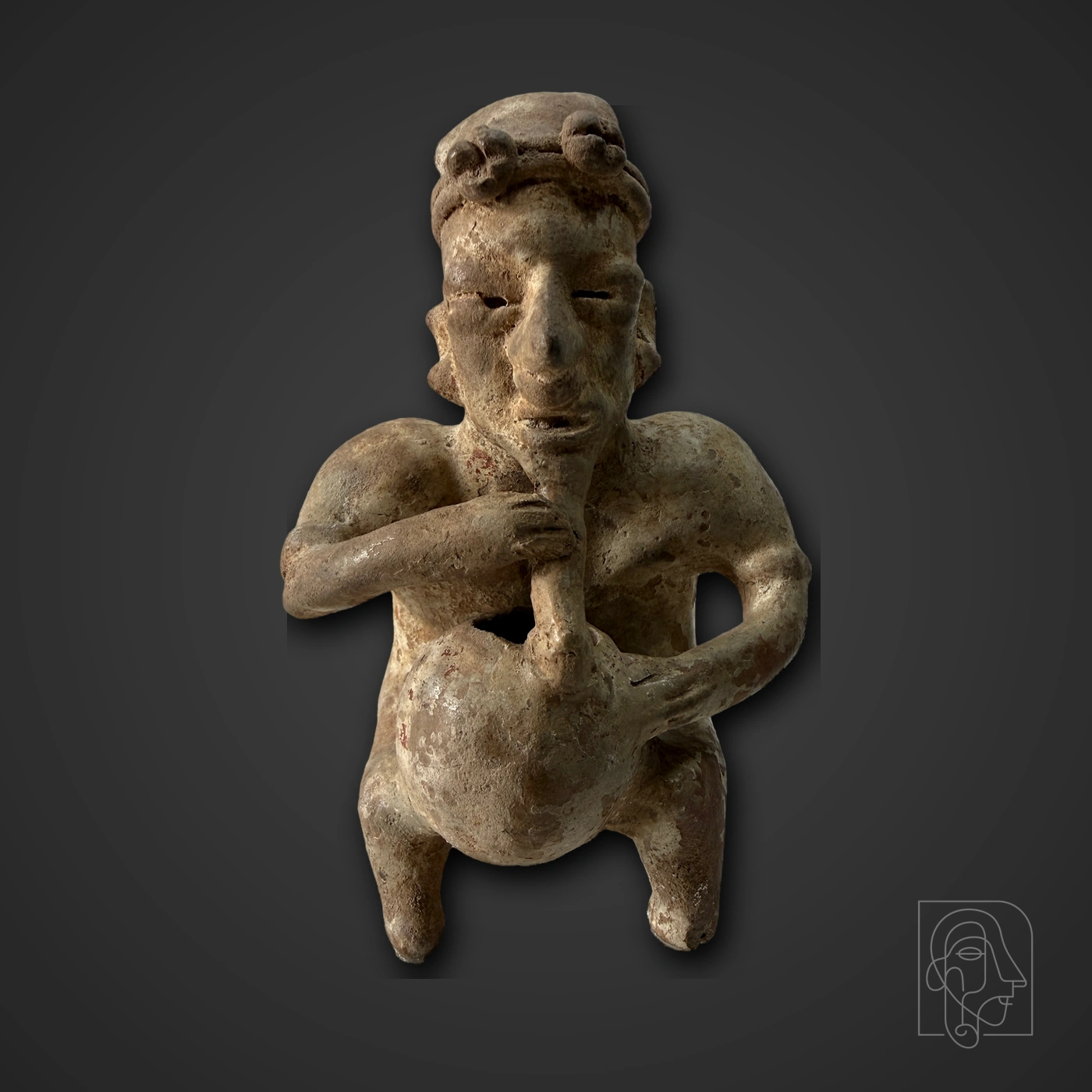
Extended description
JCA.2026.079 is a small hollow hand-modeled terracotta seated male figure documented as Barakat Gallery stock PF.3510. The figure leans forward and supports a rounded open vessel against the abdomen while placing a long narrow tube to the mouth; the tube appears to communicate directly with the vessel. This observable configuration is more securely described as tube-and-vessel use than as a musical performance. The head is oversized relative to the body, with a high sloping forehead, strongly projecting nose, slit-like eyes and mouth, applied ear ornaments, and a tall headpiece or headband with paired rounded elements. Uneven cream slip survives with traces of red pigment and broad areas of old surface loss. Barakat catalogued the object as Jalisco. Independent comparison places it more cautiously within the West Mexican Shaft Tomb tradition, with meaningful southern Nayarit/Lagunillas affinities in the cream slip, stocky body, thin limbs, large head, and facial modeling. Tube-and-vessel figures occur in both Colima and Nayarit, so the subject cannot resolve state-level attribution. Drawing or drinking through the tube and blowing or breathing into a mixture are both documented interpretations of comparable figures. Ritual-specialist or shaman status is plausible but not demonstrable from the attributes alone.
Technical analysis
The object is a hollow hand-modeled earthenware figure with irregular modeled surfaces, open negative spaces, and a rear firing/vent opening. No visible mold seam is recorded in the supplied photographs. Uneven cream slip and sparse red pigment survive over a body showing pitting, abrasion, edge rounding, dark staining, and localized crusts across exposed and recessed areas. These characteristics are compatible with long-lived West Mexican ceramic surfaces but are not independently diagnostic of antiquity. Dark branching or spot-like deposits may be morphologically compatible with manganese-type staining, yet composition and formation history remain untested and such appearances can be imitated. The interior has not been adequately documented and is potentially more discriminating than the exterior: endoscopy and radiography should examine internal walls, joins, tool marks, deposits, restorations, fills, wall thickness, and any evidence of modern coating. A long transverse line across the upper back requires examination to distinguish construction/firing cracking from later breakage or repair. Four modern contact pads or adhesive areas on the underside should be mapped under UV before any intervention. Slip, accretions, and repair boundaries should remain undisturbed until documented.
Authentication methodology
Authentication is divided into independent questions: exact object identity, cultural/style attribution, and firing date. Exact identity is established by direct photographic correspondence with Barakat PF.3510, including unique modeled details, surface-loss patterns, and the matching underside label. Antiquity requires a separate examination sequence. First, a ceramics conservator should map joins, fills, overpaint, coatings, cracks, and modern contact pads under magnification and UV. Second, endoscopy through an existing vent/opening should document interior walls, deposits, joins, tool marks, and restoration without drilling. Third, X-radiography or CT should assess wall thickness, internal construction, hidden breaks, pins, and fills. Fourth, thermoluminescence should date a conservator-confirmed sample of original ceramic fabric under documented chain of custody. Targeted XRF, Raman, FTIR, petrography, or related methods may characterize pigments, coatings, fills, and accretions but do not substitute for chronological testing. Photography alone supports a favorable assessment; it does not conclusively determine age.
Comparative works
The Art Institute of Chicago preserves a Colima seated figure shown drinking from a vessel using a tube (acc. 1997.473), 200 BCE–300 CE, 30.8 cm high, providing direct museum precedent for the observable tube-and-vessel action. The Bowers Museum preserves a closely related pair from the Dr. Eli B. and Aimee Cohen Memorial Collection: "Shaman with Tube and Jar" (acc. 2000.40.5), Nayarit, 300 BCE–200 CE, 20.3 cm high, interpreted by the museum as a shaman blowing vital breath into an herbal mixture; and its pendant "Figure with Tube and Jar" (acc. 2000.40.4), attributed specifically to Ixtlán del Río, 300 BCE–200 CE, 20.3 cm high, whose record notes surviving residue inside the bowl. The Metropolitan Museum of Art preserves two Lagunillas comparanda: a seated male figure (acc. 1999.272.2), 200 BCE–200 CE, 30.3 cm high; and "Seated Figure with vessel" (acc. 2005.91.10), 200 BCE–200 CE, 22.9 cm high, described by the museum as modeled with a protruding nose, thinly incised eyes and mouth, and disproportionately thin arms against a bulky physique, with one hand raised to hold a vessel — the closest published parallel in both scale and formal vocabulary. A Met Jalisco female figure (acc. 1979.355), 1st century BCE–3rd century CE, supports aspects of Barakat's Jalisco reading through tall headdress and long aquiline nose, though at 50.2 cm and with staring rather than slit eyes it remains a distant comparison. Sotheby's, New York, 12–22 November 2021, lot 20, offered a "Nayarit Seated Figure with Bowl and Tube, Ixtlán del Rio style," circa 100 BCE–250 CE. Two of the three closest tube-and-vessel parallels — Bowers 2000.40.4 and Sotheby's lot 20 — carry an Ixtlán del Río rather than a Lagunillas attribution. A scale caution applies throughout: at approximately 14 cm the present figure is roughly half the height of the Art Institute, Metropolitan, and Sotheby's comparanda and about two-thirds the height of the Bowers pair, and comparative and market weight should be adjusted accordingly.
Provenance
The current object is photographically identical to Barakat Gallery stock PF.3510, catalogued there as a Jalisco seated shaman holding a bowl. The underside paper label reads PF.3510, directly linking the physical object to that stock record. This is a strong documentary anchor for object identity. It does not establish when Barakat first inventoried the piece, whether Barakat owned or consigned it, who held it previously, or when and how it left Mexico. No excavated findspot, pre-Barakat owner, export documentation, or continuous earlier chain of custody is presently attached to the research file. Future provenance work should prioritize the Barakat stock card, first inventory date, invoices or consignment records, earlier-owner information, treatment records, and older photographs.
Historical context
West Mexican Shaft Tomb cultures produced complex ceramic figures representing people, animals, activities, social roles, and ritual actions. JCA.2026.079 belongs to a documented iconographic family in which seated figures interact with vessels through long tubes. Institutional interpretations vary: some identify drinking or drawing through the tube, while others propose blowing or breathing into a vessel or mixture. That disagreement is itself important because it demonstrates that the visible configuration is secure while the precise ritual action is not. Terms such as “shaman” or “ritual specialist” can therefore be retained only as interpretive labels. The object’s formal vocabulary overlaps both Jalisco and southern Nayarit/Lagunillas traditions, so a qualified West Mexican attribution is more defensible than a categorical state-level origin without findspot or material sourcing.
Conservation history
No complete treatment history is documented. The figure is substantially complete but has extensive slip loss, abrasion, pitting, localized chips, accretions, and a transverse upper-back line of uncertain origin. Four clear modern contact pads, wax, or adhesive areas are visible on the underside and should remain in place until identified and their removal risk assessed by a ceramics conservator. Do not pick, swab, or mechanically clean the granular deposits or stained recesses before technical documentation. The projecting tube, arms, headpiece, and vessel are high-risk handling zones; support the object from the body/base rather than these elements. UV examination, endoscopy, and radiography should precede any invasive work or thermoluminescence sampling.
Bibliography
Barakat Gallery. "Jalisco Seated Shaman Holding a Bowl," stock PF.3510, 300 BCE–300 CE. Art Institute of Chicago. Seated Figure Drinking from a Vessel using a Tube, Colima, 200 BCE–300 CE, acc. 1997.473. Bowers Museum. Shaman with Tube and Jar, Nayarit, 300 BCE–200 CE, acc. 2000.40.5; Figure with Tube and Jar, Ixtlán del Río, 300 BCE–200 CE, acc. 2000.40.4; Figure with Jar, Nayarit, 200 BCE–400 CE (accession number to verify). The Metropolitan Museum of Art. Seated male figure, Lagunillas artist(s), Nayarit, 200 BCE–200 CE, acc. 1999.272.2; Seated Figure with vessel, Lagunillas artist(s), Nayarit, 200 BCE–200 CE, acc. 2005.91.10; Female figure, Jalisco, 1st century BCE–3rd century CE, acc. 1979.355. Sotheby's, New York. Art of Africa, Oceania, and the Americas, 12–22 November 2021, lot 20: Nayarit Seated Figure with Bowl and Tube, Ixtlán del Rio style, Protoclassic, circa 100 BC–AD 250. Beekman, Christopher S., and Robert B. Pickering, eds. Shaft Tombs and Figures in West Mexican Society: A Reassessment. Tulsa: Gilcrease Museum, 2016. Butterwick, Kristi. Heritage of Power: Ancient Sculpture from West Mexico: The Andrall E. Pearson Family Collection. New York, New Haven, and London: The Metropolitan Museum of Art, 2004. Norwood, Lauren Wilson. "Ancestors in Clay: A Case for Portraiture in Lagunillas Style E Figurines," pp. 195–205, in Beekman and Pickering, eds., Shaft Tombs and Figures in West Mexican Society: A Reassessment, 2016. (Author also publishes as Beth Norwood; see also "Body Doubles: An Exploration of Representation in Lagunillas Style E Figurines from West Mexico," MA thesis, University of Texas at San Antonio, 2012.) Pickering, Robert B., and Ephraim Cuevas. "The Ancient Ceramics of West Mexico: Corpse-Eating Insects and Mineral Stains Help a Forensic Anthropologist and a Chemist Determine the Authenticity of 2,000-Year-Old Figurines." American Scientist 91, no. 3 (2003): 242–49. Townsend, Richard, ed. Ancient West Mexico: Art and Archaeology of the Unknown Past. Chicago: Art Institute of Chicago, 1998. Hudson Museum, University of Maine. Context Found: authentication observations including manganese staining and interior evidence. Oxford Authentication. Thermoluminescence testing process for ceramics. J. Paul Getty Museum. From Fragment to Vase: visual examination, UV fluorescence, X-radiography, and XRF in ceramic conservation.