Ronson Petite Pocket Lighter with Associated Case — Scholarly Analysis
Extended scholarly study of "Ronson Petite Pocket Lighter with Associated Case" (accession JCA.2026.090): material analysis, authentication methodology, comparative works, and bibliography.
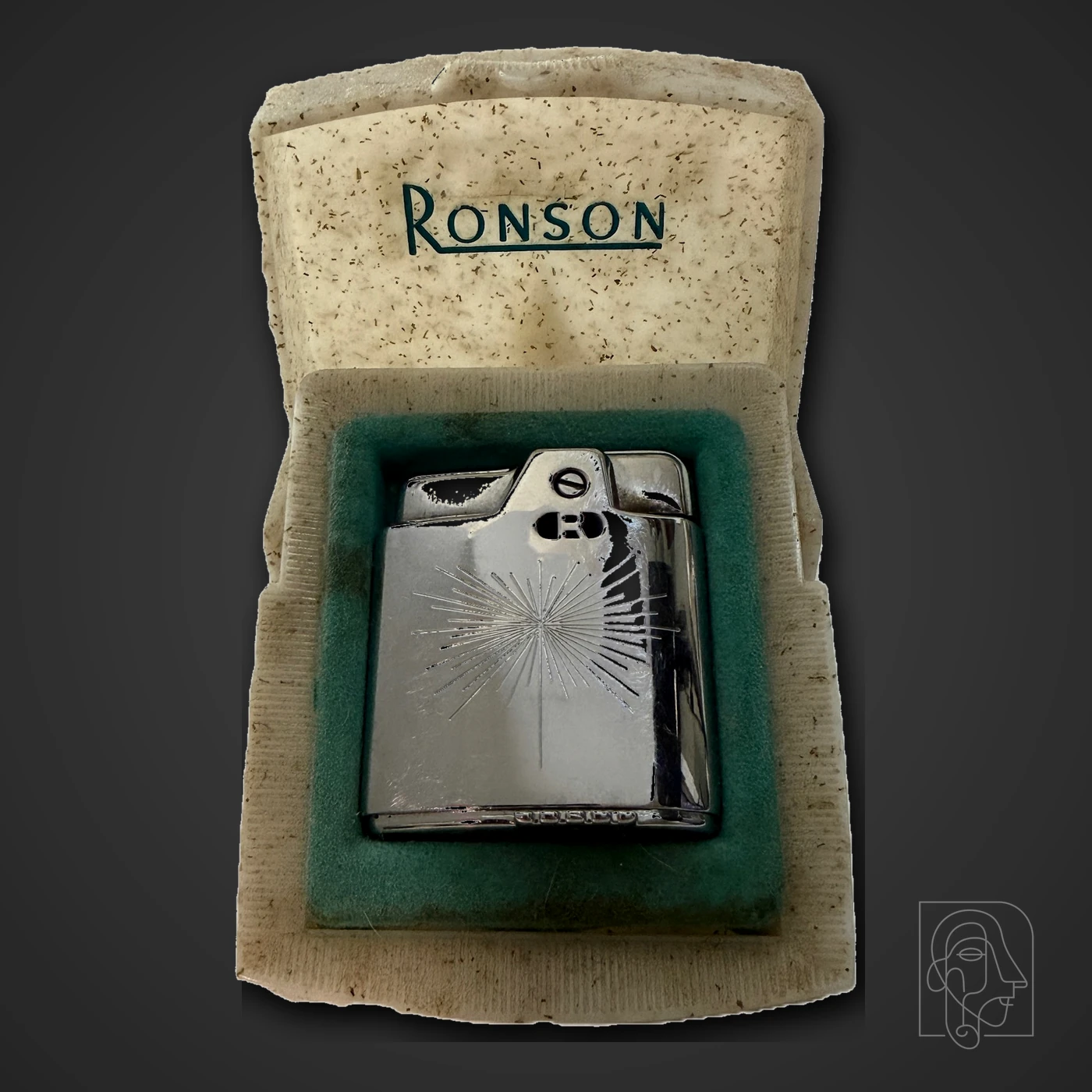
Extended description
JCA.2026.090 is a small Ronson Petite petrol/flint pocket lighter approximately 1.5 in. high by 1.25 in. wide, with polished silver-tone plating, engraved starburst/sunburst decoration on the front and engine-turned linear panels on the reverse. Its base is marked “RONSON,” “NEWARK N.J. U.S.A.,” “OPEN FOR FLINT,” “PETITE,” and U.S. patent/design numbers 2,481,195; 2,505,167; 2,715,329; and D-170,536. Those marks identify Ronson, model and a documented patent family directly on the object. A presentation/display case is retained with the lighter, but the current record does not document an original matched sale or serial relationship between case and lighter.
Technical analysis
The Petite uses a liquid-fuel wick and flint/pyrophoric ignition system. Patent 2,481,195, granted to Ronson Art Metal Works in 1949, concerns pyrophoric lighter wheel/clutch and operating mechanisms; patent 2,505,167, granted in 1950, concerns a lighter casing/fuel-chamber construction; patent 2,715,329, granted in 1955 to Ronson Corporation, concerns an improved closure-cap mounting arrangement for a pyrophoric lighter; design patent D170,536, granted in 1953 to Frederick Kaupmann and assigned to Ronson, covers an ornamental cigar-lighter design. The presence of this patent stack on the base provides a useful terminus and technical lineage. It does not demonstrate that every patented feature is unique to the Petite or establish an exact assembly date.
Authentication methodology
Authentication is supported by the Ronson/Newark/Petite base legend, internally coherent patent numbers assigned to Ronson, model proportions, petrol/flint architecture, decoration and associated case. Future documentation should include perpendicular base macros, mechanism/top views, flint access, wick/burner, hinge/lever, plating, decoration, case exterior/interior and all case branding. The function is currently untested; do not fuel or operate merely to authenticate. Exact model dating should combine patent chronology with period Ronson catalogues or advertisements if located.
Comparative works
Ronson reference catalogues describe the Petite as a shortened version of the Capri and place first manufacture in approximately 1958, with multiple decorative variants. U.S. patent records independently establish the sequence of stamped Ronson inventions/designs from 1949 through 1955. The combination supports a late-1950s model-family context for JCA.2026.090. Decorative pattern and case should still be compared with period Ronson catalogues before a named finish or original boxed-set claim is made.
Provenance
Recorded as from a private collection; earlier ownership is undocumented. The associated presentation case accompanies the lighter in the current collection, but no receipt, matching label, serial record, gift inscription or period photograph establishes that the two have remained together since retail sale. They should be catalogued as associated unless stronger documentation emerges.
Historical context
Compact automatic lighters were part of the postwar expansion of personal smoking accessories, where mechanical convenience and decorative finish were marketed together. The Petite’s small scale and decorative variants have often led to gendered “ladies’ lighter” descriptions in later collecting literature; unless period Ronson advertising for this exact variant is produced, the catalogue should treat that marketing category as contextual rather than inherent to the object.
Conservation history
Function is untested. The lighter shows plating wear, scratches and residue, while the case shows soiling, discoloration and compressed/stained felt. Do not over-polish plated surfaces or clean engraved recesses aggressively. Store the lighter unfueled and the case open or ventilated if needed to prevent trapped residues. Preserve the case separately supported so degraded felt/plastic does not abrade or chemically affect the lighter. Record any future flint, wick or packing replacement as maintenance.
Bibliography
U.S. Patent 2,481,195, Ray L. Burchett and Frederick Meyer, “Pyrophoric lighter,” assigned to Ronson Art Metal Works, issued 6 September 1949. U.S. Patent 2,505,167, Alexander H. Aronson, “Lighter casing construction,” assigned to Ronson Art Metal Works, issued 25 April 1950. U.S. Design Patent D170,536, Frederick Kaupmann, “Cigar lighter or similar article,” assigned to Ronson Art Metal Works, issued 6 October 1953. U.S. Patent 2,715,329, Ray L. Burchett, “Pyrophoric lighter,” assigned to Ronson Corporation, issued 16 August 1955. Vintage Cigarette Lighters/Ronson reference catalogue, Petite entry, first production listed as 1958.