Glazed Scarab-Form Amulet with Standing Figure, Egyptian Type — Scholarly Analysis
Extended scholarly study of "Glazed Scarab-Form Amulet with Standing Figure, Egyptian Type" (accession JCA.2026.094): material analysis, authentication methodology, comparative works, and bibliography.
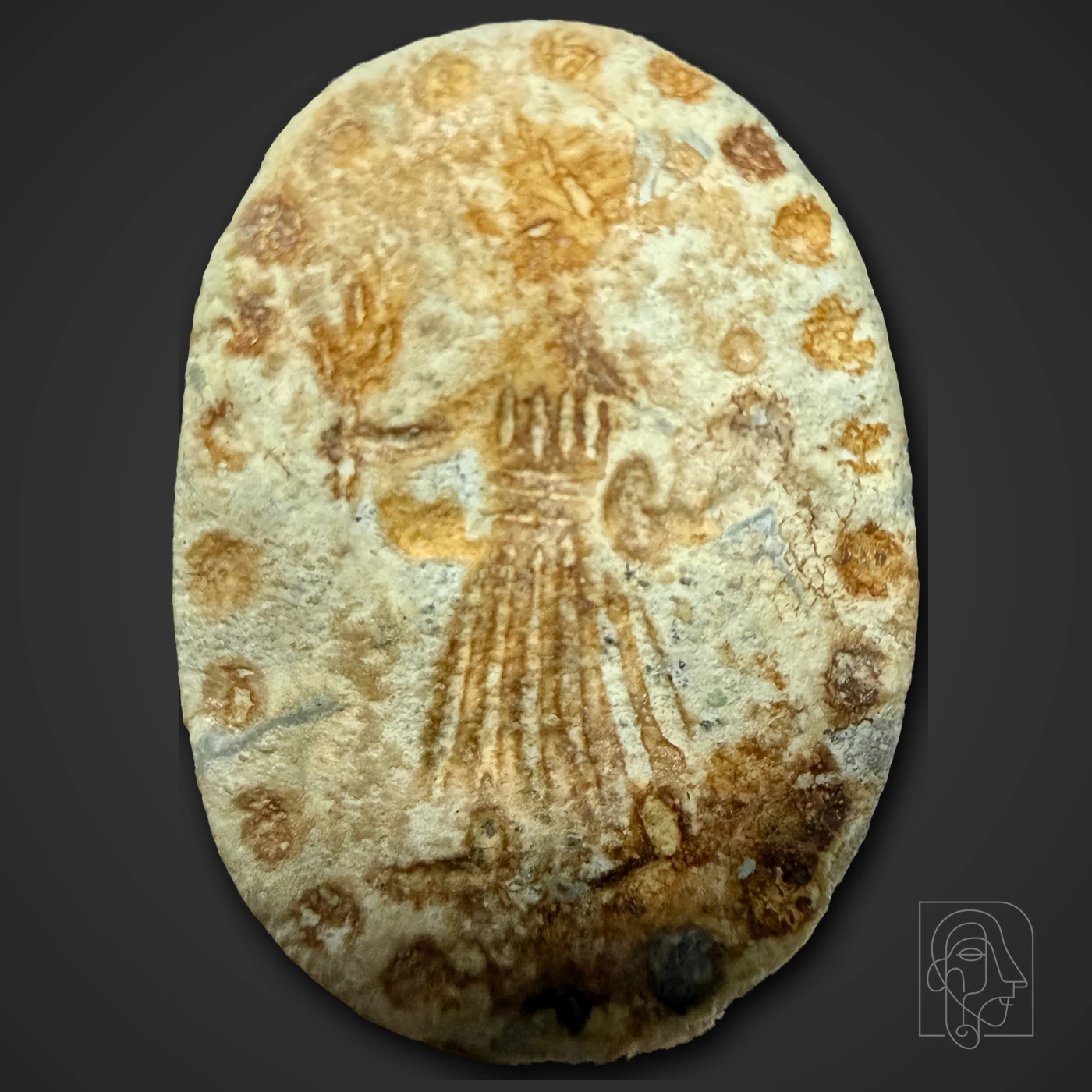
Extended description
JCA.2026.094 is a small blue-white to blue-green glazed scarab/scaraboid approximately 20 × 15 × 11 mm with a domed back, longitudinal perforation and a flat underside bearing a standing human figure within a dotted border. The figure appears to hold one or more elongated or vegetal objects, but current visibility does not support a secure attribute reading. The body shows an exposed tan core, patchy glaze, pale accretion and darker staining. Egyptian comparanda include New Kingdom faience scarabs with standing goddesses holding papyrus stems and later glazed scarabs with female figures holding flowers. The motif therefore supports an Egyptian/Egyptianizing type without fixing date or deity.
Technical analysis
The recorded body/core is tan and granular beneath a pale blue/green glaze-like surface. The longitudinal bore is described as uneven and pitted with staining near the mouth. These are relevant observations but not chronological proof. Technical study should establish whether the body is quartz-rich faience/glazed composition, glazed steatite, ceramic, or a later imitation material; document whether engraving cuts through glaze or precedes glazing; and examine the bore for wear, deposits, rotary striations, or modern finishing. Heavy accretion can obscure both original carving and later tooling.
Authentication methodology
First obtain sharp perpendicular and raking-light images of the underside motif plus all sides, back divisions, both bore mouths, bore interior and glaze/core transitions. A specialist should attempt the iconographic reading without assuming the figure is female or divine. Material characterization may include non-destructive XRF/Raman and, where justified, microscopy or SEM/EDS. No percentage probability should be treated as authentication evidence. Provenance research, comparative scarab typology and material study should converge before assigning an ancient date.
Comparative works
The Metropolitan Museum of Art object 10.130.702, “Scarab with the goddess Neit,” faience, New Kingdom ca. 1300–1080 BCE, depicts a standing goddess holding a papyrus stem. Met object 26.7.454 depicts two standing goddesses on a New Kingdom scarab. British Museum E48223 (1884,0714.209), a glazed white steatite scarab dated 750–332 BCE, includes a female figure holding a flower on a long stalk. Together these examples demonstrate both the plausibility and the chronological breadth of standing-female/divine scarab imagery.
Provenance
Recorded only as private collection. No named earlier collector, auction record, excavation, findspot, export permit, pre-1970 chain, or Egyptian source documentation is presently attached to the public record. “Egyptian” therefore remains an object-type attribution rather than provenance.
Historical context
Egyptian scarabs and scaraboids frequently combine beetle-shaped backs with flat bases carrying inscriptions, symbols, plants, animals and divine or human figures. Such imagery could have protective, devotional, administrative or decorative significance depending on context. Without a legible inscription, secure attributes or archaeological findspot, JCA.2026.094 cannot presently identify a named goddess, owner, workshop or intended amuletic function.
Conservation history
No formal treatment history is documented. Preserve glaze fragments, pale accretions, brown staining, the bore interior and exposed core. Do not soak, scrub, scrape, polish or clear the perforation. Store on a padded inert mount to avoid abrasion. Any analytical cleaning or sampling should occur only after complete macro documentation because the deposits and glaze/core boundaries are authentication evidence.
Bibliography
Metropolitan Museum of Art: object 10.130.702, “Scarab with the goddess Neit,” New Kingdom ca. 1300–1080 BCE; object 26.7.454, New Kingdom/Ramesside scarab with two standing goddesses. British Museum E48223 / 1884,0714.209, glazed steatite scarab dated 750–332 BCE with a female figure holding a flower. These comparanda demonstrate motif range rather than identifying JCA.2026.094.