Otacilia Severa Antoninianus, Pudicitia — Scholarly Analysis
Extended scholarly study of "Otacilia Severa Antoninianus, Pudicitia" (accession JCA.2026.099): material analysis, authentication methodology, comparative works, and bibliography.
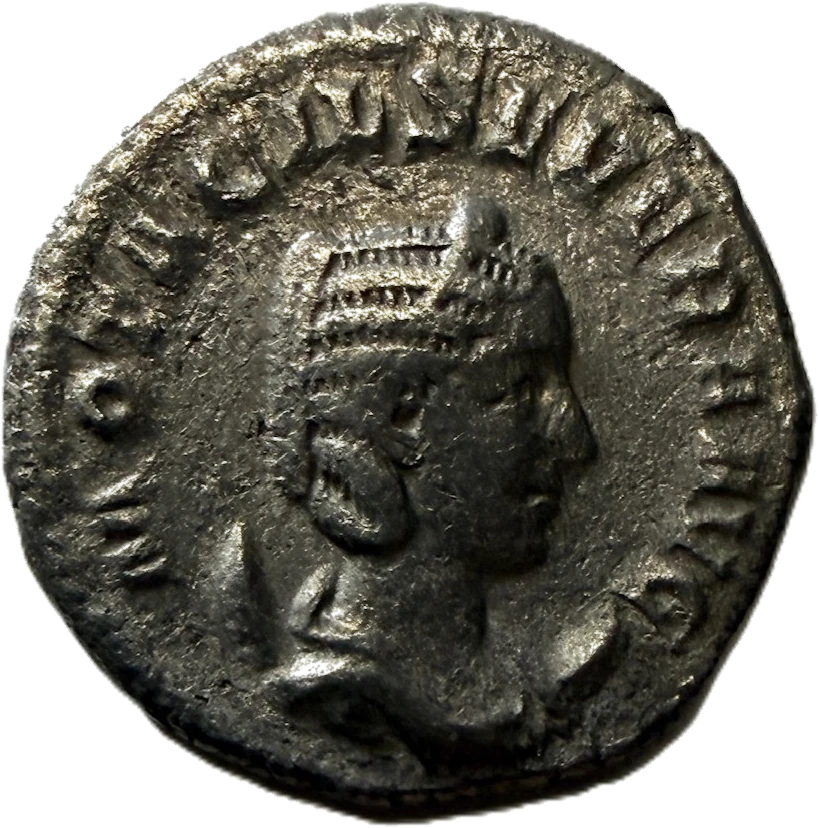
Extended description
Antoninianus attributed to Otacilia Severa and Rome, in the broad AD 244–249 reign context. Recorded obverse MARCIA OTACIL SEVERA AVG accompanies a diademed, draped bust on crescent; reverse PVDICITIA AVG accompanies Pudicitia seated left with transverse sceptre. Earlier RIC 125c is superseded by a published type conflict; 123c is provisional. Recorded measurements are 21.55 mm diameter, 1.65 mm thickness, 3.29 g and 6h die axis. Exact issue and Sear match remain unconfirmed.
Technical analysis
The coin retains strong obverse detail in the stepped diadem, facial features, and drapery, while the reverse figure preserves clear limb and drapery definition. Slight coppery toning at the flan edge is consistent with billon composition. Current examination records no obvious tooling, smoothing, casting, plating anomaly, or active corrosion. The crescent beneath the bust is a diagnostic denominational feature for female antoniniani and forms an important part of the attribution.
Authentication methodology
Recorded legends are MARCIA OTACIL SEVERA AVG and PVDICITIA AVG, with a diademed, draped bust on crescent and Pudicitia seated left with transverse sceptre. Klisurica catalogue assigns that full-legend Pudicitia comparison to RIC IV.3 123(c); 125(c) is a CONCORDIA AVGG comparison (Numizmatičar 40, p. 218, nos. 1650–1651). The former PVDICITIA AVG/125c match is withdrawn. Public photographs support Pudicitia. RIC 123c is a provisional candidate pending exact bust and veil/attribute comparison; individual issue date and Sear edition/reference are unconfirmed.
Compare full legends, bust, crescent, veil gesture and sceptre against the located entry before final subtype assignment. Preserve dealer labels as prior attributions. Separate surface/edge observations from typological identification. No grading slab or third-party certification is associated with the coin.
Comparative works
Consulted Klisurica catalogue, Numizmatičar 40 (2022), p. 218, no. 1650, full MARCIA OTACIL SEVERA AVG/PVDICITIA AVG and RIC IV.3 123(c); no. 1651 contrasts CONCORDIA AVGG/125(c). RIC 123c remains provisional for this specimen pending exact subtype comparison. Dealer SR-2532 is preserved without claiming an unspecified Sear edition has been checked.
Provenance
The coin retains an unusually complete modern provenance packet consisting of three original documents: a typed yellow dealer tag recording issuer, date range, denomination, grade, Sear reference SR-2532, and stock number tew 857223; a typed descriptive card mounted in a sewn leather holder; and a typed advisor-signed grading card marked Extra Fine. The consistent SR-2532 reference across all three documents provides a useful record of the coin's earlier numismatic identification. All documents remain associated with JCA.2026.099.
Earlier RIC 125c is retained as superseded research history. SR-2532 is an unverified dealer reference. These documents are not third-party certification or an ancient ownership chain.
Historical context
Otacilia Severa's coinage formed part of the dynastic image program of Philip I, whose reign followed the death of Gordian III and was marked by questions of legitimacy and origin. Pudicitia, the personification of modesty and marital virtue, had deep roots in Roman civic and religious culture. On imperial women's coinage the type framed the Augusta as an embodiment of traditional Roman domestic virtue and dynastic respectability. The sceptre variant used here gives the seated personification an explicitly authoritative character.
Conservation history
No conservation treatment is documented. The existing silver-grey and localized coppery toning should be preserved as part of the coin's surface history. Abrasive cleaning, polishing, dipping, and attempts to homogenize color are not recommended. Store in an inert numismatic holder under dry, stable conditions. The three historical paper documents should be preserved separately in archival sleeves while remaining linked to the accession.
Bibliography
Borić-Brešković, Bojana, and Mirjana Vojvoda, “A Hoard of Denarii and Antoniniani from the Village of Klisurica near Prokuplje,” Numizmatičar 40 (2022), National Museum of Serbia. https://www.digitalnaizdanja.narodnimuzej.rs/Download/numizmaticar/Numizmaticar%2040.pdf Consulted p. 218, nos. 1650–1651. RIC IV.3 123(c) is provisional; 125(c) is superseded for this specimen. Dealer/advisor documents preserve SR-2532, whose Sear edition/match is unverified.