French An IX-Type Gendarmerie Pistol, Percussion Conversion — Scholarly Analysis
Extended scholarly study of "French An IX-Type Gendarmerie Pistol, Percussion Conversion" (accession JCA.2026.102): material analysis, authentication methodology, comparative works, and bibliography.
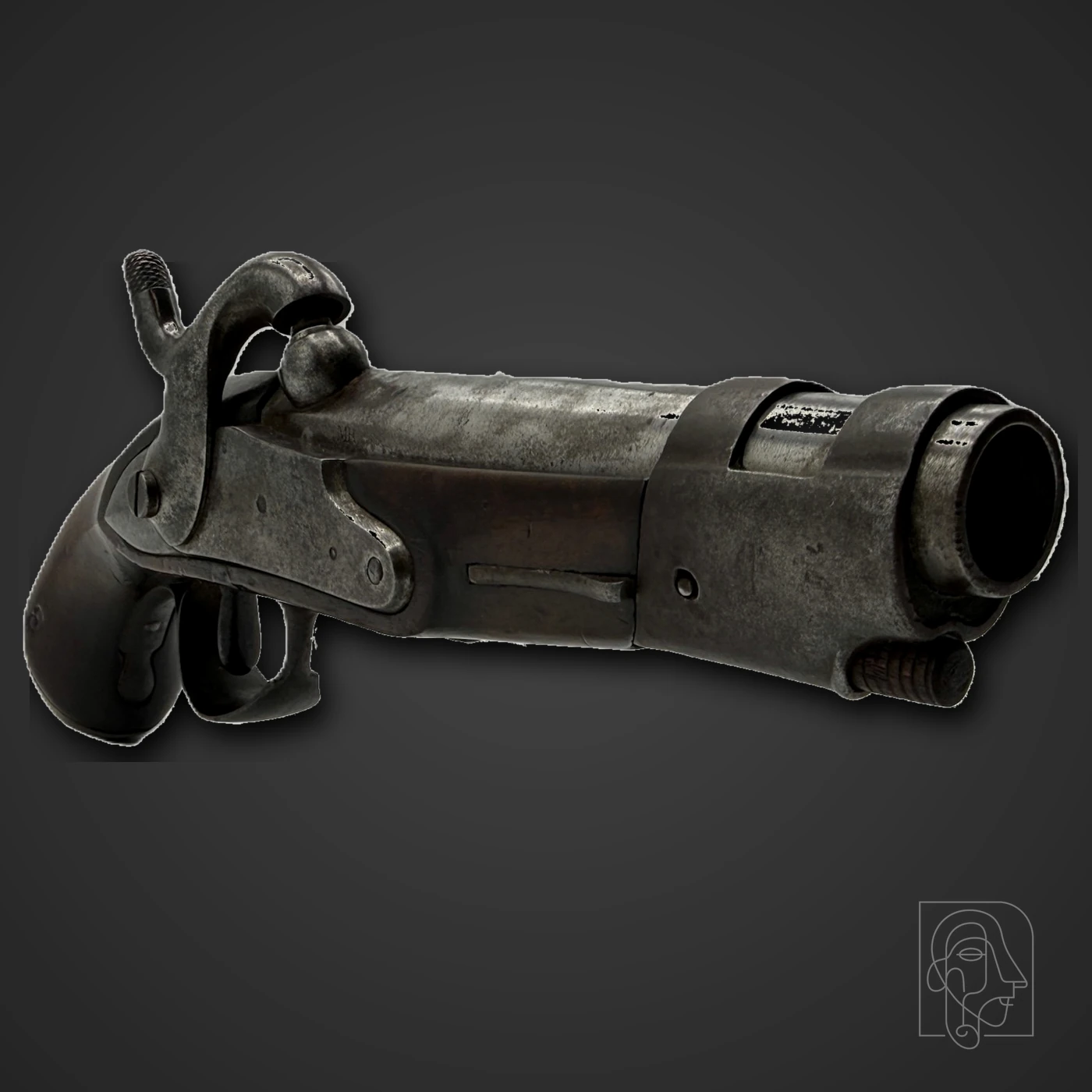
Extended description
JCA.2026.102 is a compact French single-shot smoothbore service pistol measuring approximately 10 inches overall, with a barrel of about 5 inches and a bore in the 17.1–17.5 mm range. It retains French martial characteristics including a military stock form, iron furniture, repeated numbering, inspection marks, and a later percussion conversion. The pistol’s dimensions are the strongest discriminating evidence in its present identification. Regulation Model An XIII cavalry pistols are approximately 35.2 cm overall with barrels around 20.7 cm, whereas documented French gendarmerie Model An IX pistols are approximately 25 cm overall with barrels around 12.5 cm. The JCA pistol falls closely within the compact gendarmerie proportions. Its current working attribution is therefore French Gendarmerie Model An IX / Maubeuge type, later converted to percussion. The attribution should remain probable until the lock interior, underside of the barrel, breech tang, and concealed stock markings can be examined directly.
Technical analysis
Recorded measurements are approximately 10 in overall and 5 in barrel length, with a smoothbore diameter around 17.1–17.5 mm. Repeated number 976 appears on barrel and stock, with a crowned V inspection mark and an MR mark near the breech. The later percussion architecture is consistent with conversion of an earlier flintlock arm. The compact dimensions materially contradict a regulation Model An XIII cavalry identification, whose overall and barrel lengths are substantially greater.
Authentication methodology
The current identification is based on dimensional comparison, construction, bore, French inspection marks, repeated assembly/serial numbering, and percussion-conversion architecture. The strongest negative test is dimensional: the object is approximately 25.4 cm overall with a 12.7 cm barrel, versus approximately 35.2 cm overall and 20.7 cm barrel length for a regulation Model An XIII cavalry pistol. These dimensions align much more closely with documented French gendarmerie pistols. Final attribution should await in-hand inspection of the lock interior, underside barrel marks, breech tang, and concealed stock stamps.
Comparative works
Primary comparison: French Ministry of Culture, POP/Joconde notice 10230035958, a Maubeuge Model An IX gendarmerie pistol manufactured in 1818 and later converted to percussion. Dimensional contrast: regulation French Model An XIII cavalry pistols are approximately 35.0–35.2 cm overall with barrels approximately 20.7 cm long; documented gendarmerie Model An IX examples are approximately 25 cm overall with barrels approximately 12.5 cm long.
Provenance
The pistol was acquired from a private collection; earlier ownership is undocumented. No arsenal ledger, gendarmerie issue record, unit record, named officer, nineteenth-century sale record or continuous chain of custody is presently associated with the object. The repeated number 976 and inspection marks are object evidence, not a reconstructed ownership history. Until archival documentation or hidden assembly marks can be tied to a state-manufactory record, the catalogue should not assign an individual service history, specific gendarmerie unit or exact arsenal path.
Historical context
The French state maintained distinct pistol patterns for different services. Gendarmerie pistols were notably more compact than cavalry pistols, making overall length and barrel length diagnostically important when markings are incomplete. Conversion from flintlock to percussion was common in the nineteenth century and can preserve an older weapon in later service. JCA.2026.102 should therefore be read as evidence of both standardized state manufacture and subsequent technological adaptation, while its exact arsenal history remains unresolved.
Conservation history
No formal conservation or restoration history is documented. The pistol is recorded with stable oxidation, service wear, an intact percussion conversion and handling wear/compression in the walnut stock. Preserve existing marks, patina and wood surfaces; avoid abrasive metal polishing, aggressive rust removal, sanding, refinishing or attempts to sharpen worn stamps. Do not fire or mechanically stress the arm. Any disassembly for attribution should be performed by a qualified arms conservator or specialist and photographed systematically, especially the lock interior, barrel underside, breech/tang, ramrod channel and concealed stock marks.
Bibliography
Ministère de la Culture (France), POP / Joconde, notice 10230035958: Pistolet de gendarmerie modèle An IX, Manufacture royale de Maubeuge, 1818, later converted to percussion. Royal Armouries, Waterloo 1815, French Year XIII pistol reference data. Standard Model An XIII dimensional data: approximately 352 mm overall, 207 mm barrel.
Verification status: POP/Joconde 10230035958 is a reported comparison; its contents were not directly verified in the audit. No museum object's date/maker is transferred from dimensions alone.