Imperial Japanese Navy Sailor's Cap with White Summer Cover — Scholarly Analysis
Extended scholarly study of "Imperial Japanese Navy Sailor's Cap with White Summer Cover" (accession JCA.2026.104): material analysis, authentication methodology, comparative works, and bibliography.
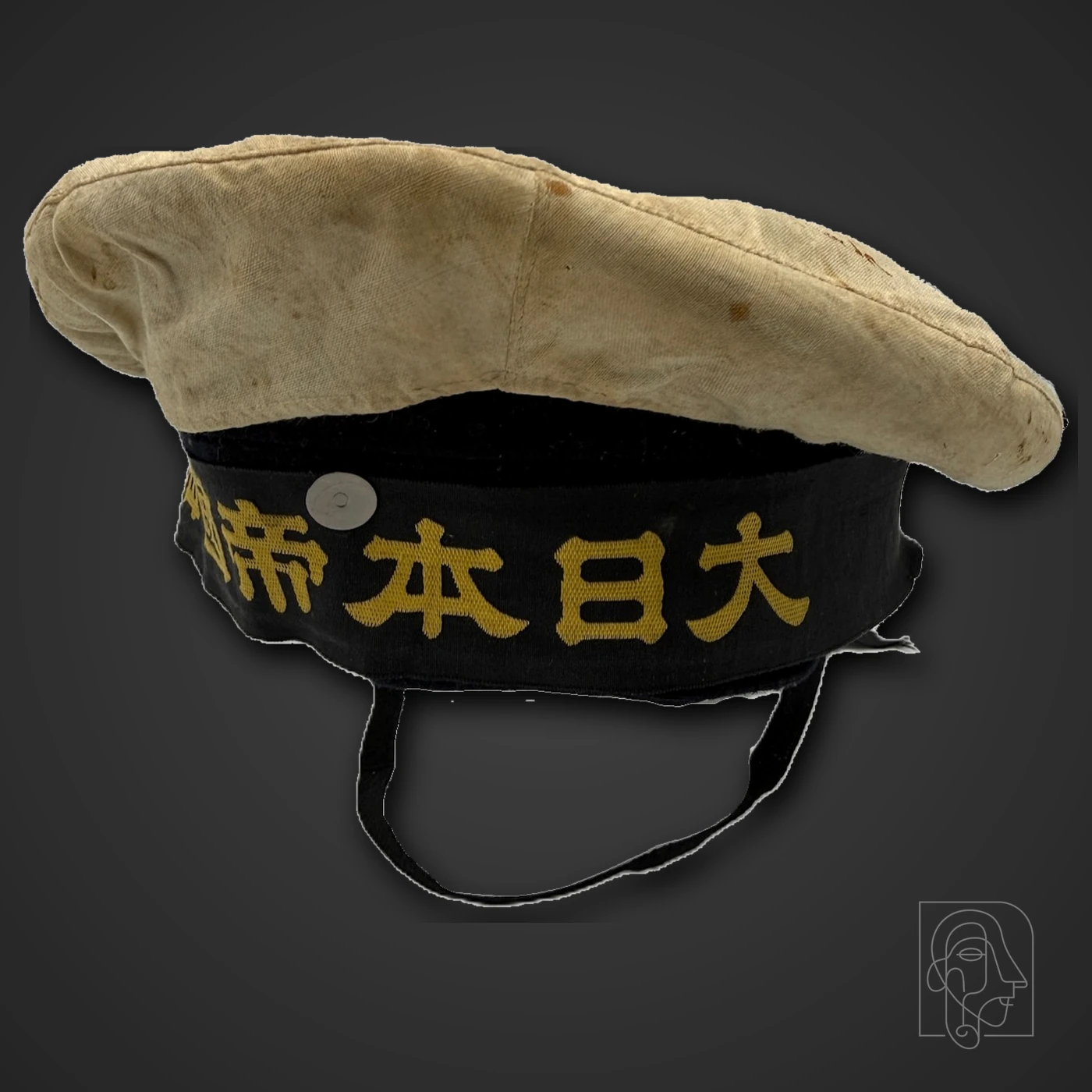
Extended description
JCA.2026.104 is consistent in form with an Imperial Japanese Navy enlisted sailor’s cap (水兵帽, suihei-bō). The photographs show a low round dark navy crown, black tally with the generic service title 大日本帝國海軍, two rear streamers bearing anchors, a removable white cover, and a metal ventilation grommet. The previous curator described the body as wool melton and the lining and cover as cotton; this study did not independently test the fibers. Yellow or gold-colored decorative threads are visible, but metallic gilt-thread composition has not been established. [1–3]
The label is the principal object-specific research evidence. Its printed depot line reads 佐世保軍需部. The preferred photographic transcription is 入籍番號: 佐志主四四九〇; 氏名: 宮末 利一; 交付年月: 拾八年四月; 寸法及製作年月: (四)十七年十一月. The first date is probably April 1943; the second is tentatively November 1942, with a proposed size 4. The era name is omitted in the handwritten entries, so conversion to Shōwa years is contextual. The manufacture-year strokes and size mark remain less secure than the depot line. [1; photographic interpretation]
The second surname character appears to have a single 末-type structure; separate 木 and 公 components expected in 松 are not clearly visible. This favors 宮末 over the previous 宮松 transcription. Written 利一 is legible, but kanji alone do not settle pronunciation. Miyasue Riichi remains a proposed reading, while 宮松利一 should be retained only as a search alternative. Plate VI is the untraced photograph used for this assessment. Plate VII contains colored interpretive tracing and is not an independent observation of the original ink. [1; photographic interpretation]
Technical analysis
DATING AND CONSTRUCTION
Imperial Ordinance No. 699 was signed October 30, 1942, published October 31, and effective November 1. Existing uniforms could continue in use until replaced. The original diagram, PDF page 21, depicts a visorless enlisted cap with the generic 大日本帝國海軍 tally and anchor devices on its ends; specified aviation trainees and musicians have different cap arrangements. The accompanying specification, PDF page 8, describes a black Hachijo-woven band with lettering and anchors woven in yellow. The visible cap and tally fit that description closely. The proposed November 1942 manufacture therefore agrees with the new specification, but a regulation match cannot authenticate this particular object or prove that its tally has always belonged to this body. [2–3]
The specification supports describing the decorative weaving as yellow. It does not establish metal-bearing gold or gilt thread. Examination of the reverse, yarn structure, and decorative thread would be needed to refine the construction and material description. No microscope, fiber, ultraviolet, or original-label examination was conducted for this update. [2–3; research scope]
LABEL AND DATES
佐志主四四九〇 is the preferred registration reading, corresponding to number 4490 in the Sasebo volunteer-shukei series. It is a registration identifier within that series; the prefix should accompany the number. The supply-department line corroborates a Sasebo administrative association. It does not identify the cap’s factory. The proposed manufacture and issue dates are five calendar months apart. That interval does not document continuous storage, an enlistment date, or a standard April intake. [1, 4–7, 13]
MEASUREMENT
The size mark is tentatively read as 4. No period size table supporting a conversion to 54–55 cm was verified. Overall measurements and internal head circumference should be recorded directly with a scale and without stretching the textile. The earlier approximately 810 × 34 mm tally dimensions have not been established here as measurements of this particular cap.
Authentication methodology
This update assesses published photographs against original regulations, official archive catalogues, and institutional comparators. It supports identification of the cap type and the internal consistency of the proposed label dates. It does not repeat the earlier in-hand examination or certify every component as period-original.
The highest-value physical checks are full views of the interior and label attachment, untraced macro photographs under raking light, the tally reverse and joins, and close examination of the fibers and ink. Ultraviolet observations may help identify some modern materials or brighteners but cannot independently date a textile or prove authenticity. Any assessment should consider possible later replacement of a cover, tally, or label as well as the cap body.
A woven-versus-printed rule is inadequate. The Australian War Memorial’s wartime Japanese cap tally REL/14421 has gold stencilled characters and anchors. Woven reproductions also exist. Construction technique must therefore be evaluated with the complete object, documented comparisons, and provenance. [8]
An archival match for 佐志主4490 could establish whether the written name corresponds to that registration. It would not by itself prove that this particular surviving cap and label remained together throughout their history. The catalogue records identified here have not been opened at the individual-entry level. [4–6]
Comparative works
ORIGINAL NAVY SPECIFICATION — Imperial Ordinance No. 699 (1942): original cap diagram and yellow-woven-tally specification. This is the strongest documentary comparison for cap form and the proposed November 1942 date. [2–3]
AUSTRALIAN WAR MEMORIAL — REL/14421, collection C108709: wartime black cotton cap tally with gold stencilled lettering and anchors, recovered from Japanese-used tunnels at Rabaul. Its documented manufacture technique shows why printed lettering alone cannot identify a reproduction. Its Rabaul provenance belongs to that museum object and cannot be transferred to JCA.2026.104. [8]
IWAKURA CITY — object 0915: enlisted cap with the generic service title, two anchor streamers, and an interior issue label using comparable headings. The museum’s label transcription distinguishes an issue date from a manufacture or reuse entry. This supports label-format comparison, without supplying a size conversion or identity for the JCA cap. [9]
NATIONAL MUSEUM OF TAIWAN HISTORY — accession 2003.001.0721: a flat round naval cap with the generic tally. This supplies an institutional type comparison. Its dimensions and broad dating apply only to that museum object. [10]
OKETO TOWN LIBRARY — W811002: an institutional example of the generic Navy cap and discussion of wartime replacement of unit-name tallies. This supports historical context without identifying the JCA wearer or ship. [11]
Provenance
DOCUMENTED OWNERSHIP
The collection record reports an eBay purchase. No earlier chain of ownership, named collecting veteran, or account of removal from Japanese possession has been independently documented. The listing, receipt, and seller’s original evidence were not examined for this update. The label is an internal issue attribution, distinct from external provenance. [1]
PREFERRED REGISTRATION AND NAME
The label is provisionally read as 佐志主四四九〇, number 4490 in the Sasebo volunteer-shukei series, with written name 宮末 利一. The name 宮松利一 remains a search alternative. Pronunciation, birth date, hometown, service record, and fate are unconfirmed. Modern surname distributions cannot identify this wearer’s birthplace. [1, 4–7; photographic interpretation]
EXACT NATIONAL ARCHIVES LEADS
1. 軍人索引簿 〔佐〕入籍番号簿 志主1~9434 30. Call number 平29厚労04627100. The current catalogue describes a paper volume dated 1946, stored at the branch, with access requiring review (要審査). Proposed number 4490 falls within the stated range. This is the most direct index lead for matching the number to a name. https://www.digital.archives.go.jp/file/4219932 [4]
2. 軍人軍属功績調査票 軍人功績調査表 佐世保 佐志主4401~4599 401. Call number 平26厚労04492100. This paper merit-record volume, dated 1946, also requires access review. Volume 401 is a more precise request target than an inferred gap between volumes 395 and 404. https://www.digital.archives.go.jp/file/4080770 [5]
3. 軍人軍属功績調査票 軍人功績調査表 佐世保(死没者) 佐志主4303~5299 346. Call number 平26厚労03848100. This is an additional deceased-series search lead. Inclusion of 4490 within the catalogue’s numerical range does not establish that this sailor died or that a corresponding entry is present. https://www.digital.archives.go.jp/file/4085209 [6]
No individual entry from these volumes has been inspected. No request or inquiry was sent. The next step is to ask the National Archives whether the proposed registration and written-name variants can be checked under its access-review procedure. The Ministry of Health, Labour and Welfare’s separate route for personal military-record copies checks eligibility as the veteran or a bereaved relative; a collector should not imply an established family relationship. [4–7, 16]
Historical context
The Navy’s 1942 uniform amendment supplies a direct period explanation for the generic 大日本帝國海軍 tally and its yellow woven lettering and anchors. It took effect November 1, at the start of the proposed month of manufacture. The transition clause allowed existing uniforms to continue until replacement, so the amendment should not be treated as proof that every generic tally originated on that date. The tally names the service, not a particular vessel. [2–3, 11]
The proposed code 佐志主 separates registry district, enlistment category, and occupational branch. 佐 denotes Sasebo, 志 the volunteer category, and 主 the shukei branch. It does not establish an officer paymaster rank. Shukei work encompassed cooking and provisioning as well as accounting and supply support. Maizuru City publishes a scan of 海軍四等主計兵厨業教科書; although first issued in 1918, the digitized copy records supplementation through October 1938. The Maritime Self-Defense Force’s Fourth Service School also describes this cooking instruction. The National Institute for Defense Studies catalogue lists a May 1944 second-class shukei cooking textbook, ⑦教育-教範(航空を除く)-263. These sources demonstrate the breadth of the branch, without establishing this wearer’s individual assignment. The full 1944 textbook was not examined. [12, 14–15]
The 1923 Naval Supply Department Ordinance placed supply departments at naval ports under district authority and assigned preparation, custody, and supply of stores. The printed 佐世保軍需部 line therefore supports supply administration. It does not identify a particular clothing factory or prove that the sailor worked at that department. [13]
The cap’s survival and brown-spotted white cover cannot establish residence at a mainland shore base, mailing of dress gear home, ammunition-party duties, damage-control duties, or survival of the war. Ships, postings, battle stations, exact rank, and fate remain unknown.
Conservation history
The earlier curator reported no conservation treatment or restoration and described minor lint, cover spotting, and streamer-tip fraying. This update did not inspect the object in person or verify treatment history. Photographs show brown spotting on the white cover; no conclusion about storage climate or wartime location follows from it.
The orange textile seen inside the cap was previously identified as modern support used for photography. It should be documented separately from the cap. Support the cap without stretching the band, minimize light and handling, and avoid wet-cleaning the cover, tally, or inked label without a textile conservator’s assessment. Preserve untraced photographs and record any future treatment before and after intervention.
Priority documentation: (1) original label under even and raking light; (2) full interior and label stitching; (3) tally reverse, ends, and attachment; (4) measured circumference and overall dimensions; (5) original auction identifier, receipt, seller information, and any earlier ownership account.
Bibliography
RESEARCH UPDATE: October 19, 2026. Object-specific transcriptions are photographic interpretations, not confirmed personnel identifications. Primary regulations, official catalogues, and institutional comparisons were used as listed below. The earlier eight-page supplement is superseded by this catalogue revision; it was not examined as a source for the update. No individual personnel entry or full 1944 cooking textbook was examined.
[1] JCA Archives, JCA.2026.104, object photographs, Plates I–VII. Plate VII contains colored tracing; Plate VI preserves the untraced label view. https://jcaarchives.com/collection/JCA.2026.104/
[2] Nagoya University, Japanese legal-history database transcription, 海軍服制中改正ノ件, Imperial Ordinance No. 699, 1942. https://jahis.law.nagoya-u.ac.jp/lawdb/l/317i0699
[3] National Archives of Japan, original 1942 uniform amendment, call number 御26568100; specification PDF p. 8 and enlisted-cap diagram p. 21. https://www.digital.archives.go.jp/file/151156
[4] National Archives of Japan, 軍人索引簿 〔佐〕入籍番号簿 志主1~9434 30, 平29厚労04627100. https://www.digital.archives.go.jp/file/4219932
[5] National Archives of Japan, Sasebo 佐志主4401–4599, volume 401, 平26厚労04492100. https://www.digital.archives.go.jp/file/4080770
[6] National Archives of Japan, Sasebo deceased series 佐志主4303–5299, volume 346, 平26厚労03848100. Range inclusion alone does not establish a death. https://www.digital.archives.go.jp/file/4085209
[7] National Archives of Japan, 北の丸 no. 57 research guide and accompanying inventory. https://www.archives.go.jp/publication/kita/pdf/kita57_p132.pdf ; https://www.archives.go.jp/publication/kita/pdf/kita57_sankoushiryo.pdf
[8] Australian War Memorial, Japanese naval cap tally REL/14421, collection C108709. https://www.awm.gov.au/collection/C108709
[9] Iwakura City, naval cap, object 0915. https://www.city.iwakura.aichi.jp/bunkazai_db/0000000582.html
[10] National Museum of Taiwan History, naval cap, accession 2003.001.0721. https://collections.nmth.gov.tw/CollectionContent.aspx?RNO=2003.001.0721&a=132
[11] Oketo Town Library, naval cap W811002. https://adeac.jp/oketo-lib/catalog/mp238110020-200020
[12] Maizuru City, 海軍四等主計兵厨業教科書, digitized copy with publication history through October 1938. https://www.city.maizuru.kyoto.jp/kankou/0000006049.html ; full scan: https://www.city.maizuru.kyoto.jp/kankou/cmsfiles/contents/0000006/6049/4tousyukei-all.pdf
[13] Naval Supply Department Ordinance, Imperial Ordinance No. 54, 1923, articles 1–2. https://jahis.law.nagoya-u.ac.jp/lawdb/l/212i0054
[14] Japan Maritime Self-Defense Force, Fourth Service School, historical naval cooking textbook. https://www.mod.go.jp/msdf/fourmss/11q-kaigun/11q-kaigun.html
[15] National Institute for Defense Studies, naval education catalogue, PDF p. 31: 海軍2等主計兵 調理術教科書, May 1944, reference ⑦教育-教範(航空を除く)-263. Catalogue listing only. https://www.nids.mod.go.jp/military_archives/pdf/catalog/n4.pdf
[16] Ministry of Health, Labour and Welfare, military-record copy applications and applicant eligibility. https://www.mhlw.go.jp/stf/seisakunitsuite/bunya/0000093051.html