Six-20 Kodak Folding Camera with No. 0 Kodal Shutter — Scholarly Analysis
Extended scholarly study of "Six-20 Kodak Folding Camera with No. 0 Kodal Shutter" (accession JCA.2026.122): material analysis, authentication methodology, comparative works, and bibliography.
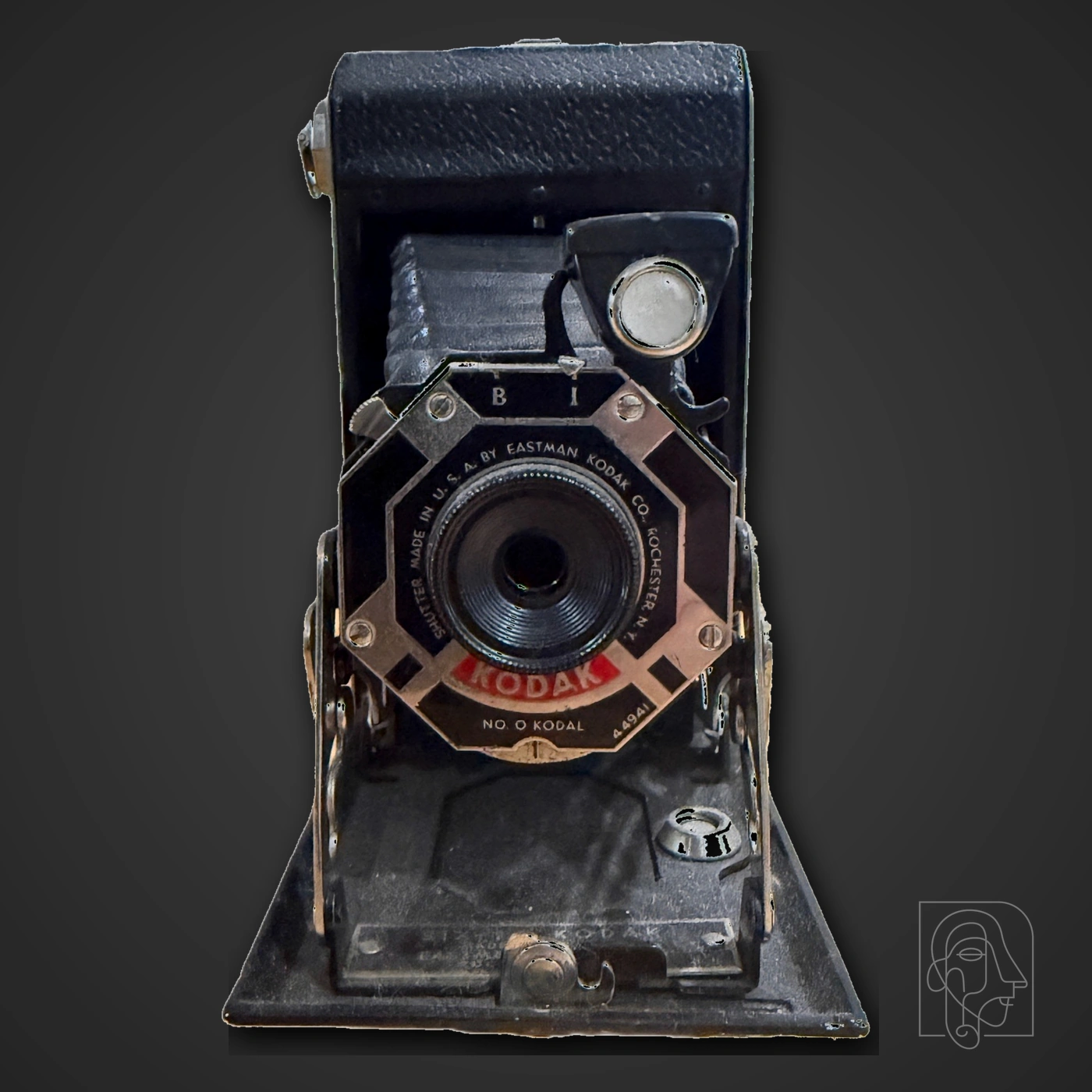
Extended description
JCA.2026.122 is an early Eastman Kodak Six-20 self-erecting folding camera for 620 roll film, producing approximately 6 × 9 cm negatives. It represents a simplified early configuration fitted with a fixed-focus meniscus-type lens, No. 0 Kodal shutter with B and I settings, swiveling brilliant finder, black-and-nickel Art Deco faceplate, ornate folding struts, ruby counting window, and standard 620-film chamber. The surviving factory markings and construction place it close to the first years of the Six-20 line, before later Model C redesigns.
Technical analysis
The camera measures approximately 80 × 150 × 32 mm closed and 80 × 150 × 121 mm open. Its self-erecting bed, struts, shutter, finder, film chamber, spool hardware, leatherette covering, enamel, and plated metal components form a coherent period assembly. The faceplate is marked SIX-20 KODAK, No. 0 KODAL, MADE IN U.S.A. BY EASTMAN KODAK CO., ROCHESTER, N.Y., and 44941. The folding action and shutter have been tested and function. Bellows light-tightness and photographic performance remain unverified.
Authentication methodology
Authentication is based on agreement among the factory faceplate inscriptions, shutter designation, mechanical architecture, strut design, slotted and riveted construction, film chamber, finder, ruby window, spool hardware, materials, and coherent age-related wear. The configuration is compared with documented Six-20 Kodak cameras from the early 1930s. No evidence of reproduction manufacture, artificial aging, wholesale re-covering, or incompatible later replacement components has been observed. The working date remains approximately 1932–1933 rather than a single factory shipment year.
Comparative works
The Science Museum Group preserves Six-20 Kodak cameras from the same broader family, including a self-erecting Six-20 Kodak dated 1932–1937 and later Six-20 Model C examples from the mid-1930s. These comparanda confirm the use of 620 roll film, self-erecting construction, 2¼ × 3¼ in. image format, and the evolution of lens, shutter, finder, and body configurations. JCA.2026.122 is distinguished by its simplified No. 0 Kodal shutter and early faceplate arrangement.
Provenance
Prior ownership history is undocumented. The camera retains its factory identity through stamped and printed markings rather than through a named-owner provenance chain. No sales receipt, case, instruction manual, dated family photograph, or original retailer documentation is presently associated with the accession. Its historical interpretation therefore rests primarily on the surviving camera itself and comparison with documented Six-20 variants.
Historical context
Introduced in 1932, the Six-20 Kodak belonged to Kodak's early generation of cameras designed around the proprietary 620 roll-film format. Its compact self-erecting architecture reduced the bulk of earlier folding cameras while retaining a large 6 × 9 cm image area. The strong geometric faceplate, black enamel, bright metal trim, and angular folding structure place the object squarely within interwar American industrial design and the broader democratization of amateur photography.
Conservation history
The camera is substantially complete and mechanically functional but shows abrasion, enamel loss, plating wear, minor oxidation, covering wear, and dust or haze in the brilliant finder. Do not oil the shutter or folding mechanism without camera-conservation guidance, as migrated lubricants can damage shutter leaves and optical surfaces. Bellows should be opened and closed gently, and prolonged display under tension should be avoided. Store dry, supported, and away from heat that could embrittle bellows coatings or lift leatherette.
Bibliography
Science Museum Group Collection, “Six-20 Kodak camera,” object 2010-5057/36, dated 1932–1937. Science Museum Group Collection, “Six-20 Kodak Model C camera,” object 1990-5036/1020, dated 1934–1937. Eastman Kodak factory markings and patent label retained on JCA.2026.122. Period Kodak Six-20 instruction and product literature should be consulted for further variant-level dating.