Japanese wakizashi in koshirae, inscribed Kanetomo
Accession JCA.2026.133. Edged Weapon, Japanese, Muromachi Period. Part of the JCA Archives collection, documented through direct examination, original photography, and provenance review.
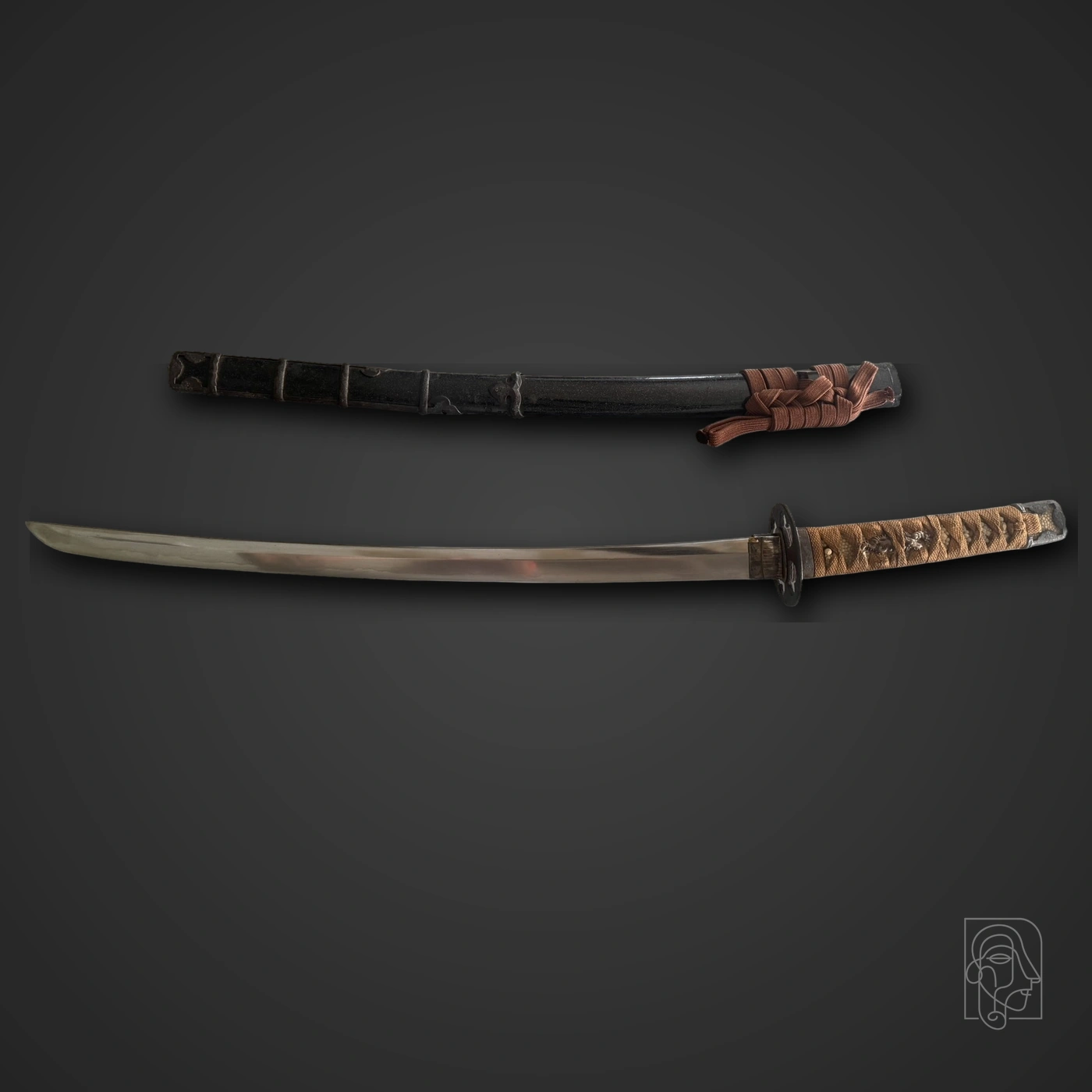
Object description
Japanese short sword in koshirae, with a shinogi-zukuri blade and apparent iori-mune. Present nagasa is reported as 52.4 cm. The tang has a rounded kurijiri-like end and one visible mekugi-ana; these features do not establish that the tang is unshortened. One face is inscribed 兼友, read Kanetomo. The opposite face is probably inscribed 三条宗近作, provisionally read as made by Sanjō Munechika. The mounting includes an openwork round guard, dragon-form menuki, tan wrapping over apparent ray skin and a dark glossy scabbard. Maker, blade date and mounting date remain undetermined.
Dimensions
Reported, not independently remeasured: nagasa 52.4 cm; sori 1.2 cm; base width 3.0 cm; tip width 2.0 cm; base thickness 0.7 cm; tip thickness 0.5 cm (seller figures). Kissaki 37 mm from yokote to tip (owner report). Measurement stations for tip width and thickness are unspecified.
Materials
Steel blade. Mounting photographs show apparent ray-skin grip covering, textile wrapping, dark glossy scabbard and metal fittings. Fitting alloys, scabbard substrate and finish composition have not been verified.
Identifying marks
Short-face mei: 兼友 (Kanetomo), preferred reading with high confidence from the supplied images; signature authenticity unconfirmed. The fish-like form of 兼 is consistent with the 魚兼 (uo-kane) engraving convention documented in Seki swordsmith signatures. Research on the former NBTHK Gifu branch website also describes the fish-shaped form outside Seki, including Naoe-Shizu traditions; it is not a school-exclusive diagnostic feature. This supports the character reading, not authenticity, maker, generation, school or date. The alternative literal reading 魚友 (Uotomo) has not been corroborated as a historical swordsmith name. Long-face mei: probably 三条宗近作 (Sanjō Munechika saku); second character 条 and final 作 require confirmation. One visible tang hole, rounded kurijiri-like tang end, probable local takanoha file marks. Dates and order of the inscriptions are unresolved. Differing groove textures, corrosion colour and inscriptions crossing file marks do not by themselves establish separate cutting dates.
Condition
Sold as out of polish, as is, according to the source report. Published photographs and video stills do not permit secure classification of hamon, jigane or boshi. Tang corrosion and worn tan grip wrapping are visible or reported. No diagnosis of wheel buffing, structural soundness or polishing suitability is established. Direct specialist examination is required for a condition assessment.
Provenance
According to the October 2026 findings report, purchased on eBay in July 2026 from GN-1-Japan, shipping from Saitama, Japan, under a listing identifying Sanjō Munechika and Kanetomo; sold out of polish, as is. The audit did not inspect the original listing, invoice or shipping records. No earlier ownership history, NBTHK/NTHK authentication paper or registration copy was supplied. Return of any registration certificate after export is unverified; shipment from Saitama does not establish the issuing prefecture.
Attribution and authentication
Maker, generation, date and authenticity of the Kanetomo mei remain unestablished. The apparent Munechika inscription is highly doubtful as an authentic signature of the Heian master and is provisionally treated as suspected gimei. Its intention, date and chronological relationship to 兼友 are unproved. Alternatives include a false or later-added Kanetomo inscription and both inscriptions being cut during one later episode. No object examination or new shinsa result is claimed. Comparative Hozon papers concern other blades and do not authenticate this one. Request complete blade/tang photographs, original transaction and registration records, exact comparison-paper readings and qualified in-hand appraisal. Disclose both inscriptions in any shinsa submission.
Historical context
The name Kanetomo was used by more than one Japanese swordsmith. Published Mino/Seki examples and a Gifu museum-listed late Muromachi San’ami Kanetomo wakizashi provide relevant comparison material, but do not attribute this blade. The institutional control for the Heian smith Munechika is the tachi Mikazuki Munechika, signed 三条. The present inscription formula and current blade form warrant serious doubt about a Heian-master attribution. Present wakizashi length alone cannot exclude alteration of an earlier blade. Mino/Seki, including San’ami Kanetomo, remains a research hypothesis; Muromachi versus Edo manufacture is unresolved.