Japanese wakizashi in koshirae, inscribed Kanetomo — Scholarly Analysis
Extended scholarly study of "Japanese wakizashi in koshirae, inscribed Kanetomo" (accession JCA.2026.133): material analysis, authentication methodology, comparative works, and bibliography.
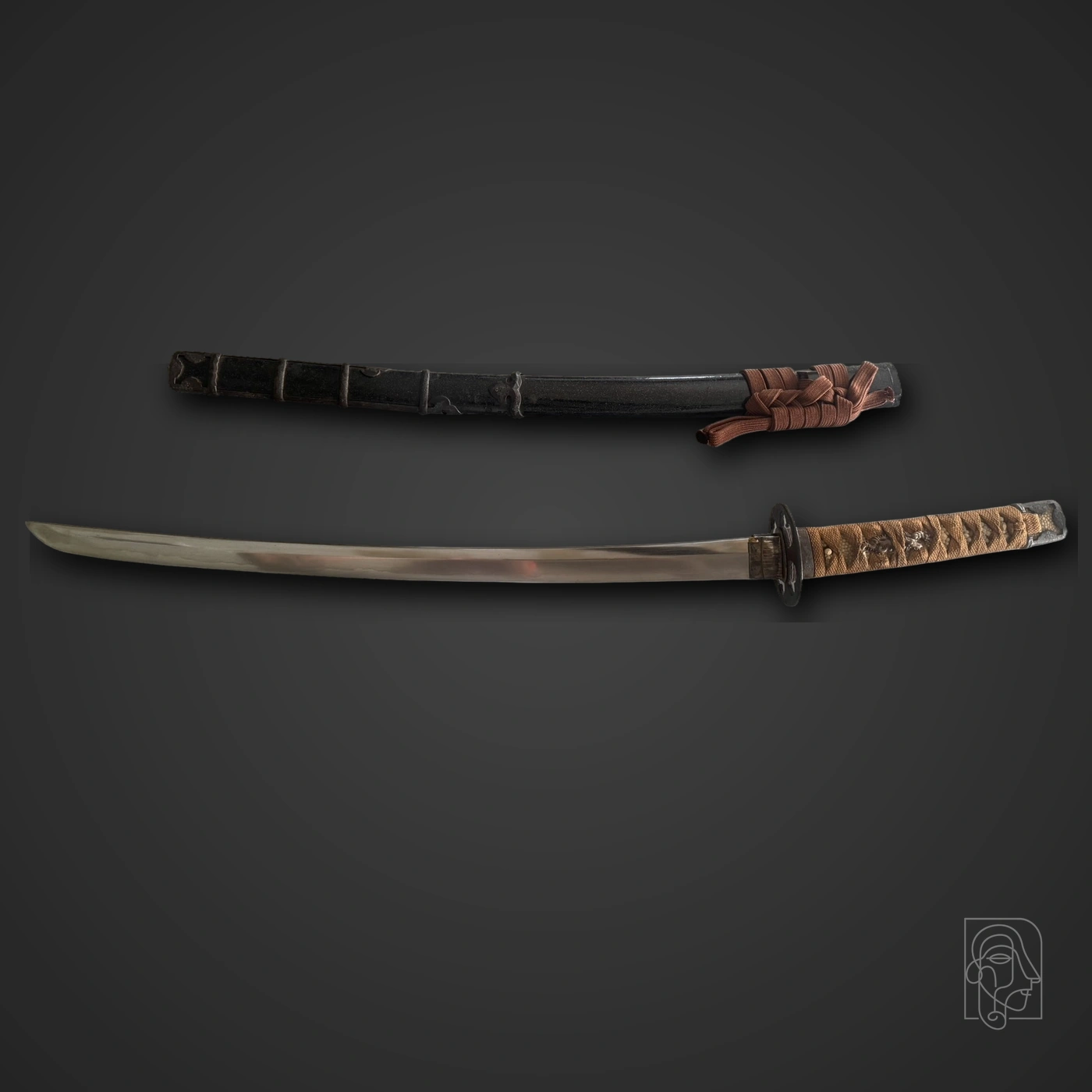
Extended description
JCA.2026.133 is a Japanese wakizashi in koshirae, with a reported nagasa of 52.4 cm and sori of 1.2 cm. The published photographs show a shinogi-zukuri blade with an apparent iori-mune, a rounded kurijiri-like tang end and one visible mekugi-ana. These features do not establish that the blade or tang retains its original length and form.
The short tang inscription is best read as 兼友 (Kanetomo). The opposite face probably reads 三条宗近作 (Sanjō Munechika saku), provisionally translated as “made by Sanjō Munechika”; the characters 条 and 作 require confirmation. Reading an inscription does not authenticate its authorship. Maker, generation, blade date and mounting date remain undetermined.
The mounting includes an openwork round guard, dragon-form menuki, worn tan wrapping over apparent ray skin and a dark glossy scabbard. Repeated cross-like and X-shaped elements suggest visual coordination among some fittings. Their alloys, common manufacture, original association with the blade and assembly date have not been established. The assessment derives from the supplied October 2026 report and its reproduced images, rather than a new physical examination. [1–3]
Technical analysis
Dimensions inherited from the seller’s account are: nagasa 52.4 cm; sori 1.2 cm; base and tip widths 3.0 and 2.0 cm; base and tip thicknesses 0.7 and 0.5 cm. Kissaki length of 37 mm, measured from yokote to tip, is owner-reported. The measurement stations for the tip width and thickness are unspecified; these figures have not been independently remeasured.
The available blade views do not securely resolve the hamon, jigane or bōshi. An undulating light boundary is visible in some images, but the earlier notare-midare description remains provisional. Neither reflectivity nor a bright surface alone establishes wheel buffing. Present length, taper and curvature cannot independently distinguish Muromachi from Edo manufacture or exclude an altered earlier blade.
The visible lower tang suggests probable takanoha file marks, supported by an owner-reported in-hand observation. The photographic classification remains provisional and is not an exclusive identifier of a school or smith. Differences in the apparent texture of inscription grooves do not establish two hands or two cutting dates. Smooth-looking grooves do not demonstrate a single uninterrupted chisel action. A genuine crossing relationship may establish that an incision postdates a particular local file mark, but cannot by itself order the inscriptions on opposite faces. Corrosion colour is not a calibrated dating method. [2, 12]
Owner-observed boshi update (October 2026): The owner reports a continuous temper line around the point with a rounded, Jizo-like head and a visible kaeri (return), following the red tracing provided in photographs. The actual hamon is insufficiently resolved in the supplied image to confirm the Jizo classification independently. The 兼知作 Sanmei comparandum also has a Jizo-like boshi, demonstrating a wider Mino/Seki form rather than a maker-specific indicator. This observation does not alter the provisional attribution or authentication status. [16]
Authentication methodology
The audit separated inscription transcription, smith attribution and physical chronology. It compared the reproduced characters with published Kanetomo examples, checked accessible certificate images and institutional records, and distinguished those sources from dealer descriptions and inherited owner or seller statements. The original photographs, full microscope videos, earlier dossier, transaction records and physical object were unavailable for renewed examination. No metallurgical analysis, direct surface examination or new shinsa result is claimed. [2–3]
The preferred short-face reading is 兼友, with high confidence in the reading from the supplied images. Authenticity of the mei and identification of a particular Kanetomo remain unestablished. Mino or Seki manufacture, including an association with San’ami Kanetomo, is a plausible research hypothesis requiring appraisal of the whole blade and controlled signature comparisons.
The probable 三条宗近作 inscription is highly doubtful as an authentic signature of the Heian master and is provisionally treated as suspected gimei in that attribution. Its date, intention and chronological relationship to 兼友 remain unresolved. Possibilities include a later or false Kanetomo inscription and both inscriptions being cut during one later episode. A doubtful inscription on one face does not authenticate the other. The institutional Mikazuki Munechika record is a historical control, not a complete catalogue of every later use of the name. [8]
Further examination should document blade geometry, possible shortening or reshaping, both complete tang faces, ambiguous characters and multiple inscription/file-mark junctions under controlled lighting. Any appraisal inquiry should disclose both inscriptions. NBTHK’s published criteria and application instructions do not establish that this object’s two faces can be independently certified, and no outcome is predicted. [9–10]
Comparative works
Gifu Prefectural Museum’s 2024 exhibition list, entry 1-27, records a late Muromachi wakizashi attributed to San’ami Kanetomo, signed 兼友, measuring 43.5 cm with sori of 1.1 cm and associated with Seki Kaji Denshōkan. This is an institutional comparison lead; its object photographs and supporting catalogue documentation should be obtained before a close mei comparison. It does not attribute JCA.2026.133. [4]
Iida Kōendō no. 849 reproduces Hozon certificate no. 388734, dated 21 June 2011, reading 兼友作(関). Eirakudo no. 353682 reproduces Hozon certificate no. 326441, dated 17 January 1991, recording 兼友 with additional kiritsuke inscriptions; the Naoe-Shizu attribution is the dealer’s description, rather than a school qualification visible on that paper. E-sword no. 1010-2029 reproduces Hozon certificate no. 385447, dated 19 March 2010, reading 兼友作(美濃・新刀). These published paper images were checked during the audit; the original certificates were not authenticated. [5–7]
The comparisons support the reading 兼友 while demonstrating variation in attributed contexts and signature forms. Photographic magnification, illumination and surface condition prevent calibrated comparison of groove dimensions. Certificates concerning other objects do not transfer authentication to this blade. The revised report also excludes examples signed 兼付 or 兼知作 from a corpus defined by 兼友, regardless of inconsistent dealer romanization. [2]
Additional paleographic comparison (25 October 2026): Chūō Tōkenkai describes 魚兼 (uo-kane), a fish-like form of 兼 in Seki swordsmith signatures, noting variation from smith to smith. Sanmei documents Kanewaka using this form and subsequently changing his style. A Samurai Museum Seki Kanetomo wakizashi (dealer-reproduced NBTHK Tokubetsu Hozon certificate no. 1019912) supplies a particularly useful documentary contrast: the accompanying Aichi registration record appears to transcribe the characters 魚友, whereas the NBTHK paper reads 兼友(関). The readings concern the COMPARISON SWORD, not JCA.2026.133; they demonstrate plausible transcription ambiguity, not a verified 魚友 swordsmith and not authentication of the JCA inscription. Its chisel stroke weight and letter forms still require direct specialist comparison. [13–15]
Additional specialist comparanda (25 October 2026): Sanmei / Tokugawa Art H49731(W3197) is titled in English as a 'KANETOMO-saku' wakizashi, but the Japanese title, inscription transcription and maker discussion identify 兼知作 (Kanetomo, written 兼知), attributed to the Tokuin (得印) branch of Seki in the Eisho era, c. 1504–1520. The listing reports a 32.9 cm shobu-zukuri blade, higaki yasurime, a kurijiri nakago, two mekugi-ana (one filled), and a Jizo-like boshi with hakikake and a long return joining mune-yaki. This is NOT a 兼友 signature comparison and must not be entered in the verified corpus for the proposed 兼友 mei on JCA.2026.133. It is a wider Mino workmanship comparison only. The seller describes Hozon Token and older Tokubetsu Kicho certification for that other sword; neither applies to JCA.2026.133. [16]
NihontoWatch listing 35720 reproduces a Ginza Choshuya dealer offering for a sold, late-Muromachi Seki wakizashi identified as 兼友 (Kanetomo), San'ami tradition, Mino, around the Daiei/Tenbun eras. Ginza Choshuya's original Japanese listing describes flowing itame approaching masame and a characteristically Mino-style hamon. NihontoWatch reports no located authentication certificate; therefore this is a dealer-assessed comparison, NOT an independently papered or verified Kanetomo work. Its claimed forging grain and hamon must not be transferred to the JCA blade, whose jigane and finer hamon remain unresolved in the present photographs. [17–18]
Wakahara research note (source capture dated 25 October 2026): An English-translated capture of an essay attributed to Toshihiko Wakahara and hosted on the former NBTHK Gifu branch website argues that fish-shaped 兼 forms were not unique to Seki smiths and were also found in Naoe-Shizu and related earlier traditions. The author discusses distinctive and sometimes mirror-reversed name characters, citing a Kanetomo 兼 example in an unnamed museum; the capture does not reproduce or identify that object, so no individual mei match or NBTHK certification is established. The author treats unusual handwriting as potentially intentional rather than inherently evidence of incompetence or false signatures, while some explanations (such as division-of-labor inscription practices) are explicitly speculative or anecdotal. As the supplied capture is in English translation, the exact Japanese wording and citation chain have not been independently verified. This source contextualizes the fish-shaped 兼 reading but does NOT authenticate JCA.2026.133, identify its maker, confirm a date or establish that its engraver used a mirror-image form. [19]
Kusanagi no Ya comparison (added 25 October 2026): Kusanagi no Ya, item 352, publishes a wakizashi signed 兼友 (Kanetomo) and reports nagasa 52.6 cm, sori 1.0 cm, motohaba 28 mm, sakihaba 20 mm, motogasane 6 mm, and sakigasane 4.5 mm. JCA.2026.133 has seller-reported nagasa 52.4 cm, sori 1.2 cm, corresponding widths 30/20 mm and thicknesses 7/5 mm. This close dimensional resemblance is a comparative lead, not an individual-hand identification. The submitted photograph of the other sword's NBTHK Tokubetsu Hozon certificate (no. 1006533; Heisei 29 year, February 2, 2017) reads 脇指 銘 兼友(関), blade length 一尺七寸四分 (about 52.7 cm in traditional units); the certificate reproduces a nakago with three visible peg holes. It does NOT specify a generation or an early Naoe-Shizu attribution. The dealer additionally proposes an earlier Kanetomo associated with Shizu/early Muromachi traditions; classify that as dealer attribution rather than NBTHK-certified date or generation. The photographed sayagaki reads, insofar as legible, 濃州兼友 / 室町初期 / 佳作; the attribution to a Kunzan-signed opinion and a dating formula possibly corresponding to June 1973 are dealer-stated and photo-interpreted, not independently handwriting-authenticated. It is a distinct historical scholarly opinion, NOT part of the 2017 NBTHK determination. The reproduced NBTHK tang picture is too small for conclusive stroke-by-stroke comparison. No certificate or sayagaki applies to JCA.2026.133, whose inscription and maker remain unverified. [20–21]
Provenance
According to the original October 2026 findings report, the sword was purchased on eBay in July 2026 from GN-1-Japan and shipped from Saitama, Japan. The listing reportedly identified Sanjō Munechika and Kanetomo and offered the object out of polish, as is. These are inherited transaction statements: the original listing, invoice, correspondence and shipping documents were not inspected in this audit. [1–3]
No earlier ownership history, NBTHK or NTHK authentication paper, or registration copy was supplied. Return of any registration certificate after export is unverified. Shipment from Saitama does not establish the registering prefecture, place of manufacture or earlier ownership. Registration documentation, if recovered and securely matched to this blade, may provide dated inscription information but would not itself authenticate a signature.
Research priorities are to retain the original listing and payment record, recover any registration photograph or number and issuing prefecture, obtain export documentation and preserve the native photographs and videos with their metadata. The current provenance record should remain explicit about these gaps.
Historical context
Kanetomo was a name used by more than one Japanese swordsmith. Published Mino/Seki examples and the museum-listed San’ami wakizashi justify further comparison, but a shared name and broadly similar character forms cannot establish a particular hand, lineage or century. The present record therefore retains Japanese cultural origin while leaving the maker and date undetermined. Muromachi and Edo manufacture remain unresolved possibilities rather than an assigned date range. [2, 4–7]
The name Sanjō Munechika is associated with the celebrated Heian swordsmith represented by the tachi Mikazuki Munechika, institutionally catalogued as an 80.0 cm blade signed 三条. That historical association explains the significance of the long inscription, but does not validate its claim on this object. Present wakizashi length cannot alone exclude the alteration of an earlier blade. [8]
Blade, individual fittings, wrapping, scabbard finish and final assembly may belong to different episodes. No Edo mounting date or original ensemble is established. Any map reference to Seki should be labelled as a provisional research association, since a place of manufacture or discovery has not been documented for JCA.2026.133.
Conservation history
No independently verified conservation or restoration history was available. The source report describes the sword as sold out of polish, as is. Worn wrapping, tang corrosion and the present blade surface should be documented without assigning an unsupported treatment history. Wheel buffing has not been established, and no polishing recommendation follows from the photographs alone. [1–3]
Preserve the tang and its inscription evidence. Do not scrape, sand, chemically clean, recolour or alter the inscriptions to improve legibility, and do not apply oil specifically to obtain research photographs. This photographic precaution is not a blanket statement about all routine sword-care practice. Seek advice from a qualified Japanese-sword specialist, polisher or conservator concerning condition, active corrosion, safe handling and appropriate care. Any future treatment should be recorded with dated photographs and a written account. [11–12]
Bibliography
Public-source checks are those recorded in the audit of 25 October 2026. A retrieved dealer page documents its published claims; a reproduced certificate is not authentication of the original document. No new physical examination or scientific testing is represented by this catalogue text.
[13] Chūō Tōkenkai, “なかごと銘並びに彫物について,” Muromachi section (魚兼), https://chuo-toukenkai.org/nakago (consulted 25 October 2026). [14] Sanmei / Tokugawa Art, “槍 銘 賀州住藤原辻村四郎右衛門兼若造 延宝七年八月吉日,” historical commentary on Kanewaka’s 魚兼 form, https://www.sanmei.com/contents/media/H71494_Y1454_PUP.html (consulted 25 October 2026). [15] Samurai Museum, “Antique Japanese Sword Wakizashi Signed by Seki Kanetomo (NBTHK Tokubetsu Hozon Certificate),” dealer-posted tang, registration and NBTHK documents, https://www.samuraimuseum.jp/shop/product/antique-japanese-sword-wakizashi-signed-by-seki-kanetomonbthk-tokubetsu-hozon-certificate/ (comparison only; consulted 25 October 2026).
[16] Sanmei / Tokugawa Art, H49731(W3197), '脇指 銘 兼知作', https://www.sanmei.com/contents/media/H49731_W3197_PUP.html; English page https://sanmei.com/contents/media/H49731_W3197_PUP_E.html (accessed 25 October 2026; heed Japanese mei 兼知作, not English title alone). [17] Ginza Choshuya, '脇差&拵 銘 兼友(関)', https://www.choshuya.co.jp/senrigan-1/%E9%8A%98%E3%80%80%E5%85%BC%E5%8F%8B%EF%BC%88%E9%96%A2%EF%BC%89/1532 (accessed 25 October 2026; specialist seller attribution, no certificate established). [18] NihontoWatch, listing 35720, https://nihontowatch.com/listing/35720 (accessed 25 October 2026; aggregating seller description and explicitly reporting no authentication certificate).
[19] Toshihiko Wakahara (author as rendered in an English-translated four-page capture), essay on unusual 魚兼 (uo-kane) signatures, formerly hosted by NBTHK Gifu branch, http://www.nbthk-gf.or.jp/shironuokane/uokane.html; collector-provided screen-capture PDF dated 25 October 2026 (pp. 1–4). The live website was inaccessible during verification; transcription and proper names are based on a translated screenshot, not independently checked Japanese original. This is an interpretive article, NOT an NBTHK authentication certificate or shinsa result.
[20] Kusanagi no Ya, Japanese sword retailer, item 352, 兼友 wakizashi, https://www.kusanaginosya.com/SHOP/352.html (consulted 25 October 2026; measurements, dealer historical attribution and reproductions). [21] Owner-supplied image reproductions from the Kusanagi listing: NBTHK Tokubetsu Hozon certificate no. 1006533, dated 2 February 2017, inscription 兼友(関), blade length 一尺七寸四分, and reportedly Honma Kunzan sayagaki reading 濃州兼友 / 室町初期 / 佳作 (photographic reading and attribution, not independently authenticated). Comparison blade only; the certificates do not concern JCA.2026.133.